Best Carbon Steel Loaf Pans: P&P CHEF Leads

Five loaf pans compared on published specs alone: pan length, depth, count per box and coating type. Two are actually carbon steel, and that changes the shortlist for anyone baking in volume.

By Zaria JarvisUpdated 15 min read
On this page
- Best carbon steel loaf pan for professional chefs at a glance
- How I matched pans to the person doing the baking
- Which pans here are actually carbon steel?
- 1. P&P CHEF Loaf Pan, 9 x 5 Inch Stainless Steel Bread Pan — Best overall
- 2. Beasea Long Loaf Bread Pan — Best for pros
- 3. PERLLI Meat Loaf Pan with Drip Tray — Best minimal setup
- 4. P&P CHEF Bread Loaf Pan — Best upgrade
- 5. Zyliss Non-Stick Loaf Pan — Best premium
- What more money buys across these five pans
- Pan length is the spec that decides this
- What the loaf pan listings don't tell you
- The verdict
- FAQ
The best carbon steel loaf pan for professional chefs is the P&P CHEF 9 x 5 Inch Stainless Steel Bread Pan, a 2-piece set weighing 1 lb per pan with a 2.5 x 9.2 x 4.9 in body that gives you two matched cavities per bake. If you need a longer, narrower crumb, the Beasea Long Loaf Bread Pan at 12 x 4 in is the better call.
Price tiers in loaf pans buy very specific things. At the entry end you get bare metal in pairs, which is what a working kitchen actually burns through. In the middle you get a coating and an insert tray. At the top you get either a much bigger cavity or a branded nonstick film on a single pan, and only one of those two helps if you bake more than one loaf at a time.
Best carbon steel loaf pan for professional chefs at a glance
| Pick | Pan size | Pans per box | Price |
|---|---|---|---|
| 2.5 x 9.2 x 4.9 in | 2 | Check Price | |
Best for pros Beasea Long Loaf Bread Pan |
2.6 x 4.4 x 12 in | 2 | Check Price |
Best minimal setup PERLLI Meat Loaf Pan with Drip Tray |
2.75 x 6 x 11.5 in | 1 plus drip tray | Check Price |
Best upgrade P&P CHEF Bread Loaf Pan |
3 x 12.3 x 5.4 in | 2 | Check Price |
Best premium Zyliss Non-Stick Loaf Pan |
3.94 x 8.27 x 5.12 in | 1 | Check Price |


How I matched pans to the person doing the baking
I read every published specification for these five listings and sorted them by who would actually reach for them, because a loaf pan is not one product. It is at least four.
There is the person turning out sandwich loaves in pairs. There is the person making pâté, terrines and long pain de mie. There is the person roasting meatloaf and wanting the grease somewhere other than the crumb. And there is the person baking one pound cake on a Sunday.
Those four profiles map cleanly onto the numbers here:
- Volume baker. Needs two identical pans per box and a standard 9-inch footprint. The P&P CHEF 9 x 5 fits, at 1 lb per pan.
- Long-loaf specialist. Needs length without width. Beasea's 12 x 4 in cavity is the only one in this group with that ratio.
- Meat cook. Needs a drain. PERLLI is the only pick with a separate insert.
- Occasional baker. Needs one pan and easy release. Zyliss, at 1.3 lb with a coated interior.
That leaves the P&P CHEF 12.3 in pan as the outlier: same brand, same stainless construction, but 3 in deep and 2.14 lb for the pair. It is the choice when batter volume, not pan count, is the constraint.
Which pans here are actually carbon steel?
Two. Worth saying plainly, because the search that brought you here does not filter by metal.
The Zyliss and the Beasea are the carbon steel pans in this group. Zyliss states heavy-duty carbon steel construction with an ILAG coating the brand says is free from PFAS, PFOA, PTFE, lead and cadmium. Beasea states premium carbon steel with a nonstick coating and a seamless, one-piece body with rolled edges.
The other three are not carbon steel. Both P&P CHEF pans are stainless steel with no coating at all, which the brand frames as its selling point. PERLLI is a nonstick pan in copper finish, and the listing does not name the base metal.
So if the metal itself is non-negotiable, your shortlist here is two pans, and only one of them comes in a pair. That is why the winner is a stainless pan rather than a coated one. Bare stainless survives a bench scraper, a metal spatula and a commercial dishwasher cycle in a way a thin coated pan does not, and a coating that flakes is a pan you throw away. Search results in this category mix the metals freely, so read the material line before you read anything else.
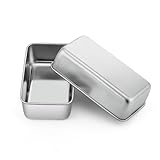
1. P&P CHEF Loaf Pan, 9 x 5 Inch Stainless Steel Bread Pan — Best overall
Two matched 9-inch pans in uncoated stainless steel, which is the configuration that survives daily use and steel tools.
Best for: high-volume bakers who want two identical 9-inch pans Skip it if: you need a nonstick release surface
The measured cavity is 2.5 x 9.2 x 4.9 in, which is the industry-standard sandwich loaf footprint, and you get two of them at 1 lb each. That matters more than it sounds. Two identical pans means one recipe splits into two loaves that bake at the same rate on the same shelf, and it means you are never waiting for a pan to cool before the next batch.
P&P CHEF says the pans are pure stainless steel with no coating and nothing to release at high temperature, and describes a heavy gauge wall plus a crimped rim for grip. Model SSBP-88. The listing also claims a brushed finish and rounded interior corners for easier cleanup, and states dishwasher safety.
It is the cheapest of the five and the one buyers choose most often in this set, which is unusual pairing. The trade-off against the coated picks is direct: bare stainless needs greasing and lining, and a lean dough will grab. Against the 12.3 in P&P CHEF pan, you also give up depth, since 2.5 in of side wall limits how much batter you can pour.
Pros:
- Two matched pans per box for parallel batches
- Standard 2.5 x 9.2 x 4.9 in sandwich loaf footprint
- Uncoated stainless, so nothing to flake off
- Crimped rim for a secure grip
- Cheapest pick in this group
Cons:
- No nonstick surface, so lining or greasing is mandatory
- Only 2.5 in deep, the shallowest cavity here
- Not carbon steel, despite the search that finds it
- No warranty stated on the listing
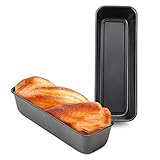
2. Beasea Long Loaf Bread Pan — Best for pros
The only long-and-narrow cavity in the group, and one of just two genuine carbon steel picks.

Best for: narrow pain de mie and terrine-style loaves Skip it if: you bake tall, domed sandwich loaves
At 2.6 x 4.4 x 12 in, this is a different shape rather than a bigger one. The cavity runs 12 in long and only 4 in wide, which produces a slim slice with more crust per bite. That geometry is why it earns the pro label: it is the pan shape you use for pâté en croûte, terrines, biscotti logs and long sandwich pullman-style bread. Two pans per box at 1.19 lb each.
Beasea states premium carbon steel with a special nonstick coating, a seamless one-piece body with no welding gaps, and rolled edges. Model BCUS520412_2x. The listing claims easier demoulding and less oil needed thanks to that coating.
It is the second-cheapest of the five, and it is the only pick that combines carbon steel with a pair-per-box format. The compromise is that a 4.4 in width will not hold a standard 9 x 5 recipe without spillover, and 2.6 in of depth means a well-risen dough crests early. If you bake one style of loaf and it is the classic dome, the P&P CHEF 9-inch is the safer default.
Pros:
- Genuine carbon steel with a stated nonstick coating
- 12 in length in a 4.4 in width, unique here
- Two pans per box
- Seamless one-piece body, no welded seams
- Rolled edges for handling
Cons:
- Narrow cavity won't take a standard 9 x 5 recipe
- 2.6 in depth is shallow for enriched doughs
- Coating limits you to non-metal tools
- No warranty stated on the listing
3. PERLLI Meat Loaf Pan with Drip Tray — Best minimal setup
A two-piece pan and insert that drains fat away, so one item covers roasting duty as well as baking.

Best for: meatloaf and roasts where fat needs to drain Skip it if: you want two pans in the box
This is the only pick in the set built as two parts. The outer pan measures 2.75 x 6 x 11.5 in, and a perforated insert sits inside it so rendered fat collects underneath instead of pooling around the loaf. Total weight is 1.54 lb, and the finish is copper. Model PERML2PC-COPR.
PERLLI states nonstick coating with ergonomic handles for lifting food out cleanly, oven use up to 450°F without warping or cracking, and dishwasher safety. The listing frames the drip design as a way to get a reduced-fat meatloaf or roast.
The insert is what makes this the minimal-setup choice: one purchase replaces a loaf pan plus a rack for anything meat-based. It sits mid-priced here. The costs are real, though. You get one pan, not two, so batch work means two purchases. The listing never names the base metal, only the coating and the copper finish, which puts it outside the carbon steel shortlist by omission. And a 6 in width makes it wide for bread, so a lean dough spreads rather than climbing.
Pros:
- Separate drip insert, the only one in this set
- Handles built in for lifting the insert out
- Rated to 450°F per the listing
- Covers roasting and baking in one item
- Nonstick surface for messy mixtures
Cons:
- Only one pan per box
- Base metal not stated on the listing
- 6 in width is wide for a bread loaf
- Two-piece design means two things to clean
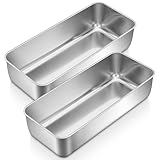
4. P&P CHEF Bread Loaf Pan — Best upgrade
The biggest cavity here at 3 in deep and 12.3 in long, in the same uncoated stainless as the winner.

Best for: wide, deep loaves and big batter volumes Skip it if: your oven shelf is short or crowded
Step up from the 9-inch P&P CHEF and what you buy is volume. This pan measures 3 x 12.3 x 5.4 in, giving you half an inch more depth and three more inches of length than the winner, with two pans at 2.14 lb for the set. Model SSBP-182. It is the heaviest pick per box in this comparison.
P&P CHEF states food-grade stainless steel with no chemical coating, a one-piece seamless build, a flat bottom, smooth rolled edges and oven use to 450°F. The brand points to the 3-inch side wall as the reason it holds more batter without overflowing, and says the interior and exterior carry a brushed finish with rounded corners for cleaning.
It is the most expensive pick here alongside the Zyliss, and it is the slowest-moving of the two P&P CHEF pans in this set. That premium buys size, not surface: it is still bare stainless, so lining is still your job. The real constraint is physical. At 12.3 in per pan, two of them side by side need a wide oven rack, and a standard home oven may only take one comfortably.
Pros:
- Deepest cavity in this comparison at 3 in
- 12.3 in length holds large batter volumes
- Two matched pans per box
- Seamless one-piece stainless build
- Rated to 450°F per the listing
Cons:
- Most expensive here with no coating in return
- 12.3 in per pan crowds a standard oven rack
- Heaviest set at 2.14 lb, awkward when full
- Only one seller lists it
5. Zyliss Non-Stick Loaf Pan — Best premium
Carbon steel with a named ILAG coating the brand says excludes PFAS, PFOA and PTFE, in the smallest cavity here.

Best for: small-batch pound cakes with a coated release Skip it if: you want more than one pan
Zyliss lists the pan at 21 cm x 13 cm x 10 cm, which works out to 3.94 x 8.27 x 5.12 in, weighing 1.3 lb. That makes it the shortest pan in this group and the second-deepest at just under 4 in, so the loaf comes out taller and stubbier than a 9 x 5 would give you. Model E980314. It is sold as one pan and rated 2 lb by the brand.
The coating is the differentiator. Zyliss names ILAG and states it is free from PFAS, PFOA, PTFE, lead and cadmium, which is more specific than any other coating claim in this set. The brand also states even heat distribution, heavy-duty carbon steel construction and dishwasher-safe cleanup.
It is the most expensive pick here and the slowest seller of the five by a wide margin. That combination is worth pausing on. You are paying a premium for one pan, where the winner gives you two for less, and the trade-off against every other pick is throughput. This is a single-loaf tool. Coated pans also age: the moment that ILAG film wears, you have a carbon steel pan with a patchy surface.
Pros:
- Coating specified as free from PFAS, PFOA and PTFE
- Genuine heavy-duty carbon steel construction
- Deep 3.94 in cavity for a tall loaf
- Dishwasher-safe per the listing
- Lightest single pan here at 1.3 lb
Cons:
- One pan only, at the top of this price group
- Shortest cavity at 8.27 in long
- Coating wear is a lifespan limit
- Only one seller lists it
What more money buys across these five pans
Spending more in this category does not reliably get you better metal. Here is what each tier actually delivers in this group.
- Entry. Both entry picks come as pairs. The P&P CHEF 9-inch gives you two uncoated stainless pans at 1 lb each; Beasea gives you two coated carbon steel pans at 1.19 lb each. Two pans is the productivity feature, and it lives at the bottom of the range.
- Mid. One pan plus a drip insert. PERLLI's second piece is a genuine function you cannot improvise easily, but you are paying for tooling rather than capacity.
- Premium. Two very different things. P&P CHEF's 12.3 in pan spends the premium on size, giving you 3 in of depth and two pans. Zyliss spends it on a named coating and a Swiss brand, and gives you one pan measuring 8.27 in long.
Read that list again and the pattern is clear: capacity is cheap here, and surface treatment is expensive. If your bottleneck is how many loaves you can bake in an evening, the money is better spent at the entry end. If your bottleneck is release and cleanup, the premium coated pan earns its place, but only for one loaf at a time.
Pan length is the spec that decides this
Most guides to loaf pans lead with material. Material matters, but it is not what makes a loaf come out right or wrong. Length and depth are.
A recipe written for a 9 x 5 pan poured into a 12 x 4 pan gives you a flat, over-baked loaf, because the same batter is spread over more base area and less height. Pour it into a 3.94 x 8.27 in Zyliss and you get the opposite problem: batter climbing past the rim, or a raw centre.
The dimensions in this set split into three groups:
- Standard sandwich: P&P CHEF 9-inch, at 2.5 x 9.2 x 4.9 in. This is what most published recipes assume.
- Long and narrow: Beasea, at 2.6 x 4.4 x 12 in. Slim slices, more crust.
- Deep or oversized: P&P CHEF 12.3 in and Zyliss at 3.94 in deep. Bigger batches or taller loaves, and recipe maths required.
PERLLI's 6 in width sits on its own, closer to a roasting vessel than a bread pan. Match the pan to the recipes you actually bake most often, then filter on metal. Doing it in the other order is how people end up with three pans and one usable one.
What the loaf pan listings don't tell you
Read these five listings side by side and the gaps are consistent.
None of the five publishes a warranty term. Not one. For a professional kitchen where pans get dropped, scraped and run through a commercial wash cycle daily, that is a meaningful blank, and it is the same blank across every price tier here.
Gauge is missing too. Three listings use the phrase heavy gauge or heavy-duty, but none states a thickness. Thickness is what determines whether a pan warps at 450°F over hundreds of cycles, and it is exactly the number a working chef would want.
PERLLI never names its base metal, only the nonstick coating and the copper finish. Zyliss and Beasea both state carbon steel, and both P&P CHEF pans state stainless, so PERLLI's silence is the outlier.
Two listings have only a single seller: the P&P CHEF 12.3 in pan and the Zyliss. The other three have two sellers each. That is worth knowing if you plan to reorder identical pans in a year to keep a matched set on the shelf.
Finally, none of these listings claims commercial or NSF certification. Search for the best carbon steel loaf pan for professional chefs and you get consumer bakeware, which is a category boundary the search itself does not draw.
The verdict
The best carbon steel loaf pan for professional chefs, judged across these five listings, is the P&P CHEF 9 x 5 Inch Stainless Steel Bread Pan. Two matched pans at 1 lb each in a 2.5 x 9.2 x 4.9 in standard footprint, uncoated so there is no film to flake off a metal spatula, and the cheapest pick in the group. Nothing else here gives you that combination of throughput, standard sizing and a surface that tolerates steel tools.
Two conditions flip it. First, if the metal is genuinely non-negotiable and you need a pair, Beasea's 12 x 4 in carbon steel set is the answer, and its narrow 4.4 in cavity is a real advantage for terrines and long sandwich loaves rather than a compromise. Second, if you regularly bake batters that overflow a 2.5 in wall, step up to the P&P CHEF 12.3 x 5.4 x 3 in set and accept that two of those pans will crowd a standard oven rack.
Beasea's exact advantage over the winner is stated material plus a coating. It is the only pick that pairs genuine carbon steel with two pans in the box. If you want the metal in the search term and the productivity of a pair, that is where they overlap.
FAQ
Is a carbon steel loaf pan worth it over stainless steel?
A carbon steel loaf pan is worth it mainly for the coating that usually comes with it. Both carbon steel picks here, Zyliss and Beasea, are nonstick. Neither P&P CHEF pan is coated at all. If you want easy release without lining, the carbon steel options deliver it. If you want a surface that shrugs off metal tools and heavy washing, uncoated stainless is the tougher choice.
Which pans here are genuinely carbon steel?
The pans here genuinely made of carbon steel are the Zyliss Non-Stick Loaf Pan and the Beasea Long Loaf Bread Pan. Both listings state carbon steel construction explicitly. The two P&P CHEF pans are stainless steel with no coating, and PERLLI's listing names only its nonstick coating and copper finish without identifying the base metal.
Does the best carbon steel loaf pan for professional chefs need to come in pairs?
The best carbon steel loaf pan for a working kitchen almost always comes in pairs, because two matched cavities let one recipe bake as two loaves on the same shelf at the same rate. Three of these five picks include two pans: both P&P CHEF sets and Beasea. PERLLI and Zyliss are single pans, which caps how much you can turn out per bake.
P&P CHEF 9-inch or Beasea 12 x 4: which should I buy?
P&P CHEF 9-inch or Beasea comes down to loaf shape. The P&P CHEF measures 2.5 x 9.2 x 4.9 in, the standard footprint most recipes assume, so no conversion maths. Beasea's 2.6 x 4.4 x 12 in cavity produces a long, slim loaf with more crust per slice, ideal for terrines and pain de mie but wrong for a standard recipe.
What's the most common mistake when buying a loaf pan?
The most common mistake when buying is filtering on material before dimensions. A recipe written for a 9 x 5 pan bakes badly in a 12 x 4 or an 8.27 in pan, regardless of the metal. Check the length and depth against the recipes you bake weekly, then narrow by material and coating. Depth here ranges from 2.5 in to 3.94 in.
Start with the shape of loaf you cut most often, then buy the pan that matches it. For most kitchens that is a 9 x 5, which puts the P&P CHEF pair at the front of the queue: two standard cavities, bare stainless that outlives any coating, and the lowest price in this group. Keep it lined with parchment and it will handle sandwich bread, pound cake and meatloaf without complaint. Add the Beasea set later if long, narrow loaves become part of your repertoire, since the two shapes cover almost everything a loaf pan is asked to do.