Best Ceramic Apron for Beginners: Who This Suits

Seven split-leg pottery aprons compared for new potters, from a cotton canvas Claypron at 43.5 inches long to a waterproof polyester option with a 6-month warranty.

By Zaria JarvisUpdated 18 min read
On this page
- Best ceramic apron for beginners at a glance
- Who this guide is not for
- 1. KITCHIEF Pottery Apron Split Leg — Best overall
- 2. XLSXEXCL Pottery Split Leg Apron — Best budget pick
- 3. Potterhyme Waterproof Pottery Apron — Best for pros
- 4. LIBKUR Pottery Apron Split Leg — Most versatile
- 5. Molaxhome Split Pottery Apron with 3 Pockets — Best upgrade
- 6. Claypron in Oatmeal — Best premium
- 7. Exclaith 42 Pcs Pottery Tools + Apron — Best minimal setup
- How I narrowed seven listings to a shortlist
- What actually makes an apron beginner-friendly?
- Split-leg versus overlap: which covers you better?
- How many pockets do you really need?
- What the listings do not tell you
- The verdict
- FAQ
The best ceramic apron for beginners is the KITCHIEF Pottery Apron Split Leg, because cross-back straps and adjustable brass buckles solve the two problems new potters hit first: neck strain after an hour on the wheel and an apron that keeps sliding off one shoulder. If your studio is soaked in slip and glaze, the Potterhyme Waterproof Pottery Apron, a 47 x 30 in lined polyester piece with three chest pockets and a stated 6-month warranty, is the better call. Everything else in this guide is a version of that trade-off.
Best ceramic apron for beginners at a glance
| Pick | Material claim | Pockets | Price |
|---|---|---|---|
Best overall KITCHIEF Pottery Apron Split Leg |
Polyester (claim) | 2 | Check Price |
Best budget pick XLSXEXCL Pottery Split Leg Apron |
Polyester (claim) | 3 | Check Price |
Best for pros Potterhyme Waterproof Pottery Apron |
Lined polyester, waterproof claim | 3 | Check Price |
Most versatile LIBKUR Pottery Apron Split Leg |
Canvas (claim) | 3 (chest + 2 side) | Check Price |
Best upgrade Molaxhome Split Pottery Apron |
Cotton blend (claim) | 3 | Check Price |
Best premium Claypron in Oatmeal |
100% cotton canvas (claim) | 2 slanted side | Check Price |
Best minimal setup Exclaith 42 Pcs Pottery Kit + Apron |
Apron plus 42-piece tool kit | Kit only | Check Price |



Who this guide is not for
Amazon's results for this keyword do not filter for "beginner". You are looking at the same shortlist a returning potter sees, and I did not invent a beginner-only tier to make the results feel tidier. If you have already thrown a hundred pots, you know your own preferences on strap width and hem length better than I can guess from a listing.
This guide is written for one specific person: someone signed up for a first pottery class or setting up a home wheel this month, who wants a ceramic apron that will not fight them while they learn. If that is not you, the same seven picks still apply, but skim past the reasoning about cross-back straps and jump to the specification table.
Three cases where you should not buy any of these:
- You need certified food-safe or flame-resistant workwear. None of the listings claim either.
- You want a leather blacksmithing apron for the heat. Ceramics is a cool, wet mess, not a hot one.
- You need a plus-size cut with published measurements above 187 lb. Only the Molaxhome listing publishes a weight ceiling, and that is where it lands.
1. KITCHIEF Pottery Apron Split Leg — Best overall
The KITCHIEF wins on the two beginner problems the other picks half-solve: a neck that hurts after an hour, and straps that will not stay put.
Best for: a first wheel class where you need cross-back comfort and simple pockets Skip it if: you want cotton canvas rather than polyester
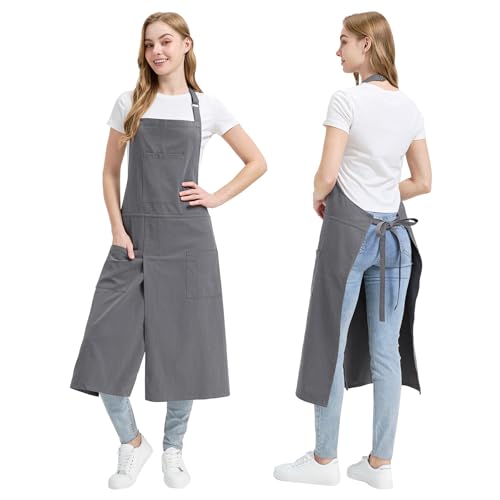
Cross-back straps route the load across your shoulder blades instead of hanging it off your neck, and that matters more in the first month of pottery than in the tenth, because you are hunched forward and tense. KITCHIEF pairs that with brass buckle fasteners the listing calls removable and adjustable, so a beginner can size the apron once and stop fiddling. The split-leg cut lets you kneel to reload a wheel splash pan or sit cross-legged at a slab table without the hem riding up your thighs.
KITCHIEF calls the fabric high-quality polyester and describes it as breathable, heat-resistant, lightweight and machine-washable. Two pockets is fewer than the three-pocket picks below, which is the real trade-off here: if you carry a sponge, a rib, a needle tool and a chamois all at once, you will run out of pockets faster than with the LIBKUR or Molaxhome. Against the set, it also sells faster on this list than any other apron here, which is a soft signal that beginners keep landing on it and keeping it.
Pros:
- Cross-back strap layout that keeps weight off the neck
- Brass buckle hardware called removable and adjustable
- Split-leg cut for kneeling and sitting
- Sells faster than the rest of this set
- Sits in the entry price band
Cons:
- Only two pockets, versus three on several picks here
- Polyester rather than cotton canvas
- No published weight or dimensions in the listing
2. XLSXEXCL Pottery Split Leg Apron — Best budget pick
The cheapest apron here that still commits to a published size and three pockets, which is exactly the deal a first-time buyer wants.

Best for: a low-commitment first apron before you know whether pottery sticks Skip it if: you need a published weight or warranty on paper
XLSXEXCL is the cheapest of the seven and it does not skimp on the two specifications that matter for a beginner. The listing publishes a size of 80 cm x 90 cm, which converts to 31.49 x 35.43 in, and it commits to three pockets on the chest for small tools. That is the same pocket count as the Potterhyme, at the lowest price position on this list.
The listing calls the fabric wear-resistant, easy-to-clean polyester, and describes the front piece as wide enough to prevent mud and glaze from staining clothes, with side coverage extending toward the knees. Those are manufacturer claims, not measurements I can verify, so treat the coverage description as a design intent rather than a promise. The real cost of buying at this price position is what is missing from the listing: no published weight, no warranty, no dimensions in a standard imperial-first format. If you like your data neat before you order, the Molaxhome upgrade below prints more of it.
Pros:
- Cheapest of the seven
- Three pockets on the chest
- Published size in both cm and inches
- Wide front panel called out for coverage
- Adjustable straps
Cons:
- No published weight or warranty
- Polyester rather than natural fibre
- Sells more slowly than the KITCHIEF
3. Potterhyme Waterproof Pottery Apron — Best for pros
Only apron here that pairs a waterproof lining claim with a stated 6-month warranty.

Best for: a wet studio where glaze splashes soak through cotton in minutes Skip it if: you want a breathable natural fibre against the skin
Potterhyme is the pick I would give a beginner who has already discovered they hate walking home in wet jeans. The listing calls the apron 100% waterproof, made of high-quality lined polyester, and prints dimensions of 0.15 x 47 x 30 in. That length puts it among the longer picks here, and the leg straps keep the coverage in place when you swing a leg over a wheel. Three chest pockets hold a pen or a needle tool upright, in the pattern the LIBKUR and Molaxhome also use.
The 6-month warranty is the only stated warranty on this list. Everything else either says no or stays quiet. That is a small thing until the buckle fails in month four, at which point it is not a small thing. The trade-off is honest: a lined polyester waterproof apron does not breathe like cotton canvas, and if you already run hot at the wheel you will feel that. It is also the black option here, so glaze splatter shows differently than on the grey and oatmeal picks. Sits in the entry price band despite the extra features, which is why it earns the "for pros" award rather than "premium".
Pros:
- 100% waterproof lining, per the listing
- 6-month warranty stated
- Three tool pockets on the chest
- 47 in length with leg straps
- Entry price band
Cons:
- Polyester does not breathe like cotton
- Black shows dust and dried slip
- No published weight
4. LIBKUR Pottery Apron Split Leg — Most versatile
A canvas-claim apron that the listing pitches at potters, painters, gardeners and teachers with equal weight.

Best for: a beginner who also teaches, gardens or paints and wants one apron for all of it Skip it if: you need a published size chart before buying
LIBKUR is what you buy if the apron is for more than one hobby. The listing describes a chest pocket that holds trimming tools upright, plus side pockets for sponges and ribs, which is the same layout serious potters set up manually on plain aprons. It calls the fabric lightweight canvas with a tight weave that resists clay dust, though canvas is described in marketing terms rather than a stated fibre percentage the way the Claypron prints it.
The neck and waist straps are adjustable so you can wear the apron over a t-shirt in summer or a hoodie in winter, which sounds like filler until you remember most studios are unheated. The catch is missing data: no published size, no dimensions, no weight. You are buying on the promise of the design and the split-leg cut. That is fine for a versatile mid-priced pick, but it is why the Molaxhome one price position higher earns the upgrade slot instead of this one. Sells the slowest of the seven on this list, which may reflect the missing specifications more than any real fit problem.
Pros:
- Chest pocket sized for trimming tools upright
- Side pockets for sponges and ribs
- Adjustable neck and waist straps
- Canvas fabric claim
- Split-leg cut
Cons:
- No published size, weight or dimensions
- Fibre content not specified
- Sells the slowest of the seven
5. Molaxhome Split Pottery Apron with 3 Pockets — Best upgrade
The only listing here that prints a size chart, pocket dimensions and a weight ceiling before you buy.
Best for: a beginner who wants a published size and pocket chart before ordering Skip it if: you are taller than 6'1" or heavier than 187 lb
Molaxhome earns the upgrade award for one reason: the listing publishes numbers the others hide. Apron measurements are 41.3 x 30.3 in. Recommended fit is up to 85 kg or 187 lb, and heights above 165 cm or 65 in. Pockets are dimensioned: the top pocket is 1.6 in plus 4 in long by 6.7 in wide, and the two below are 5.9 x 6 in. That is the level of detail a beginner needs, because a first apron that does not fit is an apron that lives on a hook.
The listing calls the fabric a cotton blend, soft and lightweight, which is closer to the Claypron's natural feel than the polyester picks. Care instructions specify low-temperature hand wash, low-temperature iron, no bleach and no tumble drying, which is more finicky than the polyester picks that accept a machine wash. That extra care is the real trade-off. It is the most expensive apron here that is not a full kit, and if you would forget the hand-wash rule after a week, buy the Potterhyme instead.
Pros:
- Apron measurements printed as 41.3 x 30.3 in
- Weight ceiling stated at 187 lb
- All three pockets dimensioned individually
- Cotton blend fabric claim
- Foldable in half for shorter wearers
Cons:
- Hand-wash only, no tumble dry
- Premium price band
- Weight ceiling excludes heavier wearers
6. Claypron in Oatmeal — Best premium
The only apron here that publishes a fibre content of 100% cotton canvas, a stated weight of 0.69 lb and an overlap front panel for seated wheel work.

Best for: a beginner who sits at the wheel and wants natural cotton canvas Skip it if: you are over about 5'10" and want full shin coverage
Claypron is a pottery apron brand from Echo Ceramics, a studio in Los Angeles, and it shows in the detail of the listing. Fibre content is stated: 100% cotton canvas. Weight is stated: 0.69 lb. Dimensions are 48 x 0.01 x 29 in, though the listing separately calls out 43.5 in long and 29 in wide for this shorter Oatmeal version, with two slanted side pockets about 6 x 6 in each.
The design difference is the overlap. Instead of a split-leg cut with two separate panels, the front panel overlaps itself, so when you sit at the wheel the overlap covers both thighs at once. The listing calls this out specifically for seated wheel work, and it is the trade-off that defines the pick: better seated coverage, less freedom when you kneel or stride. Two pockets rather than three is the other trade. This is the most expensive standalone apron here and the second-highest sales rank position of the seven, so it is a considered purchase, not a first grab. If you are on the tall side, note that the Oatmeal colour is shorter than the other Claypron shades.
Pros:
- 100% cotton canvas, stated
- Weight published at 0.69 lb
- Overlap front panel for seated wheel work
- Length and width printed as 43.5 x 29 in
- Available in multiple colours
Cons:
- Oatmeal is the shorter version
- Only two pockets, not three
- Most expensive standalone apron here
7. Exclaith 42 Pcs Pottery Tools + Apron — Best minimal setup
Only pick that solves the "I own nothing yet" problem in one order.
Best for: a first-timer who has no tools yet and wants apron and kit together Skip it if: you already own trimming tools and just need the apron
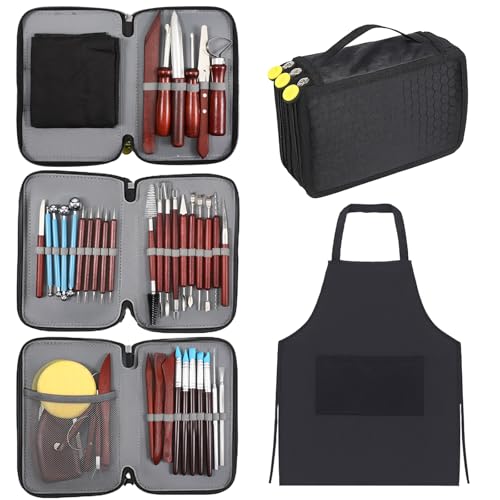
The Exclaith listing is not really an apron listing. It is a 42-piece pottery kit with a carrying case measured at 3.35 x 8.27 x 5.12 in, and the apron is bundled inside. That makes it the pick for someone starting from zero. You get double-ended stainless steel tools for carving, shaping and modelling, wooden and rubber handles the listing calls ergonomic, and a case with individual slots so the sharp edges do not blunt each other.
The trade-off is straightforward: the apron itself is not the star of the listing, and the specifications lean toward the tools. There is no fibre content and no dimensions for the apron alone, so if apron fit is your priority you should buy one of the six standalone picks and add tools separately. If you are equipping yourself for a first class next week and would otherwise be at the studio in a t-shirt with borrowed tools, this closes the gap in one purchase. Sits in the premium price band, which is expected: you are paying for the kit, not the apron.
Pros:
- 42 tools included in one purchase
- Carrying case with individual tool slots
- Case dimensions printed as 3.35 x 8.27 x 5.12 in
- Suits polymer, pottery and air-dry clay
- Ergonomic handle claim
Cons:
- Apron specifications not published separately
- No warranty stated
- Premium price band
- Overkill if you already own tools
How I narrowed seven listings to a shortlist
I cut on data completeness first, then on beginner fit.
- Missing pocket count. A ceramic apron without pockets is a smock. Every pick here publishes a pocket layout, whether that is two or three.
- Missing size or fit information. Only two listings, Molaxhome and Claypron, print full measurements. The rest say "adjustable" or "one size fits most", and I flagged that as a real risk in each pick.
- Missing coverage claim. Beginners kneel and sit. An apron that does not commit to a split-leg or overlap design was cut.
Three reasons picks were disqualified from being labelled the winner even though they made the shortlist: the Potterhyme is polyester when a beginner in a warm studio may prefer breathable cotton, the Molaxhome is hand-wash only when a beginner will forget, and the Claypron overlap panel is a specialist choice for seated wheel work rather than a neutral first purchase. The KITCHIEF wins because it does the neutral job well and asks nothing unusual of the user.
What actually makes an apron beginner-friendly?
Most guides compare fabric weight in ounces. That is not what decides it. Fabric weight matters in month six, when you know whether you prefer canvas drag or polyester slide. In month one, three things decide whether the apron gets worn:
- Strap layout. A single loop around the neck hurts after 40 minutes. Cross-back straps distribute the load and keep the apron centred when you lean forward at the wheel.
- Split-leg or overlap coverage. Slip runs down your thighs when you sit at a wheel. A flat apron pools it in your lap. A split-leg or overlap panel routes it past your knees.
- Reachable pockets. A single hip pocket is where sponges go to die. A chest pocket keeps a needle tool visible; side pockets sized around 6 x 6 in hold ribs and chamois flat.
Two of the picks here nail all three: KITCHIEF for strap layout, and LIBKUR for the pocket layout. Potterhyme adds the waterproof lining if your studio runs wetter than most. Everything else is preference.
Split-leg versus overlap: which covers you better?
Six of the seven aprons here are split-leg cuts. The Claypron is the exception, using an overlapping front panel instead. That is the deciding difference for how they behave at the wheel.
Split-leg aprons have two separate panels that fall past your knees. When you sit cross-legged or straddle a wheel, each leg keeps its own panel. Coverage stays put. The trade-off is that the split runs up the centre, so a very wet splash from the wheel can find the gap.
Overlap aprons layer the front panel over itself, so from the outside they look like a normal long apron. When you sit at the wheel, the overlap covers both thighs at once with no central gap. The trade-off is mobility: overlap panels do not spread as freely when you kneel or stride, and the Claypron's shorter Oatmeal version at 43.5 in long may not reach your shins if you are taller than about 5'10".
The cutoff is your primary posture. If you spend most of your studio time sitting at the wheel, the overlap wins. If you also hand-build, kneel to load kilns or work at a slab table, the split-leg wins. Beginners usually do all three in a first term, which is why the split-leg picks make up the top of this ranking.
How many pockets do you really need?
Two is the minimum. Three is the ceiling before pockets start getting in each other's way. Here is what actually goes in them at a first-class level:
- Pocket 1: a small sponge and a chamois. These are wet, so they want a pocket you do not mind cleaning.
- Pocket 2: a metal or wooden rib, and a wire loop tool if you already own one.
- Pocket 3, if present: a needle tool or a pen, stored upright. This is the pocket the LIBKUR listing specifically shapes for trimming tools.
The Molaxhome is the only listing that prints pocket dimensions: 1.6 in plus 4 in long by 6.7 in wide for the top pocket, and 5.9 x 6 in for the two below. The Claypron prints its side pockets at approximately 6 x 6 in. Everything else names the count and stops there. If you already own tools and want to check they will fit, buy on the two picks that dimension the pockets.
What the listings do not tell you
Read the pick sections and you will notice how often I hedge with "the listing calls" or "manufacturer claim". That is not padding. It is the shape of the evidence.
Every apron here is described as durable, comfortable, breathable or water-resistant. Only Claypron prints a fibre percentage. Only Potterhyme states a warranty. Only Molaxhome and Claypron print full dimensions, and only Molaxhome prints a weight ceiling for the wearer. The rest sit on adjectives.
That gap matters for a beginner because you cannot judge canvas weight from a photograph and you cannot judge strap length from "adjustable". If the specification is not on the page, treat it as unknown. The strongest signal in the listings is what the manufacturer chose to publish and what they chose to leave vague. A brand that prints pocket dimensions and a weight ceiling has decided that a returning customer is worth more than a mystery-shopper conversion, and that is generally a good sign.
The verdict
The best ceramic apron for beginners is the KITCHIEF Pottery Apron Split Leg, because it solves the strap comfort problem with a cross-back layout, holds size with brass buckle hardware, and sits in the entry price band while selling faster than every other pick here. Two pockets is the honest trade against the three-pocket picks, and if that shortage bothers you, the LIBKUR or Molaxhome fix it without changing the split-leg silhouette.
If you already know your studio runs wet, buy the Potterhyme instead. It is the only apron here with a waterproof lining claim and a stated 6-month warranty, and it stays in the entry price band. That combination is unusual on this list, and it is why the "for pros" label is not the winner label: the Potterhyme is the right upgrade path once you have proved to yourself that pottery has stuck. For seated wheel work specifically with natural fibre against the skin, step up to the Claypron in Oatmeal at 43.5 in long. If you own zero tools, the Exclaith kit closes the gap in a single order. Every other pick is a variation on those three trade-offs.
FAQ
Is a ceramic apron worth it for a beginner?
A ceramic apron is worth it in the first week, not the first year. Pottery slip stains cotton in a way that survives repeat washes, and glaze speckle on jeans is permanent. An apron in the entry price band, like the KITCHIEF or the XLSXEXCL, pays for itself the first time it saves a pair of jeans. The split-leg cut also protects your thighs when you sit at a wheel, which a normal cook's apron does not.
What is the difference between a pottery apron and a kitchen apron?
The difference between a pottery apron and a kitchen apron is coverage below the waist. A kitchen apron ends at the thigh and assumes you stand at a counter. A pottery apron uses a split-leg or overlap cut that reaches past the knees, because potters sit at a wheel with legs apart. Cross-back straps are also more common on pottery aprons, since sessions run longer than a dinner prep.
How does the KITCHIEF compare to the Potterhyme?
The KITCHIEF compares to the Potterhyme on comfort versus waterproofing. KITCHIEF wins on cross-back straps for a longer wheel session and sells faster on this list. Potterhyme wins on a stated waterproof lining and a 6-month warranty, the only warranty published across the seven picks. Both sit in the entry price band. Choose KITCHIEF for a dry hand-building class and Potterhyme for a glaze-splashed wheel studio.
What size ceramic apron should I buy?
The size ceramic apron you should buy depends on which listings publish measurements. Molaxhome prints 41.3 x 30.3 in with a weight ceiling of 187 lb, and Claypron prints 43.5 x 29 in for the shorter Oatmeal version at 0.69 lb. The XLSXEXCL prints 31.49 x 35.43 in. Every other pick says "adjustable" or "one size fits most" without dimensions, so buy those on strap adjustability rather than size.
Can I machine wash a ceramic apron?
You can machine wash most ceramic aprons but not all. KITCHIEF and Claypron listings describe easy washing and machine-washable canvas respectively, and Potterhyme's lined polyester is designed to rinse clean. The Molaxhome listing is the exception, specifying low-temperature hand wash, low-temperature ironing, no bleach and no tumble drying. If you know you will forget those rules, avoid the Molaxhome and pick one of the polyester options.
Start with the KITCHIEF if you want one apron to do the job without a study session in specifications. It sells faster than everything else in this shortlist for a reason: cross-back straps, brass buckles, a split-leg cut and a price you will not regret if pottery turns out to be a two-week phase. Once you know your studio, your posture and your tolerance for hand-washing, the Potterhyme, Claypron and Molaxhome become the upgrade paths, in that order, for wetness, natural fibre and printed dimensions. The best ceramic apron for beginners is the one you actually wear from the first class, and simple beats specialised while you are learning what you prefer.