Best Lightweight Ice Melt for Beginners: Maple99 Wins
A first winter on a new walkway means picking a de-icer you can actually see, spread and store. Six bags compared, one winner named, and the conditions that flip the pick spelled out plainly.

By Zaria JarvisUpdated 17 min read
On this page
- How I screened the six bags
- Best lightweight ice melt for beginners at a glance
- What decides an ice melt for a first-time buyer?
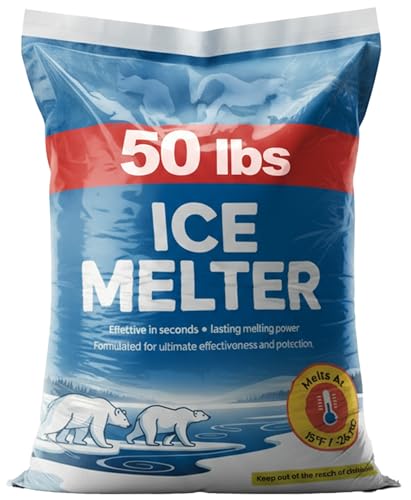
- 1. Maple99 Ice Melt Safe for Concrete Sidewalks & Driveways — Best overall
- 2. Maple99 Ice Melt Safer for Concrete — Best upgrade
- 3. Stalner Polar Ice Melt — Best minimal setup
- 4. Northern Salt North Pro Heat — Best for pros
- 5. teqnizo 2PCS Ice & Snow Melt — Best budget pick
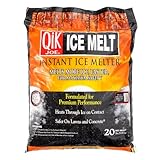
- 6. Qik Joe Calcium Chloride Ice Melt — Runner-up
- Chloride, calcium, magnesium: what the labels really mean
- Does 'lightweight' actually show up on these bags?
- What to look for so you can judge a bag I did not cover
- Head-to-head: Maple99 50 lb versus Maple99 20 lb
- The verdict
- FAQ
The best lightweight ice melt for beginners is Maple99's 50 lb green-tinted bag, because the colour shows you where you have already spread and the formula is marketed as safer for concrete than plain rock salt. If a 50 lb sack is too much to lug, the Maple99 20 lb bag, at 3.3 x 18 x 14 in, is the same formula in a size a first-timer can carry one-handed.
How I screened the six bags
I lined up six de-icer listings sold in the Snow & Ice Melters category and compared the published specifications side by side. Two things drove the ranking: how easy the bag is for a first-time buyer to handle, and what the listing actually tells you about the granule.
The screen ran in three passes.
- Bag size versus buyer. A first winter on your own property is not the moment to wrestle a 50 lb sack up three porch steps. I noted the stated weight on every listing and separated the ones a beginner can carry from the ones that need a hand truck.
- Coverage cues. Green, blue and pink tints all appeared in this set. A tinted granule matters more than it sounds: on fresh snow, plain white salt vanishes, and a beginner over-applies to compensate.
- What the label actually claims. Calcium chloride, magnesium chloride and unspecified blends behave differently in the cold. I pulled the stated low-temperature figure from each listing where the seller published one.
Two bags were cut from award contention for a beginner audience despite being competent products, and both stayed in the ranking as conditional picks. The best lightweight ice melt for beginners in this group ended up being the one with the most forgiving formula story and a visible tint, not the one with the lowest melting temperature.
Best lightweight ice melt for beginners at a glance
| Pick | Bag size | Low-temp claim | Price |
|---|---|---|---|
Best overall Maple99 Ice Melt Safe for Concrete |
50 lb | Not stated | Check Price |
Best upgrade Maple99 Ice Melt Safer for Concrete |
20 lb | Not stated | Check Price |
Best minimal setup Stalner Polar Ice Melt |
20 lb | -25F claim | Check Price |
Best for pros Northern Salt North Pro Heat |
25 lb resealable | -30F claim | Check Price |
Best budget pick teqnizo 2PCS Ice & Snow Melt |
100g pouches, 2-pack | 3F claim | Check Price |
Runner-up Qik Joe Calcium Chloride Ice Melt |
20 lb | -25F claim | Check Price |


A note on the keyword: "lightweight" is not printed on any of these six labels. Ice melt is heavy by nature, and the honest way to read the qualifier is as a preference for a smaller bag you can carry without a struggle. Two of the six weigh 20 lb, one weighs 25 lb, one weighs 50 lb, one weighs a token 100g per pouch, and one lists 20 lb as its size. Judge the bag size against your car, your porch and your back.
What decides an ice melt for a first-time buyer?
Most guides compare melting temperature. That is not what decides it for a beginner. The deciding criterion is whether you can pick up the bag, see where the granules land, and stop before you damage the concrete.
Three things matter, in order.
- Bag weight against your body. A 50 lb bag is a serious lift. If you already know you cannot manage one, halve the size and buy twice as often.
- A visible tint. Green, blue and pink granules all show up on white snow. Plain salt disappears, and you will keep pouring past the point where the driveway is treated.
- A formula the label calls safer for concrete. New concrete under a year old is vulnerable to chloride damage. Bags that flag themselves as gentler are a lower-risk starting point.
Low-temperature claims matter, but only if your winter actually hits those temperatures. A -30F rating is wasted in a climate that bottoms out at 10F, and the more aggressive the chemistry, the more careful you have to be around pets, plants and fresh concrete.
1. Maple99 Ice Melt Safe for Concrete Sidewalks & Driveways — Best overall
A green-tinted 50 lb bag that the seller pitches as safer for concrete, at a size that carries a real driveway through a full storm.
Best for: a first-time buyer clearing a standard driveway and front walk Skip it if: you cannot lift a 50 lb bag out of the trunk
This is the pick I would put in a first-time buyer's garage in October. The 50 lb bag measures 20 x 20 x 20 in, so it sits stably against a wall and gives you enough product for a full season on a typical suburban lot. Maple99 tints the granules green, which is the single most useful feature for someone who has never spread de-icer before, because you can see the trail and stop when the surface is covered. The listing calls the formula "Safety-Max" and claims it prevents refreezing once the surface is clear, and Maple99 markets it as safer for concrete than traditional ice melt.
The trade-off is honest: this is the most expensive pick here, and the listing does not publish a low-temperature rating the way Stalner and Qik Joe do. If you live where nights routinely fall below -10F, the specification blank matters, and you may prefer a bag that puts the number on the label.
Pros:
- Green tint shows coverage clearly on fresh snow
- 50 lb size lasts a full season on a standard driveway
- Marketed as safer for concrete than plain rock salt
- Same manufacturer offers a 20 lb version of the formula
- Stable 20 x 20 x 20 in bag stores upright
Cons:
- No published low-temperature rating
- 50 lb is a heavy first-buy for anyone with a bad back
- The most expensive pick in this set
- Only one seller lists it
2. Maple99 Ice Melt Safer for Concrete — Best upgrade
The same green-tinted Maple99 formula in a 20 lb bag a beginner can carry one-handed from the car.

Best for: a townhouse or apartment porch where a 50 lb bag is overkill Skip it if: you clear a full driveway every storm
If the 50 lb winner is too much bag, this is the answer. The dimensions tell the story: 3.3 x 18 x 14 in, a flat sleeve that fits under a bench or on a shelf and does not demand a dedicated corner of the garage. Maple99 keeps the green tint and the "Safety-Max" refreeze claim, so you get the same coverage-visible experience in a size that suits a smaller property. The listing recommends applying before snowfall to make shoveling easier, which is the right habit for a beginner to build.
The bag will not carry you through a heavy season on a big driveway, and it sells at a mid-range price position in this set, so the per-pound cost is not the argument. The argument is manageability. This is the bag I would hand to someone renting their first house, or to an older buyer who is done with 50 lb sacks. Compared with the winner, the loss is only bulk purchasing; the formula and the visible-tint advantage are identical.
Pros:
- Flat 3.3 x 18 x 14 in bag stores easily
- Green granules for visible coverage
- Same Maple99 refreeze-prevention claim
- Manageable 20 lb weight for one-handed carry
Cons:
- No published low-temperature figure
- Runs out fast on a full driveway
- Mid-range price for a smaller quantity
- Only one seller lists it
3. Stalner Polar Ice Melt — Best minimal setup
A blue-tinted magnesium chloride bag Stalner markets as pet-friendly and rated to melt down to -25F.

Best for: dog owners who want to see exactly where the granules land Skip it if: you already own a broadcast spreader and prefer plain granules
Stalner leans harder into the beginner story than anyone else in this set. The 20 lb bag measures 14 x 4 x 8 in, the granules are tinted blue so you can see coverage, and the listing says the tint is non-toxic, non-staining and water-soluble. Stalner claims the magnesium chloride granules melt down to -25F and calls the formula gentler on paws than traditional rock salt. The listing also says the uniform granule size flows through broadcast or handheld spreaders without clogging, so if you graduate from bag-and-hand to a proper spreader later, the same product still works.
Two honest cautions. First, "pet-friendly" is the manufacturer's phrasing on the listing, and it is a marketing category rather than a safety guarantee: rinse paws and follow the application rate on the bag. Second, this is the second-slowest seller in this set, and it costs more than the Qik Joe bag at a comparable weight, so you are paying a premium for the tint and the magnesium chloride chemistry over straight calcium chloride.
Pros:
- Blue tint shows coverage on fresh snow
- -25F melting claim on the label
- Marketed as gentler on paws than rock salt
- Flat 14 x 4 x 8 in bag is easy to store
- Listing says uniform granules feed spreaders without clogging
Cons:
- "Pet-friendly" is a manufacturer claim, not a certification
- Costs more per pound than the Qik Joe option
- Only one seller lists it
- Sells more slowly than the Maple99 bags in this set
4. Northern Salt North Pro Heat — Best for pros
A pink calcium-chloride blend in a 25 lb resealable bag, with the lowest melting-temperature claim of the six at -30F.

Best for: deep-cold regions where nights dip below -20F Skip it if: you want a bag a beginner can pour without thinking
This is the aggressive pick, and it is here for readers whose winters justify aggression. Northern Salt sells a 25 lb resealable bag naturally tinted pink, which the listing says is a hue in the crystal itself rather than an added dye. The stated melting temperature is -30F, the lowest figure in this set. The listing claims the crystal size and shape reduce bounce and scatter, and the resealable top is a real advantage: opened bags of chloride ice melt attract moisture and clump, and a proper seal keeps the product usable across a winter.
The reason it is not the beginner's default: calcium chloride is the most aggressive chloride in common use, and a first-time buyer is exactly the person most likely to over-apply. If you have not spread de-icer before, the low-temperature headroom is not worth the risk to fresh concrete or nearby lawn. This is the slowest seller in the set, and it sits at a premium price position. Reach for it if your climate demands it.
Pros:
- -30F melting claim, the lowest here
- Resealable 25 lb bag stays dry between uses
- Pink hue is inherent to the crystal, not a dye
- Listing claims reduced scatter into vegetation
Cons:
- Calcium chloride is easy for a beginner to over-apply
- Premium price position in this set
- Sells more slowly than any other pick here
- The published product weight of 15 lb on the listing conflicts with the 25 lb size on the bag
5. teqnizo 2PCS Ice & Snow Melt — Best budget pick
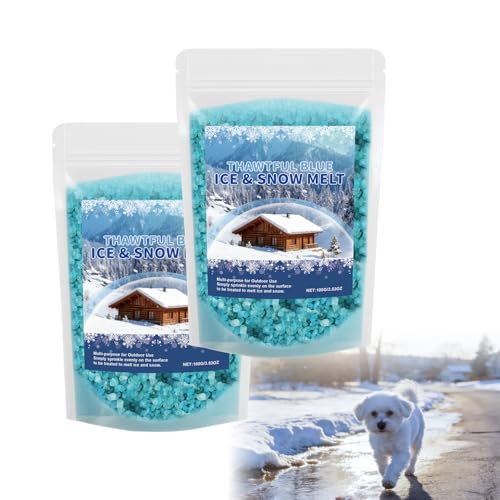
Two 100g pouches of blue-granule ice melt for testing on steps or a single stoop, with a stated 3F melting point.
Best for: trying a small pouch on a single set of steps before committing Skip it if: you need to cover anything larger than a stoop
Set expectations correctly and this pick has a real job. A 100g pouch is a sample, not a season's supply, and teqnizo sells it in a two-pack for people who want to try a granule and coverage colour before they buy a full bag. The listing calls the granules blue-tinted (though it also mentions green crystals in a different bullet, so treat the description with a grain of salt), promises fast melting, and gives a low-temperature figure of -16C, which the listing itself converts to 3F. That is the weakest low-temperature claim in this set by a wide margin.
Buy it as a small, cheap way to see whether you like the granule and the applicator behaviour before you commit to 20 or 50 lb of the same chemistry. Do not buy it expecting to clear a driveway. The listing does not specify the exact chloride used, and the product-description bullets contradict each other on granule colour, so the honest label here is "sample bag" rather than "primary de-icer".
Pros:
- The cheapest of the six
- Small enough to store in a kitchen drawer
- Blue granules show placement on snow
- Two pouches for testing two locations
Cons:
- 100g per pouch is not a season's supply
- 3F melting claim, the weakest low-temperature figure here
- Listing bullets contradict each other on granule colour
- Chloride type is not specified on the listing
6. Qik Joe Calcium Chloride Ice Melt — Runner-up
A 20 lb bag of 100% calcium chloride pellets, rated on the listing to work down to -25F.

Best for: a beginner who wants pure calcium chloride pellets in a manageable bag Skip it if: you would rather see coloured granules on white snow
Qik Joe earns the runner-up slot for one clear reason: the listing tells you exactly what is in the bag. Straight 100% calcium chloride pellets, in a 20 lb bag measuring 3 x 20 x 15 in, with a stated -25F working temperature. Calcium chloride draws moisture from the air, which is why the listing describes the pellets as long-lasting: they keep pulling water into the melt after the initial burst. For a beginner who values a plain, well-labelled formula, that transparency counts.
The trade-off against the Maple99 winner is the lack of a tint. Pure calcium chloride pellets are white, so they disappear into snow, and a first-time spreader will not know when to stop pouring. That is the whole reason it lost to Maple99 for the top slot in a guide aimed at beginners. If you are comfortable eyeballing coverage, or if you plan to run a broadcast spreader that meters the rate for you, Qik Joe is the more informative bag; if you want a granule you can see, pick one of the tinted options above.
Pros:
- 100% calcium chloride, stated on the label
- -25F melting claim
- 20 lb bag at 3 x 20 x 15 in is easy to carry
- Listing says pellets keep working by drawing moisture
Cons:
- Plain white pellets vanish on fresh snow
- Calcium chloride is easy for a beginner to over-apply
- Only one seller lists it
- No pet-safety framing on the listing
Chloride, calcium, magnesium: what the labels really mean
Three chemistries turn up on these bags, and a first-time buyer benefits from knowing which one is in the sack.
- Calcium chloride appears in the Qik Joe and Northern Salt listings. It is the aggressive one. It works at the lowest temperatures, draws moisture from the air to keep melting, and is the easiest to over-apply on concrete.
- Magnesium chloride appears in the Stalner Polar listing. It is the one manufacturers most often market as gentler on paws and vegetation. Melting performance is real but usually not as extreme as calcium chloride.
- Unspecified blends appear in the two Maple99 bags and the teqnizo pouches. The listing describes a formula and a behaviour without naming the active ingredient. That is common in consumer ice melt, and it is not a deal-breaker; it does mean you cannot verify the low-temperature claim against a chemistry.
The best lightweight ice melt for beginners does not have to be the one with the most exotic chemistry. It has to be the one whose granule you can see, whose bag you can carry, and whose application rate is printed clearly on the label. All three of those are more useful to a first winter than the difference between -25F and -30F.
Does 'lightweight' actually show up on these bags?
Short answer: not directly. None of these six listings uses the word "lightweight" as a product claim, and ice melt in bulk is inherently heavy. What the set does give you is a range of bag sizes that map to different bodies and different properties.
- 100g pouch (teqnizo): light enough to slip into a coat pocket. Good only for a stoop.
- 20 lb bag (Maple99 20 lb, Stalner, Qik Joe): the honest "lightweight" tier for a beginner. Carry it one-handed from the car to the porch.
- 25 lb resealable (Northern Salt): still manageable, with the resealable top adding a real convenience.
- 50 lb bag (Maple99 50 lb): a two-hand lift, best kept in place once it is where it needs to be.
If the qualifier "lightweight" is what brought you here, treat the 20 lb bags as your default and step up or down from there based on how much surface you clear. Do not buy a 50 lb sack just because it saves money per pound if you dread hauling it out of the trunk.
What to look for so you can judge a bag I did not cover
Six bags is a narrow set, and de-icer shelves in October carry dozens. Use these five checks on any bag you are considering.
- A stated low-temperature figure on the front of the bag. If there is no number, treat the melting claim as vague.
- A named active ingredient. "Calcium chloride", "magnesium chloride", "sodium chloride" or a blend that names its parts. Unnamed blends still work; they just tell you less.
- A visible granule colour. Green, blue and pink all read on snow. White does not.
- A concrete-safety claim, honestly worded. "Safer for concrete than rock salt" is a comparative claim, not a promise. Fresh concrete under one year old should be treated with caution regardless of what the bag says.
- A bag size you can actually carry. Weigh the bag in the store aisle by lifting it once. If the answer is "just about", size down.
The best lightweight ice melt for beginners is the bag that passes all five, in that order. A product that misses number five loses in real life even if it wins on paper.
Head-to-head: Maple99 50 lb versus Maple99 20 lb
The two Maple99 bags are the same formula in two sizes, and they occupy the top two ranks here for a reason. Choose between them on your property, not on price.
The 50 lb bag at 20 x 20 x 20 in is the right answer for a standard suburban driveway with a walk and steps. It carries you through a full storm cycle without a mid-storm restock and stores stably in a garage corner. The 20 lb bag at 3.3 x 18 x 14 in is the right answer for a townhouse porch, an apartment stoop, a shared walkway or an older buyer who is done with heavy lifting. Both have the green tint and the refreeze-prevention claim.
There is no formula advantage in either direction. The real question is bag handling and storage. If you have room and back for the 50 lb, buy once and forget it. If you do not, the 20 lb is the same product without the strain.
The verdict
The best lightweight ice melt for beginners in this set is the Maple99 50 lb green-tinted bag, on the strength of a formula the seller markets as safer for concrete and a green granule a first-time spreader can actually see. The 50 lb size gets a beginner through a full storm without a mid-job restock, and the same manufacturer's 20 lb version is available for anyone who cannot manage the larger bag.
Two conditions flip the pick. If your winter routinely drops below -20F, the Northern Salt North Pro Heat 25 lb bag is the better buy: its -30F claim is the lowest in this set, and the resealable top keeps the product usable across the season. If you have a dog and want the paw-safety framing on the label, the Stalner Polar magnesium chloride bag with its blue tint and -25F claim is the pick.
The Qik Joe runner-up is the honest calcium-chloride choice for a beginner who prefers a bag that names its chemistry, and the teqnizo two-pack is for buyers who want to sample before committing. Everything else is a matter of matching bag weight to body.
FAQ
Is lightweight ice melt actually different from regular ice melt?
Is lightweight ice melt actually different in composition? No. None of the six listings I compared uses "lightweight" as a formula claim. What varies is bag size, from a 100g pouch up to a 50 lb sack. Treat "lightweight" as shorthand for a bag you can carry without a struggle, which for most buyers means the 20 lb tier.
Is a beginner ice melt worth paying more for?
Is a beginner ice melt worth the premium over generic rock salt? For a first winter, yes. Tinted granules stop you from over-applying, and a formula the seller markets as safer for concrete lowers the risk to a new driveway. The Maple99 winner sits at a premium price position in this set, and the trade-off is a lower chance of concrete damage from over-treatment.
What is the lowest temperature these ice melts work at?
The lowest temperature published across these six bags is -30F, on the Northern Salt North Pro Heat listing. Stalner Polar claims -25F, Qik Joe claims -25F, and teqnizo lists 3F, which is the weakest figure here. The two Maple99 bags do not publish a low-temperature rating. Match the figure to your local winter, not to the biggest number on the shelf.
Should I pick Maple99 50 lb or Stalner Polar for a first driveway?
Should I pick Maple99 50 lb or Stalner? Pick Maple99 if you want the biggest bag with a visible tint and a concrete-safety pitch, and you can handle 50 lb. Pick Stalner Polar if you have a dog, want a stated -25F rating, and prefer a 20 lb bag. Both give you a coloured granule; the deciding factors are pet framing and bag size.
What is the biggest mistake beginners make with ice melt?
The biggest mistake beginners make is over-applying. A thin, even layer works. A heavy coat wastes product, tracks indoors, damages concrete and burns lawn edges. Buy a bag with tinted granules so you can see coverage on white snow, spread ahead of the storm rather than after, and follow the application rate on the label rather than eyeballing it.
Start with the Maple99 50 lb bag if the size suits your property, or step down to the 20 lb version of the same formula for a smaller space. Keep the bag sealed and dry once it is open, and spread ahead of the storm rather than after: a thin pre-treatment does more work than a heavy layer thrown on ice. What makes the Maple99 the right default for a first winter is not a temperature spec on the label; it is the green tint that stops beginners from over-applying, and a bag size range that lets you match the product to what you can actually carry from car to porch.