Best Mandoline Slicers by Thickness and Blade Set
Seven mandolines compared on thickness range, blade set and footprint, with a clear winner for home cooks and honest trade-offs on each.

By Zaria JarvisUpdated 18 min read
On this page
- Best mandoline slicer for home cooks at a glance
- How I screened seven listings down to the shortlist
- 1. Gramercy Mandoline Slicer — Best overall
- 2. Mueller Vegetable Chopper Mandoline Slicer — Best for beginners
- 3. MUELLER HOME Pro-Series 10-in-1 — Best minimal setup
- 4. SupMaKin Safe Mandoline Slicer — Best for pros
- 5. ONCE FOR ALL Upgrade Safe Mandoline Slicer Plus — Best premium
- 6. Benriner Jumbo Slicer — Runner-up
- 7. OXO Good Grips Handheld Mandoline Slicer — Best budget pick
- What actually decides a mandoline purchase?
- Thickness range: how fine is fine enough?
- Handheld, folding or full frame: which footprint fits your kitchen?
- What the listings do not tell you about safety
- Head-to-head: Gramercy vs. Benriner Jumbo
- The verdict
- FAQ
The best mandoline slicer for home cooks is the Gramercy Kitchen Company Gramercy Mandoline, because a 12-setting thickness dial and a 1.9 lb stainless steel frame handle everything from paper-thin fennel to 4CR15-cut potato planks on one board. If your counter is short on space or you want the whole prep in one box, the Mueller Vegetable Chopper at 2.03 lb wins instead, with six blades and a catch container included.
Best mandoline slicer for home cooks at a glance
| Pick | Thickness range | Weight | Price |
|---|---|---|---|
Best overall Gramercy Mandoline Slicer |
12 settings (claim) | 1.9 lb | Check Price |
Best for beginners Mueller Vegetable Chopper |
6 blades | 2.03 lb | Check Price |
Best minimal setup MUELLER HOME Pro-Series 10-in-1 |
8 blades | 2.46 lb | Check Price |
Best for pros SupMaKin Safe Mandoline Slicer |
0.1–8 mm claim | 1.5 lb | Check Price |
Best premium ONCE FOR ALL Upgrade Safe Slicer |
4 modes (claim) | 1.98 lb | Check Price |
Runner-up Benriner Jumbo Slicer |
0.5–10 mm claim | 1.32 lb | Check Price |
Best budget pick OXO Good Grips Handheld |
1, 2.5, 4 mm | 5.64 oz | Check Price |


How I screened seven listings down to the shortlist
Every mandoline slicer for home cooks in this roundup came from the Mandolines & Slicers category on Amazon. I lined up published specifications side by side: thickness range, blade count, weight, footprint, warranty, and the safety accessories the listing names. Marketing bullets went in a separate column, attributed to the brand and never treated as measured performance.
Three screening cuts shaped the final seven:
- The listing had to publish a thickness range or a defined blade set. A slicer that will not commit to a number in its own product page is not a slicer you can shop by spec.
- The frame had to be usable one-handed. Every pick here sits under 2.5 lb, which matters when the second hand is holding a guard or a glove.
- The listing had to name at least one safety feature. A guard, a glove, a hidden-blade housing, a non-slip base. Mandolines injure cooks who trust them; a slicer that never mentions safety in its own copy tells you what it thinks of the problem.
That left seven picks spanning three price bands. The cheapest is the OXO handheld at 5.64 oz; the most expensive is the ONCE FOR ALL at 1.98 lb. Between them, the shortlist splits cleanly into three shapes: full-length boards you set on the counter, folding compacts that store upright, and a handheld that lives in a drawer. Each shape suits a different kitchen, which is what the picks below reflect.
1. Gramercy Mandoline Slicer — Best overall
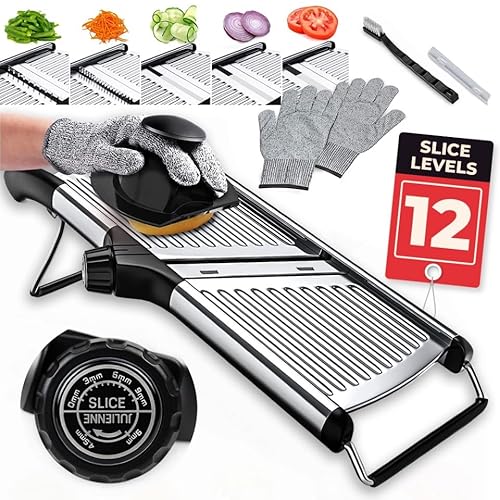
A 12-setting dial and a 1.9 lb stainless frame make this the mandoline slicer for home cooks who want one tool for every cut.
Best for: home cooks who want one tool for gratins, slaws and stir-fries. Skip it if: you need a chopper that dices for you.
The Gramercy is the only pick here that pairs a full 16.5 in board with a rotating blade cylinder, so you switch between slicing styles without hunting for a loose blade in a drawer. Gramercy says the frame is 4CR15 stainless steel and the dial covers 12 slice settings, which if accurate is the widest published range in this set. At 1.9 lb it is heavier than the Benriner Jumbo but a hair lighter than the two Mueller picks, and the 3.15 x 16.5 x 6.69 in footprint is the longest here, which is exactly what you want when you are pushing a whole cabbage down it. Gramercy also lists cut-resistant gloves, a removable blade guard and a cleaning brush in the box, and calls the frame top-rack dishwasher safe. The trade-off against the two Muellers is that the Gramercy does not dice or chop into a container; it slices, and it is the second-most expensive pick here, so you are paying premium for range rather than for a bundled catch bin.
Pros:
- 12 slice settings (manufacturer claim), the widest dial in the set
- Rotating blade cylinder, no loose blades to store
- 16.5 in board handles whole cabbage or fennel
- Gloves, guard and brush included per the listing
- Top-rack dishwasher safe by claim
Cons:
- No catch container, unlike the Muellers
- Second-most expensive of the seven
- Longest footprint here, awkward in a shallow drawer
2. Mueller Vegetable Chopper Mandoline Slicer — Best for beginners
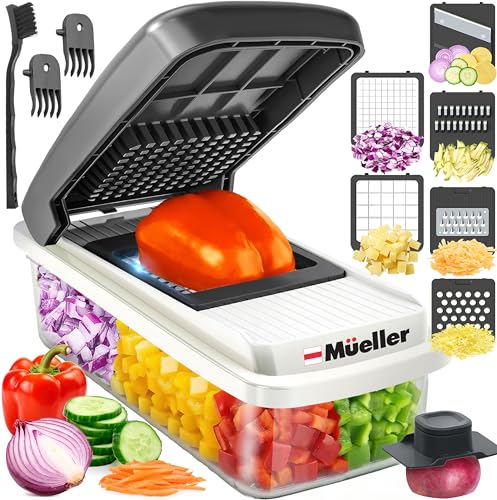
Six blades, a catch container and a 2.03 lb footprint give a first-time slicer everything in one box.
Best for: new cooks who want a catch container and a guard from day one. Skip it if: you already own a big cutting board and prefer open slicing.
The Mueller Vegetable Chopper is the pick I would put in a first apartment. Two chopper blades plus four interchangeable slicing, julienne and grating blades cover the cuts a home cook actually makes, and the container underneath catches the results so you are not chasing onion off a board. At 2.03 lb and 5.2 x 11.2 x 5.47 in, it takes about a third of the counter space the Gramercy needs, which matters in a galley kitchen. Mueller publishes a manufacturer warranty on the listing, which only three of the seven picks here do. Sales rank suggests this is the pick buyers reach for most often in the set, well ahead of everything except its own 10-in-1 sibling. The trade-off is the slicing bed: it is narrow, so half a cabbage will not fit, and the fixed-thickness blades give you fewer stops than the Gramercy's dial. If you want a slicer that dices onions into a bin, this is the one. If you want to plane 12 different thicknesses of potato, it is not.
Pros:
- Six blades cover slicing, julienne and grating
- Catch container included per the listing
- Compact 5.2 x 11.2 x 5.47 in footprint
- Manufacturer warranty stated on the listing
- Fastest-selling pick in the set
Cons:
- Narrow slicing bed, no cabbage or melon
- Fixed-thickness blades, no continuous dial
- Heavier than the Benriner and OXO
3. MUELLER HOME Pro-Series 10-in-1 — Best minimal setup
Eight blades in the same footprint as the six-blade model, for cooks who want one tool doing everything.

Best for: small kitchens that want chopping and slicing in one box. Skip it if: you slice large produce like cabbage or melon.
The Pro-Series 10-in-1 is the six-blade Mueller's bigger sibling: two chopper blades plus six interchangeable slicing, julienne, grating and shredding blades, in an identical 5.2 x 11.2 x 5.47 in body. Weight climbs to 2.46 lb, the heaviest pick here, which is the price of packing more steel in the same box. Mueller lists a manufacturer warranty, and the sales rank is the strongest in the set by a wide margin, so this is the shape buyers pick most often in this category. If you cook one-pot meals where everything ends up diced, this is the slicer that gets you there fastest, because the catch container turns prep into a single-handed job. The trade-off against the Gramercy is range on a single vegetable: eight blades are more variety, but the Gramercy's dial gives you finer control on any one cut. Against the Benriner, the Pro-Series will not handle a half-cabbage; the slicing port is too small.
Pros:
- Eight blades, the widest set at this size
- Chopper plus slicer in one tool
- Catch container included
- Manufacturer warranty on the listing
- The one buyers choose most often here
Cons:
- Heaviest pick in the set at 2.46 lb
- Narrow port, no wide produce
- Overkill if you only slice
4. SupMaKin Safe Mandoline Slicer — Best for pros
A stated 0.1 to 8 mm range and a 2-year warranty put this at the top for cooks who slice the same vegetables every day.

Best for: cooks who prep the same vegetables every day and want a 2-year warranty. Skip it if: you want a wide slicing bed for cabbage.
SupMaKin is the only pick here with a published 2-year manufacturer warranty, and the listing quotes a thickness range of 0.1 to 8 mm on a single dial. That is the finest low-end claim in the shortlist, which matters if you make carpaccio or gratin dauphinois and want translucent slices. At 1.5 lb it is the second-lightest full-frame slicer here, behind the Benriner, and the 13 x 5 x 6 in body folds for storage. SupMaKin describes the design as a hidden-blade housing, which is the same safety pattern the ONCE FOR ALL uses. The trade-off is the slicing port: SupMaKin lists it at 3 in wide, so you are prepping potatoes, carrots and cucumbers, not cabbage. Sales rank is the weakest in the set, so this is a less familiar name than the Muellers or the OXO. What you are paying for is the warranty and the fine-end thickness claim, and if you use a mandoline weekly the warranty alone may be the reason to choose it.
Pros:
- 0.1–8 mm thickness claim, finest low end here
- 2-year manufacturer warranty stated
- Folding frame for storage
- Hidden-blade housing by design
- Lightest of the folding full-frame picks
Cons:
- 3 in port, no cabbage or melon
- Slowest seller of the seven
- Manufacturer thickness range is a claim, not standardised
5. ONCE FOR ALL Upgrade Safe Mandoline Slicer Plus — Best premium
A collapsible 3.5 x 6.89 x 4.33 in body is the smallest storage footprint in the set.

Best for: counters with almost no room, where compact storage wins. Skip it if: you want the widest thickness range in the set.
The ONCE FOR ALL is the most expensive pick here, and what the extra buys is size. At 3.5 x 6.89 x 4.33 in it stores smaller than a bread box, and the listing describes a collapsible design that shrinks further when the day's prep is done. ONCE FOR ALL says the blade is 420 stainless steel with a hidden housing, so there is no guard-and-glove routine before you slice. The listing quotes four cutting modes: julienne, matchstick, slicing and dicing. That is fewer stops than the Gramercy's dial or the SupMaKin's range, and it is the main trade-off you are making for the storage win. Sales rank is second-weakest in the set, so this is a niche pick. Take it if your kitchen is genuinely too small for a 16.5 in Gramercy board or a full-frame Mueller, and skip it if you have counter room for something with a wider dial.
Pros:
- Smallest storage footprint of the full-frame picks
- Collapsible design per the listing
- Hidden-blade housing, no separate guard
- 420 stainless steel blade by claim
- Four cutting modes without blade swaps
Cons:
- Most expensive pick here
- Only four modes, no fine thickness dial
- No stated warranty on the listing
6. Benriner Jumbo Slicer — Runner-up
A 5 in wide slicing bed and 1.32 lb frame make this the pick for wide produce and stir-fry prep.

Best for: stir-fry cooks slicing wide produce like cabbage and melon. Skip it if: you want a built-in catch container.
The Benriner Jumbo is the lightest full-frame slicer in the set at 1.32 lb, and the only one whose listing describes a 5 in wide slicing surface. That is the reason to buy it: cabbage, melon, big radish, half a summer squash. The dial claim runs 0.5 to 10 mm, wider on the top end than any other pick here, which is what you want for chunky stir-fry cuts. Benriner names a Japanese stainless steel blade with a BPA-free plastic body and says the whole thing disassembles for cleaning and is top-rack dishwasher safe. The safety guard is included and the base is non-skid. Trade-offs: no catch container, no chopper function, and the wide bed means it is not the slicer to reach for when you only need a few coins of cucumber. Against the Gramercy, you gain slicing width and lose the rotating blade cylinder. Against the Muellers, you gain a wider bed and lose the container underneath.
Pros:
- 5 in wide slicing bed, widest here
- Lightest full-frame pick at 1.32 lb
- Dial claim 0.5–10 mm, widest top end
- Top-rack dishwasher safe by claim
- Safety guard and non-skid base included
Cons:
- No catch container
- Slicing only, no chopper or julienne
- Larger than needed for small vegetables
7. OXO Good Grips Handheld Mandoline Slicer — Best budget pick
Three thickness stops on a 5.64 oz handheld body that stores flat in a drawer.

Best for: renters and small kitchens that need a drawer-flat slicer. Skip it if: you want julienne or matchstick cuts.
The OXO is the cheapest of the seven and the only handheld here. At 5.64 oz and 11.5 x 3.75 x 0.5 in, it lies flat in a drawer next to a peeler, which is exactly what a renter's kitchen needs. OXO publishes three thickness settings, 1 mm, 2.5 mm and 4 mm, which is fewer stops than any full-frame pick in the set. What you gain is a hook-over-a-bowl design that skips the catch container altogether, and OXO's satisfaction-guaranteed return policy is the most generous warranty language on any listing here. The trade-off is scope: this is a slicer, not a julienne or a grater, and the handheld shape means the second hand is doing real work. Against the Muellers, you lose the container and the blade variety. Against the Gramercy, you lose nine thickness stops. What you keep is the smallest storage footprint in the shortlist and the lowest price, and for a cook who slices once a week that combination is enough.
Pros:
- Cheapest pick in the set
- 5.64 oz, lightest slicer here
- 0.5 in flat storage in a drawer
- Hooks over a bowl for direct slicing
- Satisfaction-guaranteed return policy
Cons:
- Only three thickness stops
- Slicing only, no julienne or shred
- Handheld shape needs two hands
What actually decides a mandoline purchase?
Most best mandoline slicer for home cooks guides compare blade counts. Blade counts do not decide it. Two things do: how wide the slicing bed is, and how the slicer stores. Everything else follows from those.
Bed width sets what you can slice. A 3 in port, which is what SupMaKin publishes, handles potatoes, carrots and cucumbers. A 5 in bed, which is what Benriner publishes, handles cabbage, melon and the big vegetables that turn a mandoline from a nice-to-have into a genuine time saver. If you never slice anything wider than a zucchini, a narrow port is fine and you save counter space. If you make coleslaw or gratin from a whole cabbage, a narrow port turns a five-minute job into a knife job with an extra step.
Storage sets whether you actually use it. A 16.5 in Gramercy board is a joy on the counter and a pain in a cupboard. A 0.5 in OXO handheld goes in the same drawer as the peeler. A collapsible ONCE FOR ALL shrinks between uses. The best mandoline slicer for home cooks is the one that still gets pulled out on a Wednesday, not the one that lives at the back of a shelf because it will not fit anywhere convenient.
Blade count matters, but it is a third-order decision. Pick the bed width first, the storage shape second, and then choose the blade set from what is left.
Thickness range: how fine is fine enough?
The dial numbers on these listings do not compare on equal terms. Some are manufacturer claims for continuous ranges; some are fixed stops. Take them as attributed:
- OXO: three stops, 1 mm, 2.5 mm, 4 mm
- SupMaKin: claims 0.1 to 8 mm on one dial
- Benriner: claims 0.5 to 10 mm on one dial
- Gramercy: claims 12 slice settings (no mm range published)
- Mueller six-blade, Mueller 10-in-1, ONCE FOR ALL: fixed blade sets rather than a dial
For most home cooks, 1 mm is thin enough. That is a translucent potato for a gratin, a fennel shave for a salad, a radish slice you can see through. Below 1 mm is chef territory and only the SupMaKin claim reaches it on paper. Above 4 mm you are into chip-cut territory, and only the SupMaKin and Benriner dials go there without swapping blades.
The best mandoline slicer for home cooks does not need the finest low end or the highest top end. It needs a reliable 1.5 mm to 3 mm middle for the cuts you make every week: onion for a stew, potato for a bake, cucumber for a salad. All seven picks cover that middle. The dial-versus-fixed-blade choice is really about how often you change your mind mid-prep.
Handheld, folding or full frame: which footprint fits your kitchen?
Three shapes in this shortlist, and each one suits a different kitchen. Measure your drawer before you buy.
- Handheld (OXO, 11.5 x 3.75 x 0.5 in): lives in a utensil drawer. You slice over a bowl or a plate. One thickness dial, no accessories to lose. Right for small kitchens and light users.
- Folding compact (ONCE FOR ALL, 3.5 x 6.89 x 4.33 in; SupMaKin, 13 x 5 x 6 in): collapses or folds for a shelf. You get a full frame's stability without a full frame's storage cost. Right for renters who cook often.
- Full frame (Gramercy 16.5 in; Benriner 12.2 in; Mueller pair at 11.2 in): lives on a counter or a low shelf. You get the widest beds and the most blade variety. Right for cooks with real cabinet space.
The trap is buying the shape that looks impressive rather than the shape that fits. A Gramercy on the counter of a kitchen that cannot house it becomes a slicer that gets used twice.
What the listings do not tell you about safety
Every listing here mentions safety in some form. What they do not tell you is that a mandoline injury is almost never the blade's fault. It is the fingertip finding the blade at the end of a vegetable that has become too small to hold safely.
The picks that address this directly are the ones that ship a guard. Gramercy names a removable blade guard and cut-resistant gloves; Benriner names a safety guard that holds smaller pieces; the Muellers include a food holder on the chopper unit. ONCE FOR ALL and SupMaKin take a different approach with hidden-blade housings, so your hand never crosses the blade line.
The OXO handheld does neither. You are holding the slicer with one hand and the vegetable with the other. That is the point of a handheld shape, and it is the reason to use the last inch of any vegetable for something other than mandoline slicing.
The trick most shoppers miss: buy a mandoline that includes a guard, and use the guard from the first slice, not the tenth. The habit forms on the easy cuts, and it is the habit that saves you on the hard ones.
Head-to-head: Gramercy vs. Benriner Jumbo
These two are the full-length slicers in the set, and if you have counter room the choice comes down to one question: dial or width?
The Gramercy publishes 12 slice settings on a rotating blade cylinder and weighs 1.9 lb across a 16.5 in board. That gives you the most thickness control in the shortlist on the longest bed. The trade-off is the bed itself: at 6.69 in wide it is narrower than the Benriner's 5 in slicing surface used on a 12.2 in body.
The Benriner is the wide-produce specialist. Its listing describes a straight-edge blade sized for cabbage and melon, a dial claim from 0.5 to 10 mm, and a 1.32 lb frame that is the lightest here. What you give up is the rotating cylinder: the Benriner is a slicer, not a julienne machine.
If you cook mostly root vegetables, alliums and cucumbers, the Gramercy is the better default. If cabbage, melon or wide squash are weekly cuts, the Benriner earns the counter space. Both cost more than the Muellers, and neither ships a catch container, so factor a bowl into your setup.
The verdict
Take the Gramercy Mandoline Slicer. On published specifications it has the widest dial claim in the set at 12 slice settings, a full 16.5 in board, a rotating blade cylinder that removes the loose-blade drawer problem, and a stated top-rack dishwasher safe stainless frame. It is the second-most expensive pick here and the largest, and both trade-offs earn their keep for a cook who reaches for a mandoline every week.
Two conditions flip the recommendation. If your kitchen is small and you want one tool that also chops into a container, take the Mueller Pro-Series 10-in-1: it packs eight blades and a chopper into a 5.2 x 11.2 x 5.47 in body, sells faster than anything else in the set, and publishes a manufacturer warranty. If cabbage, melon or half a squash are weekly cuts, take the Benriner Jumbo: its 5 in wide bed is the only one in the shortlist that handles wide produce, and the 1.32 lb frame is the lightest full-length slicer here.
The cutoff between the Gramercy and the Muellers is whether you need a catch container. If yes, Mueller. If no, Gramercy.
FAQ
Is a mandoline slicer worth it for a home cook?
Is a mandoline slicer worth it depends on how often you slice thin. If you make gratin, slaw, cucumber salad or stir-fry more than once a fortnight, a mandoline saves ten minutes each time and gives you a more even cut than a knife. If you slice thin twice a year, a sharp chef's knife is enough. The OXO at 5.64 oz is the low-commitment way to test the habit.
What is the safest mandoline slicer here?
The safest mandoline slicer in this set is the one you use with a guard from the first cut. Gramercy ships cut-resistant gloves and a removable blade guard; Benriner ships a safety guard; the Muellers include food holders on the chopper. ONCE FOR ALL and SupMaKin use hidden-blade housings so your hand never crosses the blade. The OXO handheld has none of these; treat the last inch of any vegetable with caution.
Gramercy vs. Mueller Pro-Series: which is right for me?
Gramercy vs. Mueller Pro-Series comes down to whether you want variety or control. The Mueller Pro-Series bundles eight blades and a catch container in a 5.2 x 11.2 x 5.47 in body, so onions land in a bin instead of on your board. The Gramercy trades the container for a 12-setting dial on a 16.5 in bed, which is what you want for fine thickness control on a single vegetable.
How thin does a mandoline slicer need to go for home cooks?
How thin a mandoline slicer needs to go for most home cooks is around 1 mm. That is the thickness for a translucent potato in a gratin or a fennel shave for salad. OXO's 1 mm stop, SupMaKin's 0.1 mm claim, Benriner's 0.5 mm claim and Gramercy's finest setting all clear that bar. Below 1 mm is chef territory and only worth paying for if you make carpaccio or crisps.
Can any of these mandoline slicers go in the dishwasher?
Can any of these mandoline slicers go in the dishwasher? Yes, several listings say so. Gramercy names top-rack dishwasher safe on the frame; Benriner says top-rack dishwasher safe once disassembled; SupMaKin says the slicer can go directly into the dishwasher. OXO, ONCE FOR ALL and the Muellers do not name dishwasher status on their listings, so hand-wash those and dry the blades immediately to keep the edge.
Pick the shape first, the dial second, the blade set third. If you are still on the fence, the Gramercy is the safest default: the widest published thickness range in the shortlist, a full-length board that handles most vegetables a home cook meets, a rotating blade cylinder that keeps the drawer tidy, and a stainless frame the listing calls dishwasher safe on the top rack. It is not the cheapest pick and it is not the smallest, and it is not trying to be. What it does is turn a weekly prep task into a two-minute job with a cut you can put on a plate. For most kitchens with room for one dedicated slicing tool, that is the whole argument.