Best Wheat Grinder for Big Families: Batch Size First

Five grain mills lined up by the one number that matters when you bake for a crowd: how much wheat goes through per run, and how long you wait between runs.

By Zaria JarvisUpdated 15 min read
On this page
- Best wheat grinder for big families at a glance
- Why three of these were nearly cut
- What actually decides a wheat grinder for big families?
- 1. VEVOR Electric Grain Mill Grinder — Best overall
- 2. universal Corona Manual Grain Mill — Best for heavy use
- 3. VEVOR 1000g Electric Grain Mill Grinder — Best for beginners
- 4. MOUNTAIN ESSENTIALS Manual Hand Grain Mill White — Best premium
- 5. MELVTATA Electric Grain Mill Grinder — Best budget pick
- Batch size, run time and the waiting game
- Electric or hand crank for a big family kitchen?
- What the listings leave out
- The verdict
- FAQ
The best wheat grinder for big families is the VEVOR Electric Grain Mill Grinder, because its 3000W motor is built for continuous running rather than short bursts, and at 27.6 x 19.9 x 9.84 in it has the body size to match. If nobody in your house wants a machine that plugs in, the Corona Manual Grain Mill is the better buy at 9.42 lb of cast iron. Batch capacity is what splits this field. One of these mills tops out at 150g per run; another handles wet and dry grinding without a stated ceiling at all.
Best wheat grinder for big families at a glance
| Pick | Batch capacity | Power source | Price |
|---|---|---|---|
Best overall VEVOR Electric Grain Mill Grinder |
Continuous feed claim | Electric, 3000W claim | Check Price |
Best for heavy use universal Corona Manual Grain Mill |
Hopper-fed, refillable | Hand crank | Check Price |
Best for beginners VEVOR 1000g Electric Grain Mill Grinder |
1000g per run | Electric, 3000W claim | Check Price |
Best premium MOUNTAIN ESSENTIALS Manual Hand Grain Mill White |
Extra-large hopper claim | Hand crank | Check Price |
Best budget pick MELVTATA Electric Grain Mill Grinder |
150g per run | Electric, 1500W claim | Check Price |


Why three of these were nearly cut
I started by looking for reasons to remove picks, not reasons to keep them. Three came close to being cut.
The MELVTATA nearly went for capacity. A 150g chamber is a spice grinder's chamber. That's a fraction of what one loaf of bread flour weighs, so calling it a family mill on its own would be wrong.
The MOUNTAIN ESSENTIALS nearly went for weight. It's 28.6 lb, the heaviest here by a wide margin, and its listed size of "170 * 130 cm" doesn't match its stated dimensions of 15.6 x 17.5 x 12.2 in. When a listing contradicts itself, that matters.
The VEVOR 1000g nearly went for its duty cycle. The listing states 5 minutes of operation followed by 10 minutes of interval time. That ratio is the single most important number in this whole roundup and almost nobody talks about it.
All three survived because each one wins a specific job:
- The MELVTATA is the cheapest of the five and does spices well.
- The MOUNTAIN ESSENTIALS needs no power at all.
- The VEVOR 1000g is the simplest electric mill here to learn.
What got cut permanently: anything without published dimensions, and anything whose listing gave no adjustment mechanism for grind texture.
What actually decides a wheat grinder for big families?
Most guides compare motor wattage. Two of these mills claim 3000W, so on that measure they look identical. They aren't close.
The number that decides it is throughput over an hour, and that's a function of three things:
- Chamber or hopper capacity. How much wheat goes in before you stop.
- Duty cycle. How long the mill runs before it needs to rest.
- Reload time. How long emptying and refilling takes.
Watts only tell you how fast the burrs or blades turn while the machine is running. The VEVOR 1000g claims 28000 r/min, which is genuinely quick, but with a 5-minute run and a 10-minute rest you get 20 minutes of grinding per hour at best. That's the ceiling, not the motor.
The VEVOR GM-002 is different in kind. Its listing describes continuous grinding through a stainless steel funnel with a cast iron milling disc, which is a burr-mill design rather than a blade chamber. Grain goes in the top, flour comes out. There's no chamber to empty.
Hand mills sidestep duty cycles entirely. A cast iron Corona will grind for as long as your arm holds out, which for most people is the real limit. That's a different constraint, not an absent one.
1. VEVOR Electric Grain Mill Grinder — Best overall
The only mill here designed to be fed continuously rather than loaded, run and emptied, which is exactly what milling for a crowd demands.
Best for: households milling several pounds of flour in one session Skip it if: you have under 28 inches of clear counter or bench space
This is the largest machine of the five at 27.6 x 19.9 x 9.84 in, and the shape tells you what it's for. VEVOR describes a stainless steel funnel above a solid iron body, with a cast iron milling disc for dry grain and a separate sand milling disc for wet grinding. That second disc is unique in this set. If you also want soy milk, tofu or rice batter out of the same appliance, no other pick here does it.
The adjustment button controls flour fineness, which VEVOR lists as covering wheat, corn, coffee, cereal and nuts. The 3000W figure is the manufacturer's, as is the "continuously grind" claim, so treat both as listing copy rather than a measured result. What I can verify from the data is the physical scale and the two-disc setup, and those are the things that make it plausible for volume work.
It's the one buyers choose most often across these five. It's also priced above three of them and only one seller lists it, so there's no shopping around within this set.
Pros:
- Only pick here that grinds wet and dry
- Continuous feed instead of a fixed chamber
- Stainless steel funnel over a solid iron body
- Adjustable grind thickness for flour or cracked grain
- The one buyers choose most often of these five
Cons:
- Biggest footprint here at 27.6 x 19.9 x 9.84 in
- No published weight, so mounting and moving are unknowns
- No stated warranty on the listing
- Only one seller stocks it
2. universal Corona Manual Grain Mill — Best for heavy use
Cast iron, no motor to burn out, and the shortest list of things that can fail of any mill here.

Best for: bakers who want a mill that outlasts the kitchen it sits in Skip it if: nobody in the house wants to crank for twenty minutes
The Corona is the second-cheapest of the five and the one I'd bet on still working in twenty years. It's 9.42 lb of cast iron with food-safe tin plating, handcrafted in Colombia according to the listing, and the "High Hopper" version here gives you more grain per fill than the standard tray.
The kit is complete out of the box: body, hopper, grinding plates, clamp, handle, mounting hardware and a stabilizing pad. The clamp fits countertops up to 1.45 inches thick, which is worth measuring before you buy, because a thick butcher block will defeat it. Grind adjusts from coarse to fine, so tortillas, arepas and bread flour all come off the same plates.
The trade-off is honest and total. There's no duty cycle because there's no motor, but there's no motor. Milling flour for a family of six by hand is a shared job or a slow morning. Compared to the VEVOR GM-002 it does one thing, dry grinding, and it does it at the speed of your shoulder.
Pros:
- Solid cast iron with food-safe tin plating
- Lightest mill here at 9.42 lb
- Complete kit including clamp and stabilizing pad
- Coarse-to-fine adjustment on the same plates
- No motor, no duty cycle, nothing electrical to fail
Cons:
- Every batch costs you arm work
- Clamp limited to counters up to 1.45 inches thick
- Dry grain only, no wet grinding
- Slowest throughput of the five for a large bake
3. VEVOR 1000g Electric Grain Mill Grinder — Best for beginners
A 1000g chamber and a body that swings 270° to pour, which removes the messiest part of using a mill like this.

Best for: first-time millers who want fine flour without a learning curve Skip it if: you need more than 1000g of flour without stopping
This is the easiest mill here to get right on your first try. VEVOR publishes the full operating spec, which most listings in this category don't: 3000W, 28000 r/min, 1000g capacity, 5 minutes operation, 10 minutes interval, superfine grind. You know exactly what you're getting before it arrives.
The swing design is the real feature. At 13.7 lb, lifting the whole unit to tip flour out gets old fast, so being able to rotate the body 270° and pour is a genuine improvement over an upright chamber. Food-grade stainless steel throughout, and the lid must be fully buckled before it will start.
Where it loses to the GM-002 is arithmetic. A 1000g chamber and a 15-minute cycle means roughly two chambers of flour in half an hour, and grain must be fully dry going in. That's fine for a weekly bake and thin for a baking day. It sells the slowest of these five, and at 14.6 x 8.86 x 7.48 in it's the middle option on size as well as price.
Pros:
- Fullest published operating spec of any pick here
- 1000g per run in food-grade stainless steel
- Body swings 270° to pour instead of lifting 13.7 lb
- Superfine grind stated for grains, spices and coffee
- Two sellers list it, unlike three picks here
Cons:
- 5 minutes on, 10 minutes off caps hourly output
- Dry grain only, and it must be properly dry
- Slowest seller of the five
- No stated warranty
4. MOUNTAIN ESSENTIALS Manual Hand Grain Mill White — Best premium
The heaviest, most substantial hand mill here, with a hopper sized for long grinding sessions and a crank extension for leverage.

Best for: an off-grid or backup mill with a large hopper Skip it if: you need to move it, or you want any of your money back in speed
At 28.6 lb this is three times the weight of the Corona, and that mass is the point. A heavy hand mill doesn't shift while you crank. The listing specifies stainless steel grinding discs, a hygienic powder coating, a crank extension for more leverage per turn, and a wooden handle mounted on top of the hopper for steadying the machine.
The extra-large hopper matters more on a manual mill than an electric one. Every stop to refill breaks your rhythm, so a bigger hopper means fewer interruptions per pound of flour. Grind adjusts finely enough for coffee and spices, and the discs dismantle for cleaning.
Two things hold it back. It's the most expensive pick here and it's still powered by your arm, so you're paying premium money for mass and disc material rather than speed. And the size field reads "170 * 130 cm" while the dimensions read 15.6 x 17.5 x 12.2 in, which can't both describe the same object. Measure your space against the inches, not the first figure.
Pros:
- Stainless steel grinding discs with hygienic coating
- 28.6 lb of mass keeps it planted while cranking
- Crank extension gives more leverage per turn
- Extra-large hopper means fewer refill stops
- Discs dismantle for cleaning
Cons:
- Most expensive pick here with no speed gain
- Heaviest at 28.6 lb, awkward to store or relocate
- Listing size field contradicts the stated dimensions
- Only one seller lists it, and it's the slowest seller of the five
5. MELVTATA Electric Grain Mill Grinder — Best budget pick
The cheapest of the five and the smallest, which makes it a useful second mill rather than a primary one.
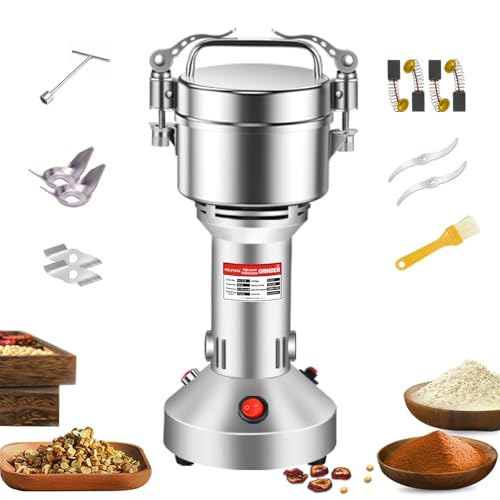
Best for: a second mill for spices and small top-up batches Skip it if: you're milling flour for more than a loaf at a time
I'd buy this one alongside a bigger mill, not instead of it. The 150g chamber and 1500W motor make it the smallest and least powerful pick here on both counts, and at 13.1 x 6.1 x 6.1 in it takes the narrowest slice of counter. That footprint is genuinely useful in a crowded kitchen.
The stand-type body is food-grade stainless steel with an overload protection device that stops the motor automatically, which is the only safety cutout named in any of these five listings. Rotating speed is listed at 28000 r/min, same as the larger VEVOR, and interval time is 5 to 10 minutes. Cleaning is brush or cloth only. MELVTATA is clear that rinsing under water risks the motor, so this is not a mill you rinse out between spices and wheat.
Set against the others, the honest read is capacity. Filling a 150g chamber repeatedly to make bread flour for a household is a chore, and the wattage and lack of a published weight put it behind the rest for volume work.
Pros:
- Cheapest of these five picks
- Smallest footprint at 13.1 x 6.1 x 6.1 in
- Overload protection stops the motor automatically
- 28000 r/min matches the larger VEVOR chamber mill
- Two sellers list it
Cons:
- 150g chamber is far too small for family-sized bakes
- 1500W is the lowest claimed power here
- No published weight for the unit
- Cannot be rinsed, only brushed clean
- No stated warranty
Batch size, run time and the waiting game
Here's the trick with chamber mills that catches people out. The capacity figure isn't a per-hour figure.
The VEVOR 1000g states it plainly: 5 minutes of operation, then 10 minutes of interval time. So one full chamber, then a wait. The MELVTATA lists a 5 to 10 minute interval on a 150g chamber, which is a worse ratio again. Small chamber, same wait.
That's why the two figures you should write down before buying are chamber size and interval time, in that order. Together they tell you your realistic output for a Saturday morning. A continuous-feed burr mill like the VEVOR GM-002 has no chamber to empty, which is the structural reason it leads this list.
Some practical thresholds:
- Under 500g per run: treat it as a spice and top-up grinder.
- 500g to 1000g per run with a rest cycle: one or two loaves per session comfortably.
- Continuous feed or hopper-fed manual: session length is limited by you, not the machine.
Grain moisture is the other trap. Both VEVOR chamber mills and the MELVTATA specify dry material only. Wheat stored in a damp basement will gum a blade chamber and can stall a motor. The GM-002 is the exception, with a separate sand milling disc listed specifically for wet work.
Electric or hand crank for a big family kitchen?
This is the fork in the road, and it's not really about speed.
Go electric if you bake on a schedule and someone needs flour ready in ten minutes. The two VEVOR units and the MELVTATA all claim 28000 r/min or a 3000W motor, and all three grind faster than any arm.
Go manual if you want the mill to work in a power cut, or if you object to motors on principle. The Corona at 9.42 lb and the MOUNTAIN ESSENTIALS at 28.6 lb both grind on muscle, with stainless steel or tin-plated cast iron plates and nothing to burn out.
There's a middle answer that a lot of big-family kitchens land on. Buy the continuous-feed electric mill for weekly flour, and keep the Corona clamped to a shelf as the backup that never needs a socket. Between the two you've spent less than the MOUNTAIN ESSENTIALS costs alone, and you've covered both failure modes.
One thing manual mills do better regardless of budget: heat. Slower grinding means less friction heat in the flour, and heat is what dulls fresh-milled flavour. Neither VEVOR listing addresses flour temperature, so I won't claim a figure. But the physics of a hand crank at crank speed versus a chamber at 28000 r/min points one way.
What the listings leave out
Four gaps run across all five of these listings, and knowing them saves an unhappy delivery.
- Warranty. Not one of these five publishes a warranty term. Budget for that.
- Noise. No decibel figure appears anywhere. A 3000W motor at 28000 r/min in an open kitchen will not be quiet, but I can't tell you how loud.
- Weight, sometimes. The VEVOR GM-002 and the MELVTATA publish no unit weight. For the GM-002 in particular, at 27.6 in long, that's a real gap if you plan to move it or mount it.
- Included accessories beyond the basics. Only the Corona spells out its full kit contents, down to the mounting hardware and stabilizing pad.
Two mismatches worth flagging. The MOUNTAIN ESSENTIALS size reads "170 * 130 cm" against dimensions of 15.6 x 17.5 x 12.2 in, and its own feature text quotes 13kg where the specification says 28.6 lb. Trust the specification line and plan your shelf accordingly.
Finally, "big families" isn't a specification any manufacturer publishes, so no listing here promises to serve one. What the data lets me do is compare batch sizes, rest cycles and feed designs, then tell you which combination scales. You'll have to judge the household side yourself.
The verdict
Split by price position, the picture is clean.
At the entry end, the MELVTATA and the Corona split the job between them. The MELVTATA gives you an electric mill with a 150g chamber and a real overload cutout, which is fine for spices and a single loaf's worth of flour. The Corona gives you 9.42 lb of cast iron that grinds anything dry, forever, for a little more money and a lot more effort. If I could only spend at this level, the Corona wins on durability alone.
In the middle sits the VEVOR 1000g. That's where the money starts buying published numbers: 1000g per run, 28000 r/min, a stated 5-minute run and 10-minute rest, and a body that swings 270° to pour. It's the easiest of the five to use correctly on day one.
At the premium end, the two picks aim at different buyers. The VEVOR GM-002 is my winner because continuous feed plus wet and dry discs plus a 27.6 in body is the only combination here built for volume. The MOUNTAIN ESSENTIALS is the pick if the mill must work without electricity and you want 28.6 lb of stainless-disc mass doing it. Choose the GM-002 unless power independence is non-negotiable.
FAQ
Is a wheat grinder for big families worth the counter space?
A wheat grinder for big families is worth the space only if you mill weekly or more. The VEVOR GM-002 needs 27.6 x 19.9 x 9.84 in of clear surface, which is a permanent commitment in most kitchens. Mill once a month and the Corona at 16.1 x 11.4 x 6.7 in stores in a cupboard between uses, which is the smarter trade.
What size batch does a big family actually need per run?
The batch size a big family needs depends on how many loaves you bake at once. A 150g chamber like the MELVTATA's covers spices and small top-ups. The VEVOR 1000g handles roughly one or two loaves per session once you factor in its 10-minute rest interval. Beyond that, a continuous-feed design removes the chamber limit entirely.
VEVOR GM-002 or VEVOR 1000g: which one for a busy kitchen?
Between the GM-002 and the 1000g, the GM-002 wins for a busy kitchen because it feeds continuously and grinds wet as well as dry. The 1000g wins on published detail and pouring convenience, with its 270° swing body at 13.7 lb. Choose the 1000g if 27.6 in of counter is impossible in your kitchen.
Can these mills grind anything besides wheat?
These mills grind more than wheat, according to their listings. Corn, barley, oats, rye, peas, soybeans, coffee beans and spices appear across all five. The VEVOR GM-002 adds wet grinding for tofu, starch and rice flour using a separate sand milling disc. The MELVTATA and both chamber mills specify dry material only, so keep wet work to the GM-002.
What mistake do first-time buyers of a wheat grinder for big families make?
The commonest mistake buyers of a wheat grinder for big families make is reading wattage as throughput. Two picks here claim 3000W and perform very differently, because one has a 1000g chamber and a 10-minute rest cycle while the other feeds continuously. Compare chamber size and interval time first. Wattage tells you nothing about how much flour you get per hour.
Start by measuring the clear run of counter or bench you can permanently give up, then pick from what fits. The VEVOR GM-002 is the default for a household that mills flour weekly, because its continuous-feed burr design has no chamber to empty and no rest cycle to wait through, and the second disc means the same machine handles wet grinding nothing else here touches. If that footprint is out of the question, clamp a Corona to a sturdy shelf and treat milling as a job two people share. Either way, check the grain is properly dry before the first run.