Best Wheat Grinder for Daily Use by Motor and Burr

Seven wheat grinders lined up by motor wattage, burr material and hopper size, with a named winner, five clear runner-up cases and honest weaknesses on every pick.

By Zaria JarvisUpdated 18 min read
On this page
- Best wheat grinder for daily use at a glance
- How I screened the field down to seven
- Motor wattage or burr material: which actually decides it?
- 1. VEVOR Electric Grain Mill Grinder GM-002 — Best overall
- 2. MOUNTAIN ESSENTIALS Manual Hand Grain Mill — Best premium
- 3. VEVOR HC-800Y Spice and Grain Mill — Most versatile
- 4. Ezato Grain Mill Attachment for KitchenAid — Best upgrade
- 5. Phaniteces Electric Grain Mill Grinder — Best budget pick
- 6. Corona Manual Grain Mill L10800 — Best minimal setup
- 7. Kitchen Crop Hand Crank Grain Mill VKP1248 — Best for pros
- Electric or hand crank for everyday flour?
- How much flour does daily use really mean?
- What the listings do not tell you
- Which pick wins for a specific kitchen?
- The verdict
- FAQ
The best wheat grinder for daily use is the VEVOR Electric Grain Mill Grinder GM-002, a 3000W dual-disc mill that switches between dry flour and wet batters on the same body. If you want a fully manual, stainless-burr alternative for an off-grid kitchen, the MOUNTAIN ESSENTIALS Manual Hand Grain Mill is the runner-up. Not every mill here is built for grinding every day, so the pick depends on how many cups of flour a week you actually need.
Most guides on this category argue about motor wattage. That is the wrong first question. Wattage tells you how fast a mill can grind, not how much flour it can deliver before it needs a rest, and not whether the burrs will survive a year of soft red wheat. The specifications that decide a daily-use pick are burr material, hopper capacity, and whether the drive is electric or hand crank. Everything else follows from those three.
Best wheat grinder for daily use at a glance
| Pick | Drive | Burr / capacity | Price |
|---|---|---|---|
Best overall VEVOR Electric Grain Mill Grinder GM-002 |
Electric, 3000W claim | Cast iron dry disc, sand wet disc | Check Price |
Best premium MOUNTAIN ESSENTIALS Manual Hand Grain Mill |
Hand crank | Stainless steel discs, extra-large hopper claim | Check Price |
Most versatile VEVOR HC-800Y Spice and Grain Mill |
Electric, 2100W claim | Swing blade, 800 g chamber | Check Price |
Best upgrade Ezato Grain Mill Attachment for KitchenAid |
KitchenAid-driven | 9-level burr, hopper not stated | Check Price |
Best budget pick Phaniteces Electric Grain Mill Grinder |
Electric, 300W claim | 8-head blade, 500 g chamber | Check Price |
Best minimal setup Corona Manual Grain Mill L10800 |
Hand crank | Cast iron plates, 0.8 qt hopper claim | Check Price |
Best for pros Kitchen Crop Hand Crank Grain Mill VKP1248 |
Hand crank, optional motor | Stainless steel burrs, 2 cup hopper | Check Price |


How I screened the field down to seven
I started with the full grain mill category and pulled every listing that published a burr or blade type, a hopper size and drive information. That is not most of them. A lot of Amazon listings for wheat grinders skip one of the three, which makes it impossible to say whether the mill will actually cope with a cup of hard red wheat every morning.
From what remained, I lined up seven that between them cover the four buying cases a daily-use shopper actually faces: an electric mill that handles dry and wet, a manual burr mill for people who do not want a motor, a stand-mixer attachment for KitchenAid owners, and a budget electric for anyone testing the habit before spending real money. Two extras made the cut: a swing-blade mill for spice grinders who also want wheat, and a compact hand crank for masa.
The specifications did the ranking. I ignored anything the listings did not actually publish, because a spec I have to guess at is a spec that will bite the reader.
Motor wattage or burr material: which actually decides it?
Wattage looks decisive on paper. The VEVOR GM-002 claims 3000W, the swing-type VEVOR HC-800Y claims 2100W, and the Phaniteces claims 300W. Order the shortlist by wattage alone and you would put the smallest budget mill at the bottom and call it a day.
That is a mistake for wheat.
- Burr material sets the ceiling on daily-use life. Cast iron is fine but wears; stainless steel resists rust from any residual moisture in the grain.
- Blade grinders heat the flour. A swing-type mill running at 28,000 RPM, as VEVOR states for the HC-800Y, turns wheat to powder in 30 seconds but the flour comes out warm, which affects the gluten in bread dough.
- Hopper size sets how many bakes fit in a single session. The Kitchen Crop VKP1248 publishes a two-cup hopper. Two cups of wheat berries yields roughly the flour for one small loaf, and you refill after that.
The right order for a daily wheat grinder is burr material first, then capacity, then drive, then wattage. That is the order this ranking follows.
1. VEVOR Electric Grain Mill Grinder GM-002 — Best overall
A 3000W dual-disc mill that handles both dry wheat flour and wet grinding for tofu or rice batter without a second machine.
Best for: a serious home baker who wants both dry flour and wet batters from one machine Skip it if: counter space is under 30 inches wide
VEVOR calls this a commercial mill and the footprint backs it up: 27.6 x 19.9 x 9.84 in on the counter, which is closer to the size of a small mixer than a countertop appliance. The reason it wins the overall pick is the two-disc system. VEVOR says the cast iron disc handles dry grinding and a separate sand milling disc handles wet, which means the same body grinds wheat for bread flour in the morning and soaked rice for dosa batter in the afternoon. Nothing else in this set does both.
The 3000W motor claim is the second reason. Wheat is hard, and the difference between a mill that grinds a pound of berries in one pass and one that needs three passes shows up quickly if you bake daily. The adjustable thickness dial covers coarse cereal down to fine flour according to the listing.
The trade-off is size and price position. It is the most expensive pick here, and the body is heavy enough that this becomes a permanent counter installation, not something you lift into a cupboard.
Pros:
- Dual dry and wet discs, unique in this set
- 3000W motor claim, highest of the seven
- Stainless steel funnel
- Adjustable coarseness dial
- Solid iron body for prolonged use
Cons:
- The largest footprint here at 27.6 x 19.9 in
- The most expensive pick in the set
- No published warranty
2. MOUNTAIN ESSENTIALS Manual Hand Grain Mill — Best premium
A 28.6 lb stainless steel hand mill built like a piece of workshop equipment for people who want no motor to fail.

Best for: an off-grid kitchen that wants a heavy stainless burr mill with no motor to fail Skip it if: you plan to grind more than a cup or two at a stretch by hand
At 28.6 lb this is by some margin the heaviest mill in the set, which is the point. MOUNTAIN ESSENTIALS says the grinding discs are stainless steel and the coating is food-safe, and the listing describes a large hopper with a wooden crank handle mounted on top. That is a specific mill shape: the crank swings horizontally and the mill sits on a table under its own weight rather than clamping.
The dimensions are 15.6 x 17.5 x 12.2 in, so it takes real counter room, but nothing like the VEVOR GM-002's footprint. The listing claims the grind adjustment goes fine enough for coffee and coarse enough for green kernel meal, which is the widest claimed range of any hand mill here.
The honest trade-off is effort. A hand mill grinding wheat for daily bread is a workout, and this one, despite being the most expensive premium pick, does not solve that. It is the right buy only if the appeal of a motorless mill outweighs the arm work. Also, no warranty is published for a mill this expensive, which is the main knock against it against the Kitchen Crop below.
Pros:
- Stainless steel burrs
- Very heavy 28.6 lb body for stability
- Wide grind range claim, coffee to coarse meal
- Wooden crank handle included
- Extra-large hopper claim
Cons:
- Heaviest mill here at 28.6 lb, awkward to move
- No published warranty for a premium price
- Manual grinding is slow for daily loaves
3. VEVOR HC-800Y Spice and Grain Mill — Most versatile
A swing-type electric mill that grinds 800 g of wheat, spices or coffee in 30-second bursts.

Best for: someone grinding wheat one day and coffee or spices the next Skip it if: you need more than 800 g in a single pass
This is the compromise pick and the mill I would suggest to anyone who wants one appliance for wheat, coffee beans, peppercorns and cinnamon. The chamber holds 800 g, VEVOR states a 28,000 RPM motor, and the timer offers 5-second, 15-second and 30-second settings with a stated 5-minute maximum run followed by a 5 to 10 minute rest.
That duty cycle is the specification that matters for daily use. A grinder that runs 5 minutes and then rests can produce roughly two full chambers of flour in a half hour, which is plenty for a household loaf a day. The 9.26 lb body is heavy enough to sit stable on the counter without clamping, and the 14.8 x 8.66 x 7.48 in footprint is by far the friendliest of the electric picks.
The trade-off against the GM-002 is real. Swing blades heat what they grind, and wheat flour that comes out warm affects yeast dough. This is not the mill for a serious sourdough baker. It is the mill for a kitchen where the same machine has to earn its counter space across many jobs.
Pros:
- 800 g single-batch capacity
- 28,000 RPM motor claim
- 5, 15 and 30 second timer settings
- Compact 14.8 x 8.66 in footprint
- Grinds wheat, spices, coffee and cereals
Cons:
- Swing blade heats flour
- 5-minute run then 5 to 10 minute rest
- No stated warranty
4. Ezato Grain Mill Attachment for KitchenAid — Best upgrade
A stainless steel attachment that turns any KitchenAid stand mixer into a nine-setting flour mill.

Best for: a household that already owns a KitchenAid stand mixer Skip it if: you do not own a KitchenAid
If you already own a KitchenAid, the entry-level price on this attachment makes it the cheapest way into fresh-milled flour. Ezato says it fits all KA models and installs without tools by attaching to the mixer's power hub. The grind dial has nine settings, from coarse to what the listing calls ultra-fine, and the body is stainless steel at 4.5 lb.
It is the only pick here with a published warranty on the standard spec sheet: 2 years, manufacturer-backed. That matters for a component that sees daily use, because a burr that goes out of true is not something you want to argue with a seller about.
The obvious weakness is the compatibility limit. If you do not own a KitchenAid, this mill is useless to you, and there is no equivalent attachment listed here for other stand mixer brands. A subtler point: the listing does not publish a hopper capacity, so you learn how many berries fit in a session by filling it. Ezato's four feature bullets cover build, adjustment, grain range and cleaning, and none give a cup or gram figure. Plan on smaller batches than a dedicated countertop mill.
Pros:
- 9 grind settings from coarse to ultra-fine
- 2-year manufacturer warranty
- Stainless steel construction
- Fits all KitchenAid stand mixer models
- Light at 4.5 lb, stores in a drawer
Cons:
- Requires a KitchenAid mixer
- No published hopper capacity
- Ties up the mixer during grinding
5. Phaniteces Electric Grain Mill Grinder — Best budget pick
A 300W countertop electric with an eight-head blade and a 500 g chamber, aimed at first-time buyers.

Best for: a first-time grinder buyer testing whether fresh flour is worth the habit Skip it if: you want published dimensions you can trust
The Phaniteces is the cheapest of the seven and it looks like a shrunk version of the VEVOR HC-800Y: same swing-blade concept, smaller chamber, smaller motor. Phaniteces publishes a 500 g capacity and a 300W motor claim, with what the listing calls an 8-head 3D grinding blade instead of the more common four-head design. Body is 304 stainless steel per the title.
For daily use, the case for the Phaniteces is narrow but real. If you have never ground your own flour and are not sure whether the extra step fits your morning, spending entry-level money on a small electric to find out is smarter than a heavy commercial mill you might resent. Grind a cup at a time, in 30-second bursts, and see whether the bread is worth it.
The listed dimensions are 0.1 x 0.1 x 0.1 in, which is obviously a listing error and the reason this is not ranked higher. When a seller has not corrected a specification that fundamental, other numbers on the page carry less weight, and there is no published warranty to fall back on. Treat this as the shortest-commitment pick in the set.
Pros:
- Cheapest pick in this set
- 500 g chamber
- 304 stainless steel construction claim
- 8-head blade design
- Timer control on the lid
Cons:
- Dimensions on the listing are unusable
- No published warranty
- Smallest chamber of the electric picks
6. Corona Manual Grain Mill L10800 — Best minimal setup
A cast iron clamp-on hand mill from Colombia built for masa, tortillas and cracked wheat.

Best for: a small kitchen that wants a clamp-on cast iron mill for masa and cracked wheat Skip it if: you want a fine bread flour in one pass
The Corona is a specific tool. Universal says it is crafted in Colombia from cast iron with food-safe tin plating, and the clamp base fits counters up to 1.45 inches thick. At 1.32 lb it is the lightest mill here by a large margin, which tells you two things: it clamps rather than sits under its own weight, and you can pack it for a camp kitchen without thinking about it.
For daily use, the Corona shines at coarse and medium grinds. The listing describes textures from masa and tortillas to cracked grains, and a 0.8-qt hopper claim, which is plenty for a batch of arepas. Fine bread flour is the honest weakness. Cast iron burrs at hand-crank speed give you flour after two or three passes, and each pass is arm work.
Against the Kitchen Crop VKP1248 below, the Corona is cheaper and simpler but has cast iron rather than stainless burrs, no published warranty, and no option to add a motor later. Buy it if masa, coarse grinds and a clamp-on footprint are what you want. If bread flour is the daily job, the Kitchen Crop is the better hand mill.
Pros:
- Lightest mill here at 1.32 lb
- Clamps to counters up to 1.45 inches
- 0.8-qt hopper claim
- Complete kit with clamp, handle and stabilizing pad
- Cast iron with food-safe tin plating
Cons:
- Multiple passes needed for fine flour
- Cast iron burrs, not stainless
- No published warranty
7. Kitchen Crop Hand Crank Grain Mill VKP1248 — Best for pros
A stainless-burr hand mill with a 5-year warranty and a mount point for an optional motor.
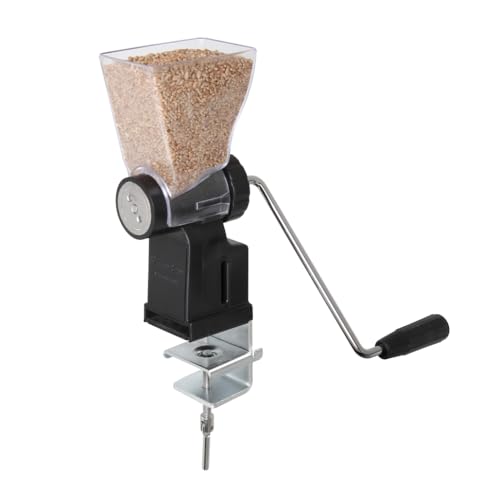
Best for: a baker who wants stainless burrs, a written warranty and the option to add a motor later Skip it if: you need a mill that grinds a full loaf's flour without arm work
The Kitchen Crop is the mill I would give a serious home baker who has decided against a heavy electric. Stainless steel burrs, a two-cup hopper, a wide adjustment dial from cracked cereal to bread flour, a 2 inch counter clamp, and a written 5-year warranty. Everything on that list is a spec, not a claim, and the warranty is the longest of any pick here.
The compact touch is the drive. Kitchen Crop says the mill accepts an optional electric drive motor, sold separately, in place of the hand crank. That gives it a path forward: start hand crank, add a motor when the habit sticks. Nothing else in this set offers that upgrade.
Weight is 2.89 lb, dimensions are 15 x 10.4 x 3 in, so it stows in a cupboard between bakes. Two-cup hopper capacity is smaller than most electrics, which is the honest trade-off: a two-cup batch grinds enough flour for one small loaf and then you refill. Buy this over the MOUNTAIN ESSENTIALS if you want a warranty and a motor path, over the Corona if you want stainless burrs and finer flour.
Pros:
- Stainless steel burrs
- 5-year warranty
- Optional motor drive available
- Two-cup hopper
- Compact 2.89 lb body, easy to store
Cons:
- Two-cup hopper limits batch size
- Motor is sold separately
- Slowest seller of the seven
Electric or hand crank for everyday flour?
This is the split that decides the shortlist. Neither option is wrong, and the picks above cover both sides for a reason.
An electric mill wins when you bake more than one loaf a week. The VEVOR GM-002 grinds continuously, the HC-800Y runs in 30-second bursts, and the Phaniteces fits a starter budget. All three deliver flour without you doing anything except loading the hopper and pressing a button. If your household eats fresh bread daily, the daily arm work of a hand mill is not romantic, it is a tax on the habit.
A hand crank wins in three cases:
- Off-grid or emergency kitchens, where a motor is a liability.
- Small-batch grinding, where you want a fresh cup of flour for pancakes and no more.
- Households that already have a stand mixer, since a KitchenAid attachment is the cheapest path in.
The MOUNTAIN ESSENTIALS, Corona and Kitchen Crop cover those three cases, and the Ezato attachment gives a KitchenAid owner the same result without a fourth appliance.
How much flour does daily use really mean?
Daily use is not one number, so put your kitchen in one of these three buckets and match a mill to it. Most guides skip this step and it is why buyers over-spend.
- Under a cup a day. Fresh flour for pancakes, a small flatbread, or a portion of pasta. Any pick here handles this without complaint, so the deciding factor is footprint. Corona, Kitchen Crop or the Ezato attachment.
- One to three cups a day. A daily loaf of bread. Both hand mills can do this, but the arm work adds up. An electric with a stated duty cycle is the honest fit: VEVOR HC-800Y or Phaniteces for smaller kitchens, VEVOR GM-002 if wet grinding also matters.
- More than three cups a day. Baking for a family, a small business or a co-op. Only the VEVOR GM-002 is built for this, and even it has no stated duty cycle you can rely on. Two units, or an industrial mill outside this set, is the honest answer.
Notice that the modifier "daily use" is a claim about your kitchen, not the mill. Amazon's search returned mills across a wide range because the phrase is fuzzy. The three buckets above are how you resolve it for yourself.
What the listings do not tell you
Every listing here is missing at least one figure a daily-use buyer wants. Read the picks with these gaps in mind.
- Duty cycles. Only the VEVOR HC-800Y publishes a run-and-rest ratio. For any other electric mill in this set, assume shorter runs than the marketing suggests and let the motor cool between batches.
- Noise. No decibel figure appears on any of the seven listings. Blade grinders like the HC-800Y and Phaniteces will be louder than burr mills; commercial-sized mills like the GM-002 will be louder still.
- Flour temperature. Swing-blade mills heat what they grind. Burr mills, especially hand crank ones, keep flour cool, which matters for sourdough.
- Replacement parts. Only the Kitchen Crop publishes a warranty period on its main spec sheet, and only the Ezato lists a manufacturer warranty for a defined term.
The pattern is straightforward: the more you plan to grind, the more these gaps should push you toward the picks that publish the most figures.
Which pick wins for a specific kitchen?
Seven options is too many when you stand in front of a counter with a bag of wheat berries in hand. Use these one-line matches.
- Big kitchen, serious baker, both dry flour and wet batters. VEVOR GM-002.
- Off-grid or emergency prep, no motors. MOUNTAIN ESSENTIALS.
- Wheat plus coffee and spices from one machine. VEVOR HC-800Y.
- KitchenAid owner. Ezato attachment.
- Testing the habit for the first time. Phaniteces.
- Masa, tortillas and coarse grinds. Corona L10800.
- Bread flour, hand crank, want a warranty. Kitchen Crop VKP1248.
The winner for daily wheat flour, unqualified, is the VEVOR GM-002. Every other pick is a better fit for a specific case, and the case is what the label on it says.
The verdict
Entry tier, this set offers the Phaniteces electric, the Corona hand mill and the Ezato KitchenAid attachment. All three make sense for the buyer they are aimed at, and the Ezato is the smartest of them because a KitchenAid owner gets fresh flour without buying a whole appliance. In the middle, the VEVOR HC-800Y is the most flexible pick because it does wheat, spices and coffee in the same 800 g chamber. At the top, the VEVOR GM-002 is the best wheat grinder for daily use if you have the counter space, and the MOUNTAIN ESSENTIALS is the answer for anyone who wants a serious mill with no motor to fail.
The runner-up story is worth naming. The Kitchen Crop VKP1248 is the mill I would recommend to a baker who is unsure whether they want to commit to an electric. Stainless burrs, a two-cup hopper, a 5-year warranty and an optional motor path mean it grows with the habit. If you are between the GM-002 and doing without a mill entirely, the VKP1248 is the right hedge.
FAQ
What is the best wheat grinder for daily use in a busy household?
The best wheat grinder for daily use in a busy household is the VEVOR GM-002 because a 3000W dual-disc mill grinds enough flour for daily bread and switches to wet grinding for batters. If you bake fewer than three cups of flour a day, the smaller VEVOR HC-800Y with its 800 g chamber is easier to live with on a compact counter and handles spices and coffee too.
Is a wheat grinder worth it for a single loaf a day?
A wheat grinder is worth it if you eat fresh bread daily, because whole-wheat flour loses aroma and some nutrient content within days of milling. For a single loaf a day the Kitchen Crop VKP1248 hits the sweet spot: a two-cup hopper handles one loaf, stainless burrs stay sharp, and the 5-year warranty covers the daily wear that lighter mills do not.
Does the Ezato attachment fit every KitchenAid mixer?
The Ezato attachment fits every KitchenAid mixer, according to the listing, because it uses the standard power hub found on all KA stand mixer models. Installation is tool-free per the manufacturer. The trade-off is that grinding ties up the mixer, so if you plan to knead and grind in the same session, budget time to swap attachments rather than running both jobs at once.
VEVOR GM-002 or MOUNTAIN ESSENTIALS: which is better for bread flour?
VEVOR GM-002 or MOUNTAIN ESSENTIALS depends on whether you accept a motor. The GM-002 grinds faster, offers wet grinding, and needs no arm work, so daily bakers gain hours a week. The MOUNTAIN ESSENTIALS uses stainless burrs and keeps flour cool for sourdough, but at 28.6 lb of hand-crank grinding, it earns its keep only in off-grid or emergency-prep kitchens.
What is the biggest mistake buyers make with wheat grinders?
The biggest mistake buyers make with wheat grinders is chasing motor wattage instead of burr material and duty cycle. A 3000W blade mill overheats flour and shortens gluten development, while a 300W burr mill grinds slower but cooler and cleaner. Read the specifications in this order: burr material, then hopper capacity, then duty cycle, then wattage. That is the order that predicts daily-use satisfaction.
Fresh flour is a habit, not a purchase, so the right mill is the one that fits how many cups of wheat pass through your kitchen in a week. Match your bucket in the daily-use section above to one of the seven picks, and check the specification gaps in the listing before you buy. The VEVOR GM-002 wins the top spot because it is the only mill here built for both dry flour and wet batters at a volume a daily baker actually needs, and the counter space it demands is the honest price of that flexibility. Start there if the space is available, and let the runner-ups catch the cases the GM-002 does not.