Best Ceramic Pizza Stone: Size, Weight and Thickness

Five ceramic and cordierite pizza stones compared on diameter, thickness and weight, with a clear winner for households baking two or three pies back to back.

By Zaria JarvisUpdated 15 min read
On this page
- Best ceramic pizza stone for large families at a glance
- How I screened these five stones
- Does a bigger stone actually feed more people?
- 1. Old Stone Round Pizza Stone — Best overall
- 2. Hans Grill Circular Pizza Stone — Best premium
- 3. Unicook 15 x 12 Inch Rectangular Pizza Stone — Best for heavy use
- 4. Culinary Couture Large Pizza Stone Set — Best compact
- 5. Unicook 15" Round Pizza Stone — Best for families
- Round or rectangular: which shape suits a family bake?
- How thick should a ceramic pizza stone be?
- What a stone listing never tells you
- The verdict
- FAQ
The best ceramic pizza stone for large families is the Old Stone Round Pizza Stone, a 16-inch clay disc weighing 7.28 lb and the widest baking surface of the five stones here. If you want a grill-rated stone with a wooden peel included, the Hans Grill Circular Pizza Stone is the better buy at 15 x 15 in. Most shoppers compare temperature ratings first. That number decides almost nothing at home, because a domestic oven tops out long before any of these stones do.
Best ceramic pizza stone for large families at a glance
| Pick | Baking surface | Thickness | Price |
|---|---|---|---|
Best overall Old Stone Round Pizza Stone |
16 x 16 in round | 0.59 in | Check Price |
Best premium Hans Grill Circular Pizza Stone |
15 x 15 in round | 0.6 in | Check Price |
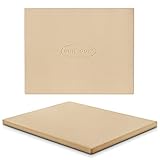
Best for heavy use Unicook 15 x 12 Inch Rectangular Pizza Stone |
15 x 12 in rectangle | 0.59 in | Check Price |
Best compact Culinary Couture Large Pizza Stone Set |
15 x 12 in rectangle | 0.4 in | Check Price |
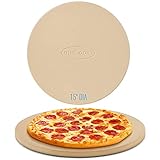
Best for families Unicook 15" Round Pizza Stone |
15 x 15 in round | 0.59 in | Check Price |



How I screened these five stones
I lined up the published specifications side by side and threw out everything a marketing bullet claimed until only measured figures were left. That leaves four numbers worth arguing about: diameter or footprint, thickness, weight, and how many pieces come in the box.
Here's what the data supports and what it doesn't. The keyword asks for a stone that suits a large family. None of these five listings publishes a serving count, a dough-weight capacity, or anything else that speaks directly to feeding six people. Amazon's search treated "large families" as a loose hint, not a filter. So I used the one thing that genuinely scales with mouths fed: surface area.
The screening ran in this order.
- Footprint first. A 16-inch round beats a 15-inch round by about two inches of extra crust all the way around. That is the only capacity signal any of these listings actually gives you.
- Thickness second. Four of the five sit at 0.59 or 0.6 in. One drops to 0.4 in, which is a real difference in stored heat.
- Weight third. Published weights run from 6.5 lb to 7.28 lb. Heavier means more thermal mass, and it also means more strain lifting a loaded stone.
- What's in the box last. Two picks ship as multi-piece sets, one of them with a peel.
No stone here was cut for a bad rating, because I have no rating data to cut on. Everything that follows comes from the listed specifications and the manufacturers' own words, clearly labelled as theirs.
Does a bigger stone actually feed more people?
Yes, but not as much as the diameter suggests, and this is where the best ceramic pizza stone for large families question gets slippery.
Area scales with the square of the radius. A 16 in round stone gives you roughly 201 square inches of cooking surface. A 15 in round gives you about 177. That single inch of extra diameter buys you close to a seventh more pizza, which is one more slice per bake for a family of five or six.
The 15 x 12 in rectangles are the interesting case. They measure about 180 square inches, so on paper they match the 15-inch rounds. But you cannot fit a 15-inch circle onto a 12-inch-wide slab. In practice you get a 12-inch round pie with corners going spare, or you shape the dough into an oval and use the whole thing.
So the honest ranking for raw pizza volume:
- Old Stone 16 in round — largest circle any pick here supports
- Hans Grill and Unicook 15 in rounds — one full inch smaller in every direction
- Both 15 x 12 in rectangles — same total area, smaller maximum round
For a household that bakes two pies back to back, none of that matters as much as the second point: a stone that sheds heat quickly gives you a soggy second pizza. That's a thickness and weight question, not a diameter one.
1. Old Stone Round Pizza Stone — Best overall
The widest baking surface here at 16 in across, the heaviest at 7.28 lb, and the cheapest of the five.
Best for: households baking 16-inch pies for five or six people Skip it if: your oven runs hotter than 500°F or you want grill use
This is the only 16 in stone in the set, and it's also the heaviest at 7.28 lb. Those two facts travel together: more clay across a wider disc holds more heat, which is what you want when the second pizza goes in five minutes behind the first. At 0.59 x 16 x 16 in it will fill most standard oven racks nearly wall to wall, so measure yours before you commit.
Old Stone describes the material as a blend of lead-free clays and calls the stone durable and non-cracking. It also states the stone absorbs oven heat and transfers it evenly. Note the temperature guidance in the listing: recommended for up to 500 degrees in a standard home oven. That's a lower ceiling than the cordierite picks claim, and it's the clearest reason to look elsewhere if you plan to throw this on a grill.
It's the only pick with a published warranty, a Honey-Can-Do household-use warranty covering defects in materials and workmanship within 60 days of purchase with proof of purchase. Two sellers list it. The listing also instructs you not to clean the stone with soap, which is standard for porous clay and worth knowing before someone in the house reaches for the sponge.
Pros:
- Largest baking surface in this set at 16 in
- Heaviest stone here at 7.28 lb
- Cheapest of the five picks
- Only pick with a published warranty
- Lead-free clay blend per the brand
Cons:
- Listing recommends up to 500 degrees only, well below the cordierite claims
- No grill use described in the listing
- Heaviest to lift when hot and loaded
- 16 in footprint may not clear smaller oven racks
- Ships as a single stone with no scraper or peel
2. Hans Grill Circular Pizza Stone — Best premium
A 15 in cordierite disc that arrives as a two-piece set with a wooden peel, and the highest claimed heat rating here.

Best for: anyone who wants a peel in the box and grill capability Skip it if: you need a published weight before you buy
The reason to pay the most in this set is the peel. This is the only pick of the five that ships a wooden launching tool, and if you've ever tried to slide a loaded 15-inch pie off a cutting board onto a screaming-hot stone, you know that tool is not an accessory. The count is 2, so stone plus peel.
Hans Grill describes the material as toughened porous cordierite, FDA safe, and heat resistant up to 1112°F (600°C). That's the top claimed figure among these five, and it's the brand's number rather than an independently verified one. The listing covers both oven and BBQ use and names pies, pastry, frozen pizza, calzone and artisan bread alongside pizza. The brand also states plainly that staining is normal and won't affect performance, which is a refreshing thing to put in a listing rather than field as a complaint later.
At 0.6 x 15 x 15 in it's marginally the thickest of the round stones by a hair. The gap in the data is weight: no figure is published, so if thermal mass is your deciding factor you're buying partly blind. It also sells faster than any other stone here, and only one seller lists it.
Pros:
- Only pick that includes a wooden peel
- Highest claimed heat resistance at 1112°F
- Thickest round stone here at 0.6 in
- Rated by the brand for oven and BBQ
- Sells faster than the rest of this set
Cons:
- Most expensive pick here
- No published weight, so thermal mass is unknown
- One inch smaller across than the 16 in winner
- Only one seller lists it
- No scraper included despite the two-piece set
3. Unicook 15 x 12 Inch Rectangular Pizza Stone — Best for heavy use
A 15 x 12 in cordierite slab with a scraper in the box, and the second-cheapest way into this category.
Best for: weekly bakers who also want flatbread and cookie space Skip it if: you want a round pie edge to edge
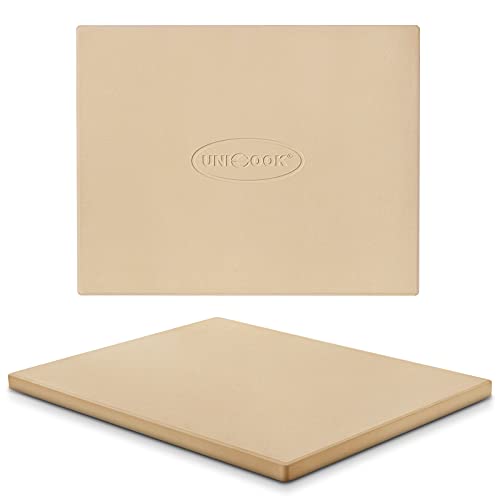
The rectangle is the shape you choose when pizza isn't the only job. A 15 x 12 in footprint takes two flatbreads side by side, a tray of rolls, or a long focaccia in a way no round stone manages. Unicook publishes 0.59 x 15 x 12 in and 6.5 lb, though the feature copy says about 6.8 lbs, so treat the exact figure as approximate.
Unicook describes the material as high-quality cordierite, heat-resistant up to 1,450°F (787°C), and claims even heat distribution without hot spots. The brand also states the porous surface draws excess moisture out of the dough for a crisp base. A plastic scraper is included, doubling as a dough cutter and a residue tool, and the care instructions say to hand wash with warm water and no detergent once the stone has cooled.
Two sellers list it, and it's the second-cheapest pick here. The trade-off against the winner is straightforward geometry. You lose the ability to bake a true 15-inch round, and you lose the extra clay that the 16 in stone brings to a second-pizza bake. What you get back is versatility and a lower price position than three of the other four.
Pros:
- Second-cheapest pick in this set
- Rectangular footprint suits flatbread and loaves
- Scraper and dough cutter included
- Cordierite rated to 1,450°F per the brand
- Two sellers list it
Cons:
- 12 in width caps the size of any round pie
- Lightest published weight here at 6.5 lb
- Listing quotes both 6.5 lb and about 6.8 lbs
- No published warranty
- Detergent explicitly ruled out for cleaning
4. Culinary Couture Large Pizza Stone Set — Best compact
A three-piece 15 x 12 in set at 0.4 in thick, the thinnest and most storage-friendly stone here.

Best for: storage-tight kitchens that still want a three-piece set Skip it if: you want the thickest stone here
Three pieces in the box, the most of any pick, and the slimmest slab at 0.4 in. That thinness is the whole personality of this stone. It slides into a cabinet gap the 0.6 in stones won't fit, and at 6.7 lb it's easier to manoeuvre in and out of a hot oven than the 7.28 lb winner.
Culinary Couture describes the material as premium cordierite engineered to withstand temperatures up to 1000°F, and says the 0.4-inch thickness resists cracking and breaking even under heavy use. The brand also states cleaning needs only a warm water rinse and air drying, with no scrubbing or harsh detergents. Take all of that as the manufacturer's position rather than a measured result.
The specification worth pausing on is the listed dimensions: 0.4 x 15 x 15 in, while the size is given as 15x12 in rectangular. Those two figures disagree about the second measurement, so if fitting the stone into an exact gap matters, check the listing yourself before ordering. It's the slowest seller of the five and only one seller stocks it. The honest verdict is that thin plus light means less stored heat, which is precisely the property a back-to-back family bake needs most.
Pros:
- Three pieces in the box, the most here
- Thinnest stone at 0.4 in, easiest to store
- Roughly mid-range for this set on price
- Cordierite rated to 1000°F per the brand
- Rinse-and-dry cleaning per the listing
Cons:
- Thinnest stone here, so least stored heat
- Listing gives conflicting 15x12 and 15x15 figures
- Slowest seller of the five
- Only one seller lists it
- No published warranty
5. Unicook 15" Round Pizza Stone — Best for families
A 15 in round cordierite stone with a scraper included, kiln-sintered at 2100°F according to the brand.

Best for: round-pie traditionalists who bake once or twice a week Skip it if: you can get the 16-inch stone for less
If the rectangle bothers you and the peel doesn't interest you, this is the round stone in the middle of the pack. It measures 0.59 x 15 x 15 in and weighs 6.61 lb, putting it third of the four picks with a published weight. Three sellers list it, the most of any pick here, which is worth something if one seller runs dry.
Unicook says the stone is made of all natural cordierite, sintered in a 2100°F kiln for hours, with no odour under proper use. The brand describes invisible micro-pores that draw moisture from the dough and distribute heat evenly for crisp crusts. The feature copy gives the thickness as a golden 0.6 in and the weight as up to 6.7 lbs, again slightly at odds with the specification figures. A plastic scraper is included, usable as a dough cutter, and the listing says to use it on a cool stone surface only.
Here's the problem. It sits in the highest price position of the five while giving up an inch of diameter and about half a pound of clay to the winner. That's a hard combination to justify unless the round shape and the extra sellers are what you're paying for.
Pros:
- Three sellers list it, the most in this set
- Plastic scraper doubles as a dough cutter
- Full 15 in round shape for traditional pies
- Cordierite kiln-sintered at 2100°F per the brand
- 0.59 in thickness matches the winner
Cons:
- Highest price position of the five despite smaller size
- One inch narrower than the 16 in winner
- Slowest seller of the round stones here
- Listed weight and feature weight disagree
- No published warranty
Round or rectangular: which shape suits a family bake?
Shape is the fork in the road that people notice last and regret first.
Choose round if pizza is the point. A 15 or 16 in circle matches the dough you'll actually stretch, and the edges cook at the same rate as the middle because nothing hangs off. Three picks here are round: the Old Stone at 16 in and the two 15 in stones.
Choose rectangular if the stone is going to earn its keep between pizza nights. The 15 x 12 in slabs from Unicook and Culinary Couture take two flatbreads, a batch of rolls, or a sheet of roasted vegetables. You just cannot make a 15-inch round on them.
There's a storage argument too. Rectangles stack against a cabinet wall neatly. A 16-inch disc needs a 16-inch gap, and 7.28 lb of clay is not something you want balanced upright behind the saucepans.
How thick should a ceramic pizza stone be?
Thickness is the specification that actually decides how the best ceramic pizza stone for large families performs on the second pie, and it's the one buried furthest down most listings.
The set splits cleanly:
- 0.6 in — Hans Grill
- 0.59 in — Old Stone, Unicook rectangular, Unicook round
- 0.4 in — Culinary Couture
Four of five sit within a hundredth of an inch of each other. The outlier is the Culinary Couture set at 0.4 in. Thinner stone stores less heat, so it recovers more slowly between bakes. The brand's counter-argument is that 0.4 in resists cracking even under heavy use, which is its claim rather than a tested finding.
Pair thickness with weight and the picture sharpens. The Old Stone gives you 0.59 in across 16 inches for 7.28 lb of total mass. The Unicook rectangular gives you the same thickness across a smaller footprint for 6.5 lb. That 0.78 lb gap is heat you get to spend on pizza number two.
Hans Grill publishes no weight at all, so it sits outside this comparison entirely.
What a stone listing never tells you
Reading five listings back to back exposes a pattern of things nobody puts in writing.
- Preheat time. Not one of these five listings states how long the stone needs in the oven. Every pick describes even heat distribution; none says how long you wait for it.
- Whether the temperature rating means anything. Hans Grill claims 1112°F, Unicook 1,450°F, Culinary Couture 1000°F. A standard home oven reaches nowhere near any of them. Old Stone is the only listing honest enough to name the practical ceiling, recommending up to 500 degrees in a home oven.
- Cracking risk from thermal shock. Both Unicook listings and the Old Stone specify no detergent and, in Old Stone's case, no soap at all. None of them tells you what happens if you put a cold stone into a hot oven.
- Serving capacity. Zero listings state how many people a stone feeds. That's why the size figures in the table are the only capacity data in this article.
- Warranty. Only the Old Stone publishes one, a 60-day defects warranty from Honey-Can-Do requiring proof of purchase. The other four listings publish nothing.
The practical takeaway: buy on published dimensions and weight, treat every temperature claim as marketing, and assume you'll need to learn preheat timing in your own oven.
The verdict
If you're feeding five or six and pizza is the main event, buy the Old Stone Round Pizza Stone. It gives you a 16 in circle when everything else here caps at 15, it carries 7.28 lb of clay when the nearest published weight is 6.7 lb, and it's the cheapest pick in the set. It's also the only stone here with a published warranty. The catch is real and you should know it going in: the listing recommends up to 500 degrees in a standard home oven, and grill use isn't described.
If you want the stone outdoors on a grill, or you want a peel in the box, buy the Hans Grill Circular Pizza Stone instead. Its exact advantage is the wooden peel, which no other pick includes and which makes launching a loaded 15-inch pie a one-person job rather than a two-person disaster. You pay the most in the set for it and you give up an inch of diameter.
The cutoff is your oven rack. Measure it. If a 16-inch disc clears with room for air to move, take the Old Stone. If it doesn't, or if the stone is heading for a grill, the Hans Grill is where your money goes.
FAQ
Is a bigger pizza stone worth it for a family?
A bigger pizza stone is worth it when you're baking pies back to back, because more clay across a wider surface holds more heat for the second bake. The Old Stone at 16 in and 7.28 lb offers roughly a seventh more area than the 15 in rounds here. Check your oven rack width first, since 16 inches leaves little clearance.
Which is the cheapest ceramic pizza stone here?
The cheapest ceramic pizza stone in this set is the Old Stone Round Pizza Stone, which is also the largest at 16 x 16 in and the heaviest at 7.28 lb. That combination is unusual: normally the biggest stone sits at the top of the price ladder. The Unicook 15 x 12 in rectangular stone is the second-cheapest option.
What thickness should I look for in a pizza stone?
The thickness to look for sits around 0.6 in, which is where four of these five stones land. Hans Grill publishes 0.6 in, while Old Stone and both Unicook stones list 0.59 in. The Culinary Couture set drops to 0.4 in, trading stored heat for easier storage and a lighter 6.7 lb lift.
Old Stone 16-inch or Unicook 15-inch round: which should I buy?
Between the Old Stone 16-inch and the Unicook 15-inch round, the Old Stone wins on size, weight and price. It gives you an extra inch of diameter, 0.67 lb more mass, a published warranty, and a lower price position. Pick the Unicook if you want the included plastic scraper or if three sellers listing it matters for availability.
Can I use these stones on a grill?
Grill use depends entirely on the pick. Hans Grill states its stone is rated for oven and BBQ up to 1112°F, and both Unicook listings and the Culinary Couture set are categorised as grilling stones with high claimed heat ratings. The Old Stone listing recommends up to 500 degrees in a standard home oven and doesn't describe grill use.
Start by measuring the widest gap on your oven rack, then decide. If 16 inches fits, the Old Stone gives you the most baking surface and the most clay for the least money, which is a rare thing in any category. If it doesn't fit, or the stone is going on the grill, the Hans Grill set puts a peel in your hand and takes the size question off the table. Either way, buy on dimensions and weight rather than the temperature numbers on the box. Your oven decides that limit, not the stone.