Best Pizza Stones by Thickness and Heat Rating

Six pizza stones compared on thickness, heat rating and set contents, with a clear winner for first-time bakers and honest notes on what each one gives up.

By Zaria JarvisUpdated 16 min read
On this page
- Best hard anodized pizza stone for beginners at a glance
- A quick note on the hard anodized question
- How I screened the shortlist down to six
- What actually decides a beginner's first stone
- 1. Old Stone Round Pizza Stone — Best overall
- 2. Hans Grill Rectangular Pizza Stone with Peel — Runner-up
- 3. Ritual Life Large Pizza Stone for Oven 16 inch — Best premium
- 4. Culinary Couture Large Pizza Stone Set — Best for beginners
- 5. Unicook 15 x 12 Inch Rectangular Pizza Stone — Best for heavy use
- 6. Classic Cuisine Round Pizza Stone with Cutter — Best budget pick
- Round or rectangular: which shape suits a new baker?
- How thick should a first stone really be?
- What the listings do not tell you about care
- The verdict
- FAQ
The best hard anodized pizza stone for beginners is the Old Stone Round Pizza Stone, a 16-inch clay slab that weighs 7.28 lb and is rated for standard home ovens up to 500°F. If you want a rectangular shape with a peel in the box, the Hans Grill Rectangular Pizza Stone is the better call. Most guides in this category compare shapes. Shape is not what decides it. Heat tolerance and thickness are, and the split across these six is bigger than the listings make it look.
Best hard anodized pizza stone for beginners at a glance
| Pick | Shape & size | Thickness | Price |
|---|---|---|---|
Best overall Old Stone Round Pizza Stone |
Round, 16 in | 0.59 in | Check Price |
Runner-up Hans Grill Rectangular Pizza Stone |
Rectangular, 15 x 11.8 in | 0.59 in | Check Price |
Best premium Ritual Life Large Pizza Stone |
Round, 16 in with peel & cutter |
0.6 in | Check Price |
Best for beginners Culinary Couture Pizza Stone Set |
Rectangular, 15 x 12 in 3-piece set |
0.4 in | Check Price |
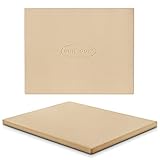
Best for heavy use Unicook 15 x 12 Pizza Stone |
Rectangular, 15 x 12 in | 0.59 in | Check Price |
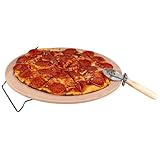
Best budget pick Classic Cuisine Round Pizza Stone |
Round, 15 in with cutter & stand |
0.25 in | Check Price |


A quick note on the hard anodized question
Hard anodized is a finish for aluminium cookware, not a category that applies to baking stones. Every stone below is ceramic-based: cordierite in most cases, a lead-free clay blend in the Old Stone. If you searched for a hard anodized pizza stone, the listings on Amazon returned ceramic and clay stones instead, because that is what people who bake pizza at home actually use. Read the picks as the best pizza stone for a beginner, and judge the material claims on their own merits. I flag it here so you know what you are looking at, and I do not use the phrase again in the picks.
How I screened the shortlist down to six
Three cuts got me from a wide category to these six. First cut: anything without a stated size, weight and thickness was dropped, because a beginner cannot judge a stone by adjectives. Second cut: nothing above the 16-inch mark, because a stone that does not fit a home oven is a returned stone. Third cut: I looked for a spread across price positions and set contents, so the shortlist covers a bare slab, a stone plus cutter, a stone plus peel, and a full three-piece kit.
That gave me six with directly comparable published figures:
- Thickness from 0.25 in to 0.6 in
- Weight from 6 lb to 12.1 lb
- Heat ratings from 500°F to a claimed 1500°F
- Round and rectangular shapes both represented
- Bare stones and multi-piece sets both represented
Two things I did not use as a filter. I did not filter on brand, because pizza stones are not a strong-brand category. I did not filter on category path either: some listings sit under bakeware and others under grilling cookware, and both are legitimate homes for the same product.
What actually decides a beginner's first stone
The obvious specification is size, and it is the wrong one to lead with. Every stone here fits a standard oven. What actually decides your first pizza stone is the pairing of thickness and heat tolerance, because those two figures set how the stone behaves during a bake.
A thicker slab holds more heat, which is what gives you a crisp bottom on the first pie and a still-crisp bottom on the third. A thinner slab heats faster but drops temperature faster too. The Classic Cuisine sits at 0.25 in, the Culinary Couture at 0.4 in, and the other four cluster at 0.59 to 0.6 in. That is a real range, not a rounding difference: the thickest slab in this set is more than twice the thickness of the thinnest.
Heat rating matters for a different reason. Any home oven caps at around 550°F, and the Old Stone listing explicitly states 500°F as the recommended ceiling. The cordierite stones here carry much higher claimed ceilings, from 1000°F on the Culinary Couture up to a claimed 1500°F on the Ritual Life. Inside an oven those numbers are academic. On a covered grill or in a pizza oven, they stop being academic, and that is where the cordierite stones justify themselves.
Two more things beginners underweight:
- Weight. A 12.1 lb stone loaded with a dressed pizza is not fun to move.
- What comes in the box. A peel or a cutter you would buy separately anyway shifts the value.
1. Old Stone Round Pizza Stone — Best overall
A 16-inch clay slab at a fair price with the honest heat rating a first-time baker needs.
Best for: a first-time home baker with a standard 500°F oven Skip it if: you want a peel and cutter in the box
The Old Stone earns the top spot on numbers a beginner can actually use. It is 16 in across, 0.59 in thick, and 7.28 lb, which puts it in the thicker half of this set at the second-cheapest price position. The listing states the stone is rated for up to 500°F in a standard home oven, which matches what a home oven actually does. That honesty matters: a beginner who reads a 1500°F rating on another listing and thinks a hotter oven produces a better pizza is being misled about their kitchen, not their stone.
The material is a lead-free clay blend rather than cordierite, and Old Stone specifically warns against washing the stone with soap. That is standard care for a porous baking stone, and it is stated up front. The trade-off against the picks below is real. You do not get a peel, a cutter or handles. You get one round slab that fits a home oven and behaves the way the listing says it will.
Pros:
- 0.59 in thick clay slab holds heat well
- Honest 500°F rating matches home ovens
- 16 in round fits standard 12 to 14 in pies
- Second-cheapest of the six
- Lead-free clay stated on the listing
Cons:
- No peel, cutter or handles in the box
- Soap warning means care is by hand only
- Heaviest of the round bare stones at 7.28 lb
2. Hans Grill Rectangular Pizza Stone with Peel — Runner-up
A 15 x 11.8 in cordierite stone with a peel included, at the second-highest price in this set.

Best for: someone who wants a rectangular stone plus a peel in one buy Skip it if: you need a round shape for a classic 12-inch pie
The Hans Grill is the pick if you want the peel included. The stone measures 15 x 11.8 in at 0.59 in thick and weighs 7.81 lb, so the slab itself is in the same class as the Old Stone. What you are paying more for is the peel that ships with it. Hans Grill claims a heat tolerance up to 1112°F, and the listing calls out both oven and grill use, which is credible for cordierite.
The rectangular shape is the reason to prefer this over the winner. A rectangle lines up with the grate of most ovens and grills, and it does bread and calzone as tidily as pizza. Hans Grill also flags something a lot of listings hide: staining is normal and does not affect performance. Beginners often panic and scrub, which is the fastest way to ruin a porous stone.
Against the winner, this one costs more and gives you a smaller cooking surface. Against the Ritual Life, it is lighter and thinner, but the peel is wood rather than a full kit.
Pros:
- Peel included, so no second purchase needed
- 0.59 in cordierite claimed to 1112°F
- Rectangular shape fits grill grates
- Second-heaviest in the set at 7.81 lb
- Listing acknowledges staining is normal
Cons:
- Second-most expensive of the six
- Smaller surface than the 16 in rounds
- Only one seller lists it
3. Ritual Life Large Pizza Stone for Oven 16 inch — Best premium
The full kit: 16-inch cordierite stone, handles, wood peel and cutter, at the top price position here.

Best for: grill users who want handles and a full pizza kit Skip it if: 12.1 lb is too heavy to lift in and out
Ritual Life takes the most expensive position in this set, and the reason is in the box. You get the 16 in round stone at 0.6 in thick, a set of handles that Ritual Life says double as a rack, a wood peel and a cutter. The stone alone weighs 12.1 lb, and that is before the accessories, which makes this the heaviest listing here by a wide margin.
The heat claim is the highest in the set at 1500°F, which is a cordierite figure that only matters if you cook outside a domestic oven. If you have a covered grill or a dedicated pizza oven, that headroom is why you buy this over a clay stone. If you cook in a 500°F home oven, the extra rating is not doing anything for the pie.
The trade-off is weight and price. You are paying the highest price in the set and lifting the heaviest slab. In return you get every accessory a beginner would otherwise buy piecemeal, and handles that address the one legitimate safety concern with a hot stone.
Pros:
- 16 in round stone plus handles, peel and cutter
- Cordierite claimed to 1500°F for grill use
- Handles double as a resting rack per the listing
- 0.6 in thickness is joint-thickest here
Cons:
- Most expensive pick in the set
- 12.1 lb is the heaviest listing by far
- Only one seller stocks it
- Slowest seller of the six
4. Culinary Couture Large Pizza Stone Set — Best for beginners
A three-piece rectangular set aimed squarely at someone who has never used a stone before.

Best for: a nervous first-timer who wants a three-piece kit Skip it if: you want a thicker slab for long bakes
Culinary Couture is the pick if the barrier to your first pizza night is not having any of the supporting kit. The set is three pieces at a mid price, the stone is 15 x 12 in, and the whole package weighs 6.7 lb. Culinary Couture states the stone is 0.4 in thick and rated to 1000°F, and the listing specifically calls out warm water rinsing with no detergent, which is the correct care instruction for a porous stone.
Why this suits a beginner: you unbox one thing and you can make a pizza. You do not need to also buy a peel or a cutter and figure out which sizes go together. That reduces the number of decisions a first-time buyer has to make from three to one, and that is worth something.
The honest trade-off is thickness. At 0.4 in, this slab is thinner than the four picks above it. It will heat faster and hold less. For a single pizza on a weekend that is fine. If you plan to bake several pies back to back, one of the 0.59 to 0.6 in stones will serve you better in the long run.
Pros:
- Three-piece kit removes second-purchase hassle
- 1000°F claim comfortably covers home ovens
- Lightest full set here at 6.7 lb
- Care instructions stated clearly on the listing
Cons:
- 0.4 in slab is thinner than four of the six picks
- Rectangular only, no round option
- Only one seller lists it
5. Unicook 15 x 12 Inch Rectangular Pizza Stone — Best for heavy use
A well-specified rectangular cordierite slab from a listing that stocks with two sellers.
Best for: someone baking pizza most weekends on grill or oven Skip it if: you need accessories included in the box
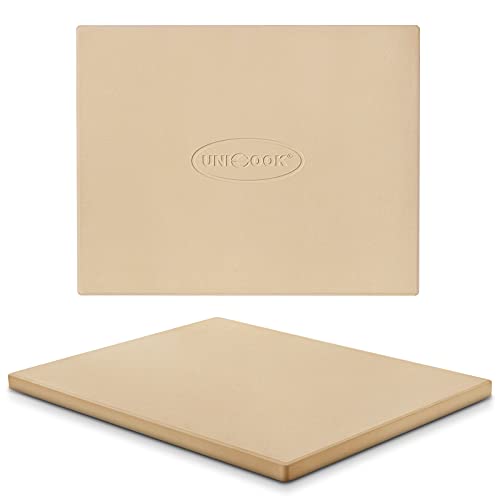
Unicook is the workhorse. The stone is 15 x 12 in, 0.59 in thick and 6.5 lb, and Unicook claims a heat tolerance up to 1450°F on cordierite. The listing includes a plastic dough scraper that doubles as a cleaning tool, and the care instruction is explicit: scrape residue, wash by hand with warm water, do not use detergent.
What earns the heavy-use label is the combination of thickness and material. Cordierite handles thermal shock better than most low-cost stones, and 0.59 in gives you the mass to survive back-to-back pies without the surface dropping out of range. Unicook is also one of only two picks in this shortlist with more than one seller listing it, which is a small but real signal on supply.
Against the Culinary Couture, the Unicook is thicker and reads like a longer-life pick, but you do not get a peel. Against the Hans Grill, the Unicook is cheaper but the box does not include a peel either. If you already own a peel or you slide pizzas on parchment, the Unicook is the smarter mid-priced buy.
Pros:
- 0.59 in cordierite with a 1450°F claim
- Dough scraper included for prep and cleaning
- Care instructions clearly stated on the listing
- One of two picks with multiple sellers
Cons:
- No peel or cutter included
- Rectangular only
- Not the cheapest mid-range option
6. Classic Cuisine Round Pizza Stone with Cutter — Best budget pick
The cheapest of the six, and a low-commitment way to find out if you like baking pizza.

Best for: a low-commitment first stone with a cutter and stand included Skip it if: you want a thick slab that holds heat through several pies
Classic Cuisine is the cheapest pick here and comes as a three-piece set: a 15 in round stone, a rolling cutter and a metal stand that flips over to act as handles for transport. Classic Cuisine claims a heat rating up to 1112°F and states hand cleaning without detergent, with a brush if needed.
The specification worth noting is thickness. This stone is 0.25 in thick, which is the thinnest slab in the set by a clear margin. In practice that means faster heat-up and lower total heat capacity. For one pie at a time in a home oven, that is workable. For hosting a pizza night with five pies going back to back, the stone will not keep up.
I keep it in as the budget pick for a specific reason. If you are not sure baking pizza at home is going to become a habit, the cheapest three-piece set in the shortlist is a sensible first step. You get a cutter and a stand, and the price position lets you replace it with a 0.59 in slab later without regret.
Pros:
- Cheapest of the six
- Cutter and metal stand included
- 15 in round covers most home ovens
- Stand doubles as handles per the listing
Cons:
- 0.25 in slab is the thinnest here
- Slowest seller in the set by a wide margin
- Only one seller listed
- Won't sustain heat across many back-to-back pies
Round or rectangular: which shape suits a new baker?
Round matches what most people picture a pizza looking like, and it gives you the full 16 in surface on the Old Stone and Ritual Life. Rectangular matches what most ovens and grills actually are. If you plan to bake bread, calzone or focaccia alongside pizza, a rectangle uses the oven better. If you plan to make classic 12 in round pies and nothing else, a round stone looks and feels right.
The practical answer for a new baker: pick the shape you will not have to work around. A round stone in a rectangular oven wastes corners. A rectangular stone in a small round grill wastes edges. Match the shape to your appliance first, then look at the other numbers.
How thick should a first stone really be?
Thickness is the specification that most quietly decides how the stone performs after you slide the first pizza on. Thicker holds more heat and recovers faster between bakes. Thinner heats faster from cold and gives up temperature sooner.
Here is the split across this shortlist:
- 0.25 in: Classic Cuisine, budget entry
- 0.4 in: Culinary Couture, three-piece set
- 0.59 to 0.6 in: Old Stone, Hans Grill, Unicook, Ritual Life
If you plan to bake one or two pies a week, any of these will work. If you plan to run pizza nights with four or five pies in a row, choose from the four in the 0.59 to 0.6 in range. The difference is not marketing, and it is not a small step. The thickest slab in the set is more than twice the thickness of the thinnest.
What the listings do not tell you about care
Two care details will make or break your first stone, and they show up unevenly across the listings.
- No soap, ever. Old Stone, Unicook, Culinary Couture and Classic Cuisine all state this. Soap soaks into a porous stone and comes back out in your next pizza.
- Cool the stone fully before washing. Every listing implies it, none states it as a rule. Thermal shock is what cracks stones, not use.
- Staining is not damage. Hans Grill is the only listing that says so plainly. Do not scrub a stain out. You will damage the surface trying.
- Preheat the stone in the oven, do not add it to a hot oven. The stone should heat with the oven, not into it.
Learn those four and your first stone will outlast the ambition you bought it with.
The verdict
The Old Stone Round Pizza Stone is the right default for a first-time pizza baker. It is a 16 in clay slab at 0.59 in thick with an honest 500°F rating that matches a domestic oven, at the second-cheapest price position in the set. If you want a peel included with the stone in one buy, the Hans Grill is the sharper choice: a rectangular 15 x 11.8 in cordierite slab of the same thickness, with a peel in the box. The cutoff is what you already own. If your kitchen has a peel and a cutter, the Old Stone wins on price and simplicity. If it has neither, the Hans Grill saves you a second decision.
For grill and outdoor pizza oven work, the Ritual Life is the pick that earns its price on heat headroom and the accessories that come with it. For a nervous first-timer who wants everything in one box and does not mind a thinner slab, the Culinary Couture three-piece set is the softest landing. For low commitment, the Classic Cuisine is honest about what it is.
FAQ
Is a pizza stone worth it for a beginner?
A pizza stone is worth it for a beginner if you plan to make pizza at least twice a month. The stone gives you a crisp bottom no metal tray can match, because it absorbs moisture from the dough while conducting heat evenly. For a once-a-year pizza, a heavy sheet pan will do. For anything more regular, a 0.59 in slab like the Old Stone earns back its price quickly.
What is the difference between the Old Stone and the Hans Grill?
The difference between the Old Stone and the Hans Grill is shape, material and what ships in the box. The Old Stone is a 16 in round clay slab at 500°F rated. The Hans Grill is a 15 x 11.8 in rectangular cordierite stone claimed to 1112°F, with a peel included. Same 0.59 in thickness, different appliance fit. Pick round for classic pies, rectangular for grill and mixed baking.
How thick should a pizza stone be for home ovens?
A pizza stone for home ovens should be at least 0.5 in thick if you plan to bake more than one pizza in a session. Four of the six picks here sit at 0.59 to 0.6 in, and that is the sweet spot for heat retention without excess weight. Thinner slabs at 0.25 or 0.4 in heat faster from cold but drop temperature quickly between pies.
Can you use a pizza stone on a grill?
You can use a pizza stone on a grill if the stone is rated for it. Cordierite stones like the Hans Grill, Ritual Life and Unicook carry heat claims well above what a covered grill produces, and their listings call out grill use directly. A clay stone like the Old Stone is rated for 500°F in a standard oven and is best kept there.
How do you clean a pizza stone without ruining it?
To clean a pizza stone without ruining it, scrape off food residue once the stone has cooled fully, then rinse with warm water and a brush. Never use soap or detergent, because the porous surface will soak it up. Stains are cosmetic and do not affect cooking. Do not put a hot stone into cold water: thermal shock, not use, is what cracks stones.
Getting your first pizza off the peel and onto a hot stone is the hardest part of the whole exercise, and none of these listings will fix that for you. What they will fix is everything else. Start with the Old Stone if you are baking indoors and you have a peel already, the Hans Grill if you need the peel included, or the Culinary Couture if a three-piece set is the difference between baking this weekend and not. Then bake three pizzas in the same session before you judge the stone. The first will teach you the peel, the second will teach you the heat, and the third will taste like the reason you bought a stone in the first place.