Best Retro Wheat Grinder for a Serious Home Baker

Stone, cast iron or burr? Six retro-style wheat grinders lined up by weight, hopper style and grinding disk, with the pick that suits daily bread baking named first.

By Zaria JarvisUpdated 17 min read
On this page
- Best retro wheat grinder at a glance
- What people compare that does not decide it
- Stone, cast iron or burr: which fits your loaf?
- 1. KDRICT Stone Grain Mill Grinder for Home — Best overall
- 2. universal Corona Manual Grain Mill — Runner-up
- 3. MOUNTAIN ESSENTIALS Manual Hand Grain Mill — Best premium
- 4. WANLIAN Stone Mill Grinder — Best for pros
- 5. MELVTATA Electric Grain Mill Grinder — Best for beginners
- 6. podafu Vintage Manual Coffee Mill Grinder — Best budget pick
- How I screened six retro wheat grinders
- How heavy should a countertop mill really be?
- What the retro look does and does not guarantee
- Care, cleaning and what the listings leave out
- The verdict
- FAQ
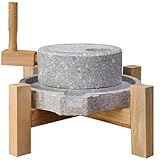
The best retro wheat grinder for a serious home baker is the KDRICT Stone Grain Mill Grinder, a 37 lb granite disk mill on a handmade wooden frame that measures 5.6 x 12.8 x 7.8 in. If you bake tortillas or arepas more than bread, the universal Corona Manual Grain Mill is the better buy, with adjustable plates from coarse to fine and a 0.8-qt hopper. The deciding specification here is the grinding element itself, not the crank or the wood.
Best retro wheat grinder at a glance
| Pick | Grinding element | Weight | Price |
|---|---|---|---|
Best overall KDRICT Stone Grain Mill Grinder |
Natural granite disks | 37 lb (claim) | Check Price |
Runner-up universal Corona Manual Grain Mill |
Cast iron plates, adjustable | 1.32 lb listed | Check Price |
Best premium MOUNTAIN ESSENTIALS Manual Hand Grain Mill |
Stainless steel disks | 28.6 lb | Check Price |
Best for pros WANLIAN Stone Mill Grinder |
Bluestone disks (claim) | 40 lb | Check Price |
Best for beginners MELVTATA Electric Grain Mill Grinder |
Stainless steel blades, 1500W claim | Not listed | Check Price |
Best budget pick podafu Vintage Manual Coffee Mill Grinder |
Ceramic conical burr | Not listed | Check Price |




What people compare that does not decide it
Most retro wheat grinder guides put the visual up front. Wood grain, brass hardware, a hand crank with a turned wooden knob. Those things sell the mill, but they do not grind the wheat. The grinding element does.
Look at this set of six. Two run on natural stone disks. One uses stainless steel disks. One uses cast iron plates. One uses a small ceramic conical burr. One uses electric blades. Same shelf on Amazon, five completely different mechanisms behind the retro look. A stone mill will crush a berry cool and slow. A cast iron plate mill will shear it. A ceramic burr will nibble a spoonful at a time. Blades will pulverise it in seconds and heat it.
That mechanism decides the loaf. It decides whether the flour is cool enough to preserve the germ oils, whether a single pass gives you bread-fine texture or a coarser grist, and how long you spend cranking for a kilogram. So before you compare hopper shapes and paint colour, sort the field into stone, plate, burr, blade. Then compare within a group.
Stone, cast iron or burr: which fits your loaf?
Grinding element sets the ceiling on what any of these mills can produce.
- Stone disks stay cool and produce a fine, even flour on repeated passes. The KDRICT and the WANLIAN both use natural stone, granite and bluestone respectively per the listings. The trade-off is weight: 37 lb and 40 lb. These are countertop fixtures, not travel gear.
- Cast iron plates cut a coarser grist by default and adjust down toward finer flour with a screw setting. That is exactly what the Corona is designed to do, and its listing calls out masa, tortillas, tamales and arepas as intended uses. It is faster than stone for cracked grain, less refined for pastry flour.
- Stainless steel disks land between the two. MOUNTAIN ESSENTIALS uses steel with an adjustable setting, and the listing claims a fine setting suitable for coffee and spice work as well as grain.
- Ceramic conical burr, as on the podafu, is a coffee mechanism. It grinds wheat, but slowly and in small volume, because the burr and chamber are sized for beans.
- Blade grinding, as on the MELVTATA electric, is fast but generates heat and produces uneven particle size. Good for beginners who want flour tonight; less good for a slow-fermented sourdough.
Pick the mechanism first. Then everything else, the wood frame, the hopper, the clamp, is preference.
1. KDRICT Stone Grain Mill Grinder for Home — Best overall
A 37 lb granite disk mill on a handmade wooden stand: the closest thing in this set to a traditional stone-milled workflow.
Best for: a home baker milling wheat two or three times a week Skip it if: you need portability or storage in a small cupboard
Two things put the KDRICT ahead in this set. First, the grinding element is natural granite, and the listing describes disks rather than a single stone, which is the traditional configuration for producing fine flour on repeated passes. Second, it is properly heavy. KDRICT gives the figure as 37 lb, and at 5.6 x 12.8 x 7.8 in the footprint is smaller than the two other stone options, which matters when the mill lives on the counter. Weight fights slippage on a granite crush; a light mill walks under the crank.
Feature-wise, KDRICT says the frame is a handmade wooden stand with an ergonomic wood handle and that no electricity is required, which is what makes the retro look functional rather than decorative. The listing pairs wheat, corn, coffee, nuts and dried spices as intended materials. The catch is the same as any stone mill: it is a fixture, not a tool you tuck away. And KDRICT publishes fewer specifications than the other picks here, with only three fields against Corona's six.
Pros:
- Natural granite disks preserve traditional stone workflow
- Handmade wooden frame with ergonomic wood handle
- 37 lb mass keeps the mill stable during grinding
- Compact 5.6 x 12.8 x 7.8 in footprint for a stone mill
- No electricity required, fully manual crank
Cons:
- Only three published specifications
- No stated warranty in the listing
- Weight makes it a permanent countertop fixture
2. universal Corona Manual Grain Mill — Runner-up
A cast iron plate mill with an adjustable coarse-to-fine setting and a 0.8-qt hopper, aimed squarely at masa and tortilla work.

Best for: Latin-style masa, tortillas and cracked grains Skip it if: you want fine bread flour in one pass
The Corona is the only cast iron plate mill in this set, and it is the one buyers choose most often here by a wide margin: its category sales rank sits far ahead of the two stone options. It is also the most fully specified pick, with size, colour, count, weight, dimensions and a model number (L10800) all listed. The listing describes the plates as adjustable from coarse to fine and calls out masa, tortillas, tamales, arepas, flour, cracked grains, spices and coffee beans as intended uses. That mechanism is a genuinely different tool from a stone mill.
Universal says the mill clamps to countertops up to 1.45 in thick and ships with hopper, grinding plates, clamp, handle, mounting hardware and a stabilising pad. That kit means you assemble once and mount it where you cook. The trade-off against the stone mills is texture. A plate mill excels at cracked grain and coarser grist; getting to fine pastry flour usually means a second or third pass. And where the KDRICT and WANLIAN plant themselves on the counter by weight alone, the Corona lives or dies by the strength of its clamp.
Pros:
- Cast iron plates adjustable coarse to fine
- 0.8-qt hopper claim, larger than the burr options
- Complete kit with clamp and stabilising pad included
- The most fully specified listing in the set
- Sells faster than any other pick here
Cons:
- Fine bread flour usually needs multiple passes
- Depends on clamp thickness fitting your counter
- No stated warranty in the listing
3. MOUNTAIN ESSENTIALS Manual Hand Grain Mill — Best premium
A 28.6 lb stainless steel disk mill with an extra-large hopper, sitting at the top of the price positions here.

Best for: a larger household grinding varied grains and spices Skip it if: you have limited counter space at 15.6 x 17.5 x 12.2 in
MOUNTAIN ESSENTIALS occupies the most expensive slot in this set, and it earns the pitch on physical spec rather than looks. Stainless steel grinding disks with a hygienic powder-coated body, a stated 28.6 lb weight and dimensions of 15.6 x 17.5 x 12.2 in put it in the middle for weight but the largest for footprint. The listing calls out an extra-large hopper with a wooden handle mounted on top for control while grinding, and says the disks disassemble for cleaning. It also claims an adjustable fineness fine enough for coffee and spices.
The category path is worth noting: MOUNTAIN ESSENTIALS is listed under Coffee Grinders rather than Grain Mills. In practice that reflects the fine-adjustment capability rather than a limit on grain. For a household grinding wheat plus coffee plus spices on one machine, that flexibility is the argument. What you give up is bench space; the 17.5 in length is roughly 40% longer than the KDRICT. And where a stone mill's mass sits low and compact, this one's mass sits spread out.
Pros:
- Stainless steel disks with adjustable fineness
- Extra-large hopper with top-mounted wooden handle
- Grinds coffee and spices as well as grain
- Disks disassemble for cleaning per the listing
- 28.6 lb keeps it steady on the counter
Cons:
- The largest footprint of the six at 15.6 x 17.5 x 12.2 in
- Highest price position in the set
- Listed under coffee grinders, not grain mills
4. WANLIAN Stone Mill Grinder — Best for pros
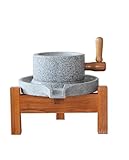
A 40 lb bluestone mill with a hand-engraved pattern, sold as much as decor as tool.

Best for: a rustic kitchen that wants a decorative stone mill on show Skip it if: you cannot dedicate a 40 lb footprint permanently
The WANLIAN is the heaviest pick in this set at 40 lb, and its 7.87 x 7.87 x 11.8 in footprint is the tallest of the group. WANLIAN describes the disks as natural bluestone and says the pattern around the millstone is hand-engraved by craftsmen, sold as both a food tool and a decorative object. The listing calls out wet soybean milk, wheat flour, corn juice, sesame seeds, almonds, peppers, spices and mung beans as intended uses, which is a wider material list than any other pick here.
Two things separate it from the KDRICT despite the shared stone principle. WANLIAN's own instruction notes that the crank turns counterclockwise, and the taller, narrower body means you crank down into the mill rather than across it. That vertical geometry suits sustained sessions; it is also why the piece works as a countertop centrepiece. The trade-off is commitment. At 40 lb and 11.8 in tall, this is not a mill you shift for a wipe-down. And WANLIAN's category rank is the slowest seller of the six.
Pros:
- 40 lb bluestone body, heaviest and most stable here
- Hand-engraved millstone pattern per the listing
- Broad materials list including wet-grind uses
- Vertical geometry suits long grinding sessions
Cons:
- Tallest footprint at 11.8 in and hardest to store
- Slowest seller of the six in its category
- No stated warranty in the listing
- Sits in the most expensive positions here
5. MELVTATA Electric Grain Mill Grinder — Best for beginners
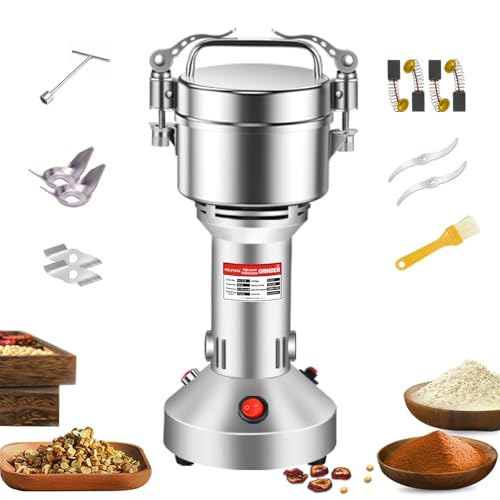
An electric high-speed grinder with a 150 g chamber, the shortcut into home milling.
Best for: someone new to milling who wants an electric shortcut Skip it if: you want a hand-cranked, traditional retro workflow
The MELVTATA sits in an unusual spot in a retro roundup, because it is not a hand-cranked mill at all. It is a stainless steel electric grinder with a 150 g chamber, and MELVTATA claims 1500W of power, a 28,000 rpm rotating speed and a 5 to 10 minute interval between grinding sessions. That is a blade-style workflow: batch in, cover on, run for seconds, tip out. It does the job that a manual mill does over ten minutes in about thirty seconds, at the cost of texture control and heat.
MELVTATA calls out grains including soybeans, corn, barley, wheat, oats, rye, peas, coffee beans and mung beans, plus star anise and other spices. The safety design includes an overload protection device that stops the motor automatically per the listing, and the cleaning note warns against rinsing the motor housing. The reason it lands in this guide is honest: a lot of first-time home millers want a low-friction way in, and a manual stone mill is a big commitment. This is the compromise. What it is not is retro. The look is chrome and plastic, and if the aesthetic is why you started reading, this is not it.
Pros:
- 1500W motor claim finishes small batches fast
- Overload protection stops the motor automatically
- Broad grain and spice materials list
- Second-cheapest position in the set
Cons:
- Not a retro or manual mill in any real sense
- 150 g chamber is small for a full loaf
- Blade grinding heats the flour and varies particle size
- Motor housing cannot be rinsed for cleaning
6. podafu Vintage Manual Coffee Mill Grinder — Best budget pick
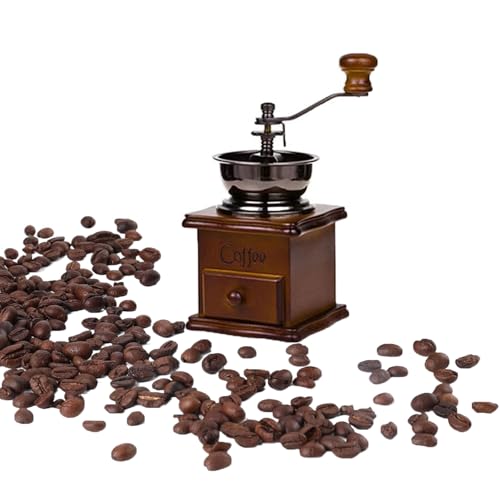
A ceramic conical burr in a pine and cast iron body, sized for a coffee ritual rather than a bread bake.
Best for: coffee, spice and very small wheat batches Skip it if: you plan to mill a full loaf's worth of flour at once
The podafu is the cheapest of the six and the smallest, at 6.7 x 3.8 x 3.8 in. It uses a ceramic conical burr, which is the mechanism you want for coffee: it cuts rather than crushes, stays cool and adjusts from coarse to fine on a stepped polygon adjuster per the listing. Podafu says the body is pine with a cast iron top and that the ceramic core avoids metallic odours and heat transfer, and describes the piece as decorative as well as functional.
Grinding wheat through a ceramic coffee burr works, but it is slow and small. A cup of berries is a realistic batch. If your interest in a retro wheat grinder is really about the ritual, a spice mill for adzuki alongside your morning coffee, this is the honest pick. If you plan to bake a loaf a week from your own flour, this is not the tool. Podafu's own product name lists it as a coffee mill first, wheat grinder never; the Amazon category confirms it as a manual coffee grinder.
Pros:
- Ceramic conical burr keeps grind cool
- Adjustable fineness via stepped polygon
- Pine and cast iron body, genuinely retro
- Cheapest pick in the set
- Compact 6.7 x 3.8 x 3.8 in footprint
Cons:
- Sized for coffee, not loaf-scale flour
- Burr chamber holds only a small batch
- Weight not listed, so stability is unclear
How I screened six retro wheat grinders
I started with the Grain Mills and Manual Coffee Grinders categories and lined up every listing that had a visible retro or vintage design cue: wood frame, hand crank, cast iron body, stone disk, brass hardware. Then I compared the published specifications side by side and cut anything without at least a weight, a dimension or a grinding element I could name.
That left six. I sorted them by mechanism first, because the mechanism decides the loaf, then by weight, because weight decides whether the mill stays put during a five-minute session. Price position I recorded as a tiebreaker, not a starting point.
A note on the word "retro". Amazon returned this set for the query, but only two products, the podafu and the WANLIAN, lean into a genuinely antique visual. The KDRICT and Corona are traditional in mechanism and functional in appearance. MOUNTAIN ESSENTIALS is modern industrial. MELVTATA is not retro at all. Treat "retro" as a category cue rather than a promise on every pick, and judge the mill by its grinding element.
How heavy should a countertop mill really be?
Weight matters more than most first-time buyers expect. A hand-cranked mill has to resist the torque you put through it, and that resistance comes from either mass or a clamp.
Here is the range in this set, using the figures the listings publish:
- WANLIAN, 40 lb, stone disks
- KDRICT, 37 lb, stone disks (claim)
- MOUNTAIN ESSENTIALS, 28.6 lb, steel disks
- Corona, 1.32 lb listed, cast iron plates with clamp
- podafu, weight not listed, ceramic burr
- MELVTATA, weight not listed, electric
The Corona's 1.32 lb figure clearly refers to a shipping component rather than the full assembled mill; a cast iron plate mill of this design typically relies on its clamp for stability rather than its own mass, which is why the listing highlights the countertop clamp fitting surfaces up to 1.45 in thick. The stone mills work the opposite way. They sit under their own weight, and you crank against gravity.
The practical rule: if your counter takes a clamp, either approach works. If it does not, or you rent and cannot fix anything down, weight is the only stabiliser you have. That points to the KDRICT or the WANLIAN.
What the retro look does and does not guarantee
The retro aesthetic is a shortcut for buyers who want a mill that looks like the object their grandparents used. It says nothing on its own about how the mill grinds.
- A wooden frame protects the disks from vibration and looks the part. It does not make the mill fine-adjustable.
- A hand crank is the trad-milling ritual. It is not automatically slower than any other manual method; a plate mill with a long handle can outrun a stone disk on a coarse setting.
- Cast iron is durable and traditional. It also transfers heat, which is why quality plate mills use food-safe tin plating, as the Corona listing notes.
- A stone disk is the historically authentic grinding element for flour. It also weighs the most and stores the worst.
- A ceramic burr looks retro when built into a wooden coffee mill. It is a coffee mechanism first, wheat second.
The retro label is helpful for finding candidates. It is not helpful for picking between them. That is what the mechanism, the weight and the hopper are for.
Care, cleaning and what the listings leave out
None of these six listings publishes a warranty. That is not unusual in this category; small-brand grain mills routinely omit warranty terms from Amazon copy. Assume you are relying on the return window rather than a manufacturer promise.
Cleaning is where the mechanisms diverge sharply:
- Stone mills (KDRICT, WANLIAN) are brushed dry. Water on porous stone risks trapping moisture in the disk. Neither listing gives cleaning instructions in detail.
- Cast iron plates (Corona) are hand-cleaned, and the listing calls out rust-resistant construction and simple maintenance.
- Stainless steel disks (MOUNTAIN ESSENTIALS) disassemble per the listing, which is the easiest cleaning workflow of the six.
- Ceramic burr (podafu) empties into a drawer and brushes clean.
- Electric (MELVTATA) cannot be rinsed at the motor housing; brush or wipe only.
Two questions worth asking before you buy. Where will the mill live between sessions, on the counter or in a cupboard? And what else, besides wheat, are you going to grind through it? Both push you toward or away from each mechanism as much as any spec.
The verdict
The best retro wheat grinder in this set is the KDRICT Stone Grain Mill Grinder. Its natural granite disks are the traditional flour-milling element, its 37 lb mass keeps it stable without a clamp, and its 5.6 x 12.8 x 7.8 in footprint is the most compact of the two stone options here. If you are baking bread from your own wheat and you want the workflow that a grandparent would recognise, this is the pick.
Two conditions flip the recommendation. If you grind more masa and tortillas than bread flour, the universal Corona Manual Grain Mill wins, because its cast iron plates adjust coarse to fine and its 0.8-qt hopper takes bigger loads than any stone mill in this set. If your counter cannot hold anything permanent and you want a single mill that handles wheat, coffee and spices with disassembly for cleaning, the MOUNTAIN ESSENTIALS Manual Hand Grain Mill is the choice, at the cost of the largest footprint here and the most expensive slot.
The MELVTATA electric and the podafu ceramic burr belong in different rooms. One is a shortcut for beginners; the other is really a coffee mill. Neither replaces a proper hand-cranked wheat mill for regular baking, and I would not build a bread habit around either.
FAQ
Is a retro wheat grinder worth it over an electric one?
A retro wheat grinder is worth it if you value cool, slow grinding and traditional workflow over speed. Stone and plate mills preserve germ oils that blade electrics can scorch, and they produce a wider particle size for bread. The trade-off is time: expect five to ten minutes for a loaf's worth of flour, versus under a minute on the MELVTATA electric.
What is the best retro wheat grinder for daily bread baking?
The best retro wheat grinder for daily bread baking in this set is the KDRICT Stone Grain Mill Grinder. Natural granite disks give you the traditional cool-grind flour that bread benefits from, the 37 lb body stays put without a clamp, and the 5.6 x 12.8 x 7.8 in footprint fits a working counter. It handles wheat, corn, coffee, nuts and spices per the listing.
Corona plate mill or KDRICT stone mill for tortillas?
Corona plate mill for tortillas, every time. The Corona's cast iron plates are designed for masa and adjust from coarse to fine, and universal calls out tortillas, tamales and arepas as intended uses. The KDRICT stone mill will produce finer flour, but a plate mill's coarser default grist is exactly what nixtamalized corn needs. Save the stone mill for wheat bread.
How heavy should a manual wheat grinder be to stay stable?
A manual wheat grinder should be heavy enough to resist crank torque without walking. In this set, the 37 lb KDRICT and 40 lb WANLIAN sit under their own mass on any counter. Lighter mills like the Corona compensate with a clamp that grips surfaces up to 1.45 in thick. If your counter cannot take a clamp, weight is your only stabiliser.
Can a retro coffee mill grind wheat properly?
A retro coffee mill can grind wheat, but not efficiently. The podafu uses a ceramic conical burr sized for coffee beans, so a batch is small and grinding time per cup of berries is long. It works for a spoonful of spice or a small experiment, not a loaf. For actual bread flour, choose a stone disk mill or a cast iron plate mill built for grain.
Start by sorting your intended use: bread flour, tortilla masa, or a bit of everything. Bread wants stone, and the KDRICT is the pick. Masa wants plates, and the Corona is the pick. Everything else wants either the MOUNTAIN ESSENTIALS for versatility or the podafu for coffee-scale rituals. Once you know which mechanism suits the loaf, the retro details, wood frame, hand crank, brass hardware, sort themselves out. The KDRICT is the default answer for a reason: it is the only pick here that combines a traditional stone element, a stable working mass and a compact enough footprint to keep on the counter every day.