Best Electric Organic Fertilizer by NPK and Bag Size

Amazon's results for this search mix granular plant food with plug-in compost hardware. Here's how the six sort out, which one to buy for a vegetable bed, and where the electric machines actually fit.

By Zaria JarvisUpdated 18 min read
On this page
- Best electric organic fertilizer at a glance
- Why does this search return plug-in machines?
- How I screened these six by buyer profile
- 1. Dr. Earth Organic 5 Tomato — Best overall
- 2. Jobe's Organics Granular All Purpose Fertilizer — Best upgrade
- 3. Espoma Organic Citrus-Tone 5-2-6 — Best for pros
- 4. Organic Plant Magic Fertilizer — Best minimal setup
- 5. Ouaken 4L Electric Composter for Kitchen — Best for quiet operation
- 6. THUXEON 220V Soil Crusher — Best premium
- What the NPK number actually decides
- Granular, water-soluble or machine-made compost?
- How long does one bag actually feed?
- What the listings do not tell you
- The verdict
- FAQ
The best electric organic fertilizer search leads to Dr. Earth Organic 5 Tomato, a 4 lb bag with an OMRI-style organic ingredient claim that feeds vegetables and herbs for several months. If you're feeding more than a couple of beds, Jobe's Organics Granular All Purpose Fertilizer arrives in a 16 lb bag at 4-4-4 NPK and covers everything from shrubs to flowers with one product.
The deciding specification here is not wattage. It's the nutrient ratio printed on the bag, and it splits this field cleanly into three groups: balanced all-purpose feeds, targeted tree formulas, and plug-in machines that make raw material rather than fertilizer.
Best electric organic fertilizer at a glance
| Pick | Nutrient / capacity | Bag or unit size | Price |
|---|---|---|---|
Best overall Dr. Earth Organic 5 Tomato |
Tomato, vegetable & herb blend | 4 lb bag 12 x 4 x 10 in |
Check Price |
Best upgrade Jobe's Organics Granular All Purpose Fertilizer |
4-4-4 NPK | 16 lb bag 11.4 x 15.4 x 6 in |
Check Price |
Best for pros Espoma Organic Citrus-Tone |
5-2-6 NPK, 5% calcium | 4 lb bag 3.5 x 8 x 7 in |
Check Price |
Best minimal setup Organic Plant Magic Fertilizer |
Makes 32+ gal liquid (claim) | 1/2 lb bag, 8 oz 3 x 6 x 9 in |
Check Price |
Best for quiet operation Ouaken 4L Electric Composter |
4L chamber, 90% reduction claim | 15.8 lb unit 13 x 12.6 x 10.2 in |
Check Price |
Best premium THUXEON 220V Soil Crusher |
3kW motor, 2800RPM claim | 209.4 lb unit 37.8 x 32.3 x 25.6 in |
Check Price |



Why does this search return plug-in machines?
Search for the best electric organic fertilizer and Amazon hands you a mixed bag. Four of these six are dry or soluble plant foods with no plug at all. Two run on mains power: a countertop composter and a 220V milling machine that weighs 209.4 lb.
That's worth naming up front, because no bag of granules in this set is electric, and neither machine is fertilizer. The Ouaken makes a dried, ground food-scrap material. The THUXEON crushes soil samples, manure and fertilizer raw material into a graded powder. Both are processing hardware.
So the word "electric" here is a filter Amazon largely ignored. You have to decide which side of the line you actually want:
- If you want to feed plants this weekend, you want a bag. Any of the four.
- If you want to stop throwing food scraps in the bin, you want the Ouaken.
- If you're producing organic fertilizer rather than buying it, the THUXEON is the only pick in this set built for that job.
None of the four bags claims any electrical function, and I'd rather say that plainly than invent a spec to make one look like it fits. The picks below are ranked for the most common intent behind this search: something organic, something that works, something you can spread today.
How I screened these six by buyer profile
I sorted this list by who's actually shopping, not by which listing published the most bullets. Four profiles came out of it, and every pick maps to one.
- The vegetable grower. Feeding tomatoes, peppers, herbs and lettuce in beds or large containers. Wants a targeted blend and a bag small enough to store. Dr. Earth and Jobe's cover this.
- The whole-garden gardener. Shrubs, trees, flowers and vegetables on one property, and no interest in owning four bags. That's 4-4-4 all-purpose territory.
- The tree owner. Citrus, avocado, lemon, nut. Needs calcium and a potassium-forward ratio, which is exactly what Espoma's 5-2-6 with 5% calcium is built around.
- The indoor grower and the scrap-recycler. Houseplants fed by watering can, or a kitchen producing scraps with nowhere to put them. Organic Plant Magic and the Ouaken land here.
Three things got picks cut in my read of the data. Listings with no published nutrient ratio and no published size were out, because you can't plan a feeding schedule around a mystery. Anything where a single seller lists the item and the specifications are thin got pushed down rather than dropped, since that combination limits how much you can verify. And I ranked the two machines last on purpose. Neither replaces a bag of plant food, and pricing them as if they do would be misleading.
1. Dr. Earth Organic 5 Tomato — Best overall
A 4 lb targeted vegetable and herb blend that costs the least of the six and sells faster than anything else here.
Best for: vegetable and herb beds fed a few times a season Skip it if: you need to cover more than a couple of raised beds
Two things put this at the top. It's the cheapest of the six, and it's the one buyers choose most often here by a wide margin over the rest of the set. That combination is rare in a category where the targeted formulas usually cost more than the generic ones.
The 4 lb bag measures 12 x 4 x 10 in, so it fits on a shelf in a garage or a deck box. Dr. Earth describes it as made with 100% organic and natural ingredients, with no GMOs, chicken manure or sewage sludge, and says it feeds for several months. That last claim matters for how you plan the season: it's positioned as a slow-release dry feed rather than something you re-apply every fortnight.
The trade-off against the rest of this set is coverage. At 4 lb, you get a quarter of what the Jobe's bag holds, and it's tuned for tomatoes, vegetables and herbs rather than trees or shrubs. There's also no published warranty on the listing, where Jobe's publishes a no-burn guarantee. For a single bed of tomatoes and basil, none of that changes the answer.
Pros:
- Cheapest pick of the six
- Sells faster than any other product here
- Targeted tomato, vegetable and herb blend
- Compact 12 x 4 x 10 in bag stores easily
- No GMOs, chicken manure or sewage sludge, per the listing
Cons:
- Only 4 lb, so coverage is limited
- No published warranty on the listing
- No NPK ratio stated in the listing specs
- Not formulated for trees or shrubs
2. Jobe's Organics Granular All Purpose Fertilizer — Best upgrade
Sixteen pounds of 4-4-4 granules, plus the only stated no-burn guarantee in this set.

Best for: larger beds and mixed plantings needing one bag for everything Skip it if: you only have a few containers on a balcony
This is the volume pick. At 16 lb it holds four times what either 4 lb bag does, and the 4-4-4 NPK ratio makes it the one product here you can put on vegetables, flowers, shrubs and trees without switching bags. Jobe's says the formula avoids wasteful runoff, mess and smells, and that it's OMRI listed for organic gardening.
The warranty language is the detail I'd point to. Jobe's states its organics are guaranteed not to burn when used as directed. Of the six picks, it's the only one carrying a plant-safety guarantee in its published warranty field, and burn risk is the thing that goes wrong most often when people over-apply a dry feed.
Application is where it differs from the winner. The listing recommends applying every 2 to 3 weeks during the growing season, so this is a frequent-feed product rather than a set-and-forget one. That's more trips to the bag than Dr. Earth's several-months positioning implies, and the 16 lb bag at 11.4 x 15.4 x 6 in takes real shelf space. It also costs more than both 4 lb bags. For a garden with mixed plantings, the one-bag simplicity earns it back.
Pros:
- 16 lb bag, largest volume among the plant foods
- Balanced 4-4-4 NPK suits nearly everything
- Only pick with a stated no-burn guarantee
- OMRI listed for organic gardening, per the listing
- Measurable granules reduce over-fertilizing
Cons:
- Needs re-application every 2 to 3 weeks
- Bulky 11.4 x 15.4 x 6 in bag to store
- Costs more than either 4 lb targeted bag
- Balanced ratio isn't ideal for fruiting trees
3. Espoma Organic Citrus-Tone 5-2-6 — Best for pros
The only pick here with a published calcium percentage, built specifically for citrus, avocado and nut trees.

Best for: citrus, avocado and nut trees on a set feeding schedule Skip it if: you're feeding tomatoes and lettuce instead of trees
Citrus-Tone is the specialist. The 5-2-6 analysis puts potassium above nitrogen and drops phosphorus low, which is a fruiting-tree ratio rather than a leafy-growth one, and Espoma states 5% calcium alongside it. No other pick in this set publishes a calcium figure at all.
The listing also gives you a schedule, which most bags don't: late winter pre-bloom, spring post-bloom, and fall. Three feeds a year against Jobe's fortnightly cadence. Espoma says to apply around the drip line and water in thoroughly, and describes the blend as a registered Organic Input Material approved for organic gardening.
At 4 lb in a 3.5 x 8 x 7 in bag, it's the second-cheapest of the six and the most compact bag here. The narrowness is the cost. Put a 5-2-6 on a bed of lettuce and you're feeding for fruit that isn't coming. There's no published warranty on this listing either, so the no-burn assurance you get from Jobe's isn't part of the deal. If you own a Meyer lemon in a pot, that's a fair swap.
Pros:
- 5-2-6 ratio tuned for fruiting trees
- Only pick publishing a calcium figure, at 5%
- Second-cheapest of the six
- Most compact bag here at 3.5 x 8 x 7 in
- Clear three-times-a-year feeding schedule
Cons:
- Wrong ratio for leafy vegetables and herbs
- No published warranty on the listing
- Only 4 lb, so mature trees need repeat buys
- Requires watering in after every application
4. Organic Plant Magic Fertilizer — Best minimal setup
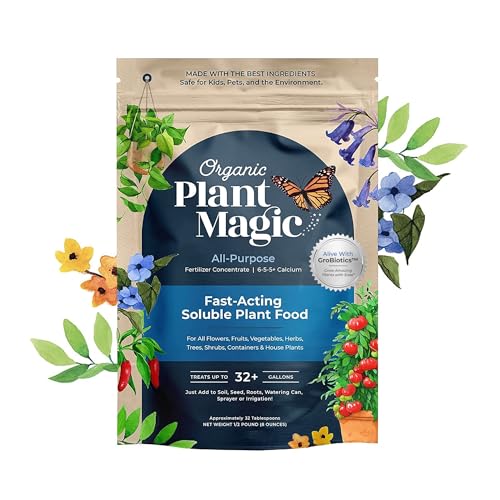
Half a pound of concentrate the brand says makes 32+ gallons of liquid feed, in a bag the size of a paperback.
Best for: houseplants and containers fed with a watering can Skip it if: you want a scatter-and-forget dry feed
This is the only water-soluble product in the set, and it changes what you're storing. The bag weighs 8 oz and measures 3 x 6 x 9 in, and Organic Plant Magic says one 1/2 lb bag makes 32+ gallons of liquid plant food. Compare that to hauling a 16 lb sack in and out of a shed.
Mixing is one tablespoon per gallon of water, then drench the soil or foliar feed with a can or sprayer. The listing says it mixes into solution cleanly, which is the part that decides whether a soluble feed is pleasant to use or a clogged-sprayer nuisance. Organic Plant Magic also claims it feeds soil life rather than just the plant, and describes it as non-toxic and free of harsh salts, safe around kids, pets and pollinators.
Where it loses is control and reach. Every feed is a mixing job, so there's no scattering granules and walking away, and liquid feeds generally need repeating more often than a slow-release dry blend. The listing publishes no NPK ratio and no warranty, so you're going on the brand's description rather than a printed analysis. For a windowsill of pothos and a few tomato pots, it's the least fuss of the six.
Pros:
- Smallest package here at 8 oz
- Brand claims 32+ gallons from one bag
- Works through a watering can or sprayer
- Doubles as a foliar feed
- Stated non-toxic, no harsh salts
Cons:
- No published NPK ratio
- Every application requires mixing
- No published warranty
- Liquid feeding usually means more frequent applications
5. Ouaken 4L Electric Composter for Kitchen — Best for quiet operation
A 15.8 lb countertop unit that dries and grinds food scraps indoors, with a carbon filter to handle the smell.

Best for: kitchens that want scraps processed indoors instead of hauled out Skip it if: you expect finished compost you can use straight away
This is where "electric" in this search actually lands for most households. The Ouaken has a 4L chamber, weighs 15.8 lb, and takes up 13 x 12.6 x 10.2 in of counter, which is roughly a bread-maker footprint. Ouaken says it uses high-temperature drying, grinding and cooling to cut waste volume by up to 90% within hours, and that a large carbon filter handles odour during the cycle.
Read the output claim carefully. Ouaken describes the result as nutrient-rich natural fertilizer, but a dried, ground scrap material is soil amendment input, not a formulated feed with a published nutrient ratio. Treat it as a way to shrink your bin and produce something to mix into beds, not as a replacement for the bags above.
Two limits stand out in the data. It's among the most expensive picks here, and only one seller lists it, which narrows your options if something goes wrong. There's no published warranty on the listing either, unusual for a powered appliance and something I'd weigh against the Jobe's guarantee sitting a few rows up. The transparent lid and touch interface are nice, but they're convenience rather than capability.
Pros:
- 4L chamber sized for a household's daily scraps
- Compact 13 x 12.6 x 10.2 in countertop footprint
- Carbon filter for odour control, per the listing
- Claimed 90% volume reduction within hours
- Transparent lid and touch controls
Cons:
- Output is processed scrap material, not a rated fertilizer
- No published warranty on the listing
- Only one seller lists it
- Among the most expensive picks here
- Slowest seller of the four indoor-friendly picks
6. THUXEON 220V Soil Crusher — Best premium
A 209.4 lb industrial mill for crushing manure, soil samples and fertilizer raw material, on 220V power.

Best for: farms and nurseries milling manure and fertilizer stock in bulk Skip it if: you garden on a residential lot with standard outlets
Nothing else in this set operates on this scale. The THUXEON weighs 209.4 lb, measures 37.8 x 32.3 x 25.6 in, and runs on 220V. THUXEON says a 3kW copper core motor drives 12 hammer blades at 2800RPM inner basket speed for a throughput of 4409 to 6613 lbs/h, screened through a 0.12 in mesh to control particle fineness. Additional screens are sold separately.
The safety and build details read like farm equipment rather than garden kit: a fully closed belt guard, a watertight control box with an emergency stop, and 0.1 in thickened steel plate on the body and discharge outlet. THUXEON lists the machine's applications as soil samples, animal manure and organic fertilizer raw materials. It processes inputs. It does not produce a graded plant food.
It's also the most expensive pick here, the slowest seller of the six by a very large margin, and only one seller lists it. The 6 month warranty covers the machine but not consumables, so blades and screens are on you. Two hundred pounds of 220V hardware is a commercial purchase, and if you're feeding a vegetable patch, the 4 lb bag at the top of this list is the honest answer.
Pros:
- 3kW motor with claimed 4409 to 6613 lbs/h throughput
- 0.12 in mesh screen controls particle fineness
- Closed belt guard and emergency stop
- 0.1 in thickened steel body construction
- 6 month machine warranty, the only powered pick with one stated
Cons:
- Requires 220V power, not a household outlet
- 209.4 lb and 37.8 x 32.3 x 25.6 in, needs dedicated space
- Most expensive pick here
- Slowest seller of the six, and only one seller lists it
- Warranty excludes consumables like screens and blades
What the NPK number actually decides
Most guides to the best electric organic fertilizer compare bag weight. Bag weight tells you how long you'll be buying, not how well your plants grow. The nutrient ratio is what decides the outcome, and this set shows why.
NPK is nitrogen, phosphorus and potassium, printed as three numbers in that order. Nitrogen drives leaves and stems. Phosphorus supports roots and flowering. Potassium supports fruit quality and overall plant function.
Look at what that means across two picks here:
- Jobe's 4-4-4 is even across all three. That's why it works on shrubs, flowers, trees and vegetables from one bag.
- Espoma's 5-2-6 runs potassium highest and phosphorus lowest, with 5% calcium added. That's a fruiting-tree profile, and calcium matters for citrus in particular.
The gap between those two is the gap between a generalist and a specialist. Put the 5-2-6 on a lettuce bed and you've paid for potassium the plant barely needs. Put the 4-4-4 on a lemon tree and it'll grow, just not with the potassium bias a fruit crop rewards.
Two picks here publish no ratio at all: Dr. Earth's tomato blend and Organic Plant Magic's concentrate. Both describe their targets in words instead, which is common with organic blends where the nutrients come from meals and composts. It's workable, but if you like planning by numbers, buy the bags that print them.
Granular, water-soluble or machine-made compost?
Three delivery formats sit in this set, and switching format changes your whole routine more than switching brand does.
Granular dry feed. Dr. Earth, Jobe's and Espoma. You scatter, work it in lightly, and water. Dr. Earth positions its blend as feeding for several months. Jobe's asks for every 2 to 3 weeks. Espoma specifies three applications a year around the drip line. Same format, wildly different cadences, so read the schedule before you assume dry means infrequent.
Water-soluble concentrate. Organic Plant Magic only. One tablespoon per gallon, applied by can or sprayer, with a claimed 32+ gallons from an 8 oz bag. Best format for houseplants and containers, where scattering granules on a small pot is awkward and easy to overdo.
Machine-processed material. Ouaken and THUXEON. Neither produces a bag of graded fertilizer. The Ouaken makes dried, ground kitchen scrap. The THUXEON mills manure and fertilizer raw material to a set particle size. Both feed a soil-building routine rather than replacing plant food.
Here's the practical read. Granules suit beds. Soluble suits pots. Machines suit people whose problem is raw material handling, not plant nutrition. If you're standing in a garden holding a phone, you want a bag.
How long does one bag actually feed?
The sizes here span 8 oz to 16 lb, and that range is the real story of this comparison.
- Organic Plant Magic, 8 oz: the brand claims 32+ gallons of mixed liquid feed from one bag. Applied to houseplants a gallon at a time, that's a long run.
- Dr. Earth, 4 lb: small bag, and the listing says it feeds for several months, so applications are few.
- Espoma, 4 lb: three feeds a year per the listing schedule, spread around tree drip lines.
- Jobe's, 16 lb: four times the weight of either 4 lb bag, but applied every 2 to 3 weeks across the season.
The counterintuitive part is that the biggest bag isn't automatically the longest-lasting. Jobe's gives you more product and asks you to use it more often. Espoma gives you less product and asks for three applications a year. Depending on the size of your planting, either can outlast the other.
My rule of thumb from this set: match bag size to application frequency, not to garden size. Frequent-feed products need volume. Slow-release products don't. That's the trick most shoppers miss when they compare weights side by side.
What the listings do not tell you
There are real gaps in this data, and pretending otherwise wastes your money.
Coverage area. Not one of the six publishes a square footage figure. A 16 lb bag of 4-4-4 will treat far more ground than a 4 lb tomato blend, but exactly how much depends on the rate you apply, and no listing here states it.
Warranty, mostly. Only two of six publish anything. Jobe's states a no-burn guarantee when used as directed. THUXEON states 6 months on the machine, excluding consumables. Dr. Earth, Espoma, Organic Plant Magic and the Ouaken publish nothing in that field, which is normal for consumables and more notable for a powered appliance.
Machine electrical detail. The Ouaken listing publishes a model number and dimensions but no wattage or noise figure. If quiet running is your priority in a small kitchen, that's an unknown you're accepting.
Output analysis from the machines. Neither the Ouaken nor the THUXEON publishes a nutrient ratio for what comes out. That's expected, since output depends entirely on input, but it means neither can be planned around like a bagged feed.
Seller depth. Both machines are listed by a single seller. The four bags each show a couple of sellers. Narrow listings limit your fallback if a unit needs replacing.
The verdict
Dr. Earth Organic 5 Tomato is the pick I'd default to for anyone searching for the best electric organic fertilizer and actually wanting to feed plants. It's the cheapest of the six, it moves faster than anything else in this set, and the 4 lb bag in a 12 x 4 x 10 in package handles a vegetable and herb bed with a slow-release schedule you don't have to babysit.
Two conditions flip that. First, planting area: past a couple of beds, or once shrubs and flowers join the vegetables, Jobe's 16 lb bag of 4-4-4 becomes the better buy, and its no-burn guarantee is the only plant-safety assurance published in this whole group. Second, what you're growing: if the plants are citrus, avocado or nut trees, Espoma's 5-2-6 with 5% calcium is the correct ratio and Dr. Earth is not, regardless of price.
The third flip is about intent rather than plants. If you came here wanting a machine, the Ouaken at 4L and 15.8 lb is the household-scale answer, and the THUXEON at 209.4 lb on 220V is farm equipment. Neither one hands you a graded fertilizer. Both hand you material you still have to apply. Know which of those two jobs you're solving before you buy.
FAQ
Is the best electric organic fertilizer actually electric?
Is the best electric organic fertilizer electric? In this set, mostly no. Four of the six picks are dry or water-soluble plant foods with no power requirement at all. The two powered products, the Ouaken composter and the THUXEON crusher, process material rather than dispensing fertilizer. Amazon's results blend both categories, so decide which job you need done first.
Is a countertop electric composter worth it?
A countertop electric composter is worth it if your problem is food waste volume, not plant nutrition. The Ouaken claims up to 90% waste reduction within hours through a 4L chamber, with a carbon filter for odour. What comes out is dried, ground scrap material you mix into soil. It won't replace a bag of 4-4-4 granules.
What NPK ratio should I choose for vegetables?
The NPK ratio to choose for vegetables is generally balanced. Jobe's 4-4-4 spreads nitrogen, phosphorus and potassium evenly, which suits leafy crops, flowers and shrubs from one bag. Espoma's 5-2-6 with 5% calcium is built for citrus and nut trees instead, so its low phosphorus and high potassium are wasted on a lettuce or herb bed.
Dr. Earth or Jobe's Organics: which should I buy?
Dr. Earth or Jobe's comes down to area and cadence. Dr. Earth's 4 lb bag is the cheapest pick here and is described as feeding for several months, so it's the low-effort choice for one or two vegetable beds. Jobe's gives you 16 lb at 4-4-4 with a stated no-burn guarantee, but wants re-application every 2 to 3 weeks.
What's the most common organic fertilizer mistake?
The most common organic fertilizer mistake is over-application, usually from ignoring the schedule on the bag. Feeding a slow-release blend fortnightly, or a fortnightly product three times a year, both produce disappointing plants. Jobe's specifically states its granules are guaranteed not to burn when used as directed, and that last phrase carries the weight.
Start with the bag that matches what you're growing this season, not the biggest one on the shelf. For most people that's Dr. Earth Organic 5 Tomato: a 4 lb package, a targeted vegetable and herb blend, and the least money spent of the six while you learn how your beds respond. Scale up to the 16 lb Jobe's once you're feeding more ground than one bag covers, and add Espoma only if there's a citrus or nut tree involved. The plug-in machines solve a different problem, and that problem is what to do with waste, not what to feed a tomato.