Best Lightweight Organic Fertilizer by Weight and Yield

Six organic fertilizers ranked by what a shopper hauling bags around a small garden actually cares about: shipped weight, the space it eats on a shelf, and how much feed each container makes.

By Zaria JarvisUpdated 17 min read
On this page
- Best lightweight organic fertilizer at a glance
- How I weighted the criteria for the best lightweight organic fertilizer
- Does lightweight actually mean anything here?
- Granules or concentrate: which suits your garden?
- 1. Dr. Earth Organic 5 Tomato — Best overall
- 2. Organic Plant Magic Fertilizer & Plant Food — Best premium
- 3. Farmer's Secret Fruit & Bloom Booster — Best upgrade
- 4. Miracle-Gro Organic Plant Food — Best minimal setup
- 5. Down To Earth Organic Vegetable Garden — Runner-up
- 6. Jobe's Organics Granular All Purpose — Best for pros
- How much shelf space does each one eat?
- What to check on the label before you buy
- The verdict
- FAQ
The best lightweight organic fertilizer is Dr. Earth Organic 5 Tomato, Vegetable & Herb, because a 4 lb bag in a 12 x 4 x 10 in box carries enough granular feed for a full season of raised beds without turning into a storage problem. If you garden in containers on a balcony, Organic Plant Magic is the better buy: an 8 oz bag that the maker says makes 32+ gallons of liquid feed.
This is not the guide for you if you're feeding half an acre. Growers with big in-ground plots want volume, and a 16 lb sack costs less per pound of nutrient than any small box will. Head straight to the Jobe's pick at the bottom. Everyone else, stay: what follows is about the trade-off between what you carry home and what it actually feeds.
Best lightweight organic fertilizer at a glance
| Pick | Weight | Form | Price |
|---|---|---|---|
Best overall Dr. Earth Organic 5 Tomato |
4 lb | Dry granular | Check Price |
Best premium Organic Plant Magic Fertilizer & Plant Food |
8 oz | Soluble powder 32+ gal claim |
Check Price |
Best upgrade Farmer's Secret Fruit & Bloom Booster |
1.4 lb | Liquid concentrate 16oz |
Check Price |
Best minimal setup Miracle-Gro Organic Plant Food |
2.23 lb | Liquid 10.75 gal claim |
Check Price |
| 5 lb | Dry granular 4-4-4 claim |
Check Price | |
Best for pros Jobe's Organics Granular All Purpose |
16 lb | Dry granular 4-4-4 claim |
Check Price |



How I weighted the criteria for the best lightweight organic fertilizer
Three criteria decided the order, and I weighted them in this sequence.
- Shipped weight and box size, at 40%. This is the whole premise. The published weights in this set run from 8 oz to 16 lb, a 32-fold spread, and the boxes range from 3 x 6 x 9 in to 11.4 x 15.4 x 6 in.
- How much feed the container produces, at 35%. Weight alone is a trap. A half-pound bag that the maker says makes 32+ gallons feeds more plants than a bottle four times heavier.
- How specific the published nutrient information is, at 25%. Two picks state a 4-4-4 NPK ratio in their listings. The rest describe their nutrition in adjectives.
Why those three, in that order? Because the shopper searching for a lightweight organic fertilizer has already made the organic decision. What's left to solve is logistics: what fits in a small shed, what you can carry up two flights, what doesn't sit half-used through a damp winter. Nutrient specificity ranks last only because every pick here is sold as an organic feed for the same broad job.
What that weighting did to the ranking: it pushed the 16 lb sack to the bottom despite it being the only pick with a published guarantee, and it pushed a 4 lb granular bag above a lighter liquid, because dry granular feed at 4 lb still covers a season of beds.
Does lightweight actually mean anything here?
Honestly, less than the search term suggests. None of these six listings uses the word lightweight as a specification, and none publishes a coverage area in square feet. So nothing here is certified as a lightweight organic fertilizer by any standard. What you get instead is a published weight and a published box size, and you have to do the judging.
Here's the trick with that. Compare weight against what the container makes, not against other weights.
- Organic Plant Magic weighs 8 oz and the maker claims 32+ gallons of liquid feed from it.
- Miracle-Gro Organic Plant Food weighs 2.23 lb and the listing claims up to 10.75 gallons.
- Farmer's Secret weighs 1.4 lb at 16oz of concentrate, diluted at a teaspoon per two gallons per the maker's recommendation.
By that arithmetic, the lightest thing in the set also makes the most liquid, which is the opposite of what shipping weight would tell you. Dry powders and concentrates carry the water at your tap instead of in the box.
Where the term does earn its keep is storage and handling. A 3 x 6 x 9 in bag slides behind a watering can. A 16 lb sack does not, and it's the one you'll dread moving in March.
Granules or concentrate: which suits your garden?
This is the fork in the road, and it matters more than brand.
Granular picks in this set are Dr. Earth at 4 lb, Down To Earth at 5 lb, and Jobe's at 16 lb. You scatter them and water them in. Dr. Earth's listing says it feeds for several months. Down To Earth describes a slow-release formula that releases nutrients gradually. That suits in-ground beds and larger containers where you'd rather feed once and forget.
Liquid or soluble picks are Farmer's Secret, Organic Plant Magic and Miracle-Gro. You dilute, then drench or spray. Feeding intervals in the listings are short: Farmer's Secret says every 2-4 weeks, and Jobe's, for comparison, says every 2-3 weeks for its granules.
Choose granular if:
- You have beds rather than pots.
- You'd rather not mix anything weekly.
- Storage space isn't your constraint.
Choose a concentrate if:
- Everything you grow lives in a container.
- You want foliar feeding as an option.
- You're hauling supplies up stairs.
Mixed gardens? Run both. A 4 lb granular bag for the beds and an 8 oz soluble bag for the pots is the most storage-efficient pairing in this whole set.
1. Dr. Earth Organic 5 Tomato — Best overall
A 4 lb granular bag that feeds beds for months and still fits on a garage shelf, which is the balance most small-plot growers actually need.
Best for: raised-bed vegetable growers who want one bag to last a season Skip it if: you need a liquid you can spray on foliage
What separates this from the other two granular picks here is the middle ground it occupies. At 4 lb it's the lightest dry feed in the set, a quarter the weight of the Jobe's sack and a pound under the Down To Earth box. The bag measures 12 x 4 x 10 in, so it stands upright in a narrow gap.
Dr. Earth's listing says the formula feeds for several months, which cuts the reapplication chore that the liquid picks here require every two to four weeks. The maker also states it contains no GMOs, chicken manure or sewage sludge, and that it's made with 100% organic and natural ingredients. Those are the manufacturer's claims, not measured results, but they're the specific kind rather than the vague kind.
It's also the one buyers choose most often among the three granular options here, and the cheapest of the six. That combination is unusual.
The trade-off is precision. Unlike Down To Earth and Jobe's, this listing publishes no NPK ratio, so you're trusting the label's phrase about optimum levels of primary plant nutrients rather than a number you can compare. It's also targeted at tomatoes, vegetables and herbs, which is narrower than the all-purpose picks.
Pros:
- Lightest granular option here at 4 lb
- Slim 12 x 4 x 10 in bag stores upright
- Cheapest of the six picks
- Maker states several months of feeding per application
- No GMOs, chicken manure or sewage sludge, per the listing
Cons:
- No NPK ratio published in the listing
- No stated warranty, unlike the Jobe's pick
- Formulated for edibles rather than all plants
- Dry granular means no foliar feeding
2. Organic Plant Magic Fertilizer & Plant Food — Best premium
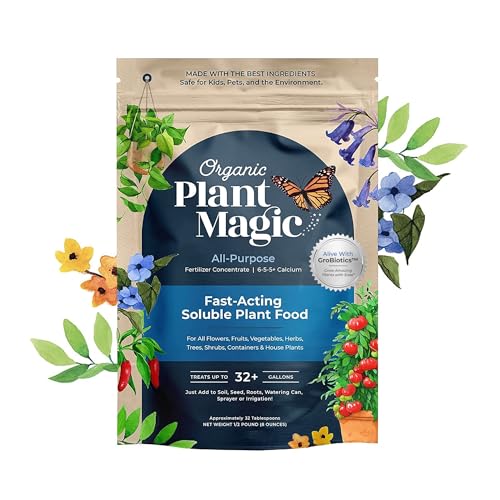
At 8 oz it's the lightest thing here by a wide margin, and the maker says it still makes 32+ gallons of liquid feed.
Best for: balcony and houseplant growers with almost no storage Skip it if: you'd rather not mix anything
This is the pick that makes the case for concentrates. The bag weighs 8 oz and measures 3 x 6 x 9 in, which is roughly the footprint of a paperback. Organic Plant Magic states that half-pound bag makes 32+ gallons of liquid plant food, triple what the Miracle-Gro bottle claims at nearly four and a half times the weight.
Mixing is a tablespoon per gallon per the listing, then you drench the soil or foliar feed with a watering can or sprayer. The maker says it mixes into solution cleanly, and describes the product as feeding the soil rather than only the plant. It also states the formula is safe for kids, pets and pollinators and free of harsh salts. Again, that's the label talking.
Two things keep it out of first place. It's the most expensive pick here, and it's the slowest seller of the six by a clear margin. Neither tells you it works less well, but paying the top price for the smallest package takes some faith in the yield claim. There's no published NPK ratio either, and the every-feeding routine is more work than scattering granules twice a season.
Pros:
- Lightest pick in the set at 8 oz
- Smallest footprint at 3 x 6 x 9 in
- Maker claims 32+ gallons from one bag
- Works as a soil drench or foliar spray
- Listing states no harsh salts
Cons:
- The most expensive of the six
- Slowest seller here
- No NPK ratio published
- Requires mixing at every feed
3. Farmer's Secret Fruit & Bloom Booster — Best upgrade
A 16oz concentrate at 1.4 lb aimed squarely at late-season fruit and flower production, not general growth.

Best for: late-season fruit and flower feeding Skip it if: you're feeding seedlings in spring
This is the specialist of the group, and the only pick here with a stated season. Farmer's Secret says the formula is made for late summer and early fall application, for the later stages of the growth cycle. Every other pick in this set is sold for the whole season.
The bottle holds 16oz and weighs 1.4 lb in a 7.5 x 2.5 x 2.5 in package, slim enough to stand in a shed door pocket. The maker recommends diluting one teaspoon per two gallons of water, repeating every 2-4 weeks, and applying by pour or spray during the normal watering routine. At that rate a 16oz bottle covers a great many gallons, though the listing doesn't put a number on it.
It sells faster than every other pick here, which for a seasonal product is worth noting.
The catch is scope. Buy this expecting an all-purpose feed and you've bought the wrong bottle: it's a booster for flowering and fruiting plants, so you'll want one of the granular picks alongside it for spring growth. The listing publishes no NPK ratio, no warranty, and no colour or model reference, which makes it the thinnest specification sheet in the set.
Pros:
- Slim 7.5 x 2.5 x 2.5 in bottle at 1.4 lb
- Heavily diluted at 1 tsp per 2 gallons, per maker
- Only pick with a stated seasonal window
- Sells faster than the rest of this set
- Pour or spray application
Cons:
- Not an all-purpose feed, so you'll need a second product
- Thinnest published specifications here
- No NPK ratio or warranty stated
- Every 2-4 week reapplication
4. Miracle-Gro Organic Plant Food — Best minimal setup
One 32 fl. oz. bottle, dilute and pour, sold for indoor pots and outdoor beds alike.

Best for: someone who wants one bottle for indoor and outdoor pots Skip it if: you have a large in-ground vegetable plot
If you want the shortest possible learning curve, this is it. The listing covers outdoor containers, in-ground plants in gardens and raised beds, and indoor container plants as houseplant food. One bottle, one routine, everything fed. Miracle-Gro states it's made from 94% plant-based fertilizer ingredients and feeds plants instantly.
Physically it's the mid-point of this set: 2.23 lb in a 9.55 x 2.85 x 4.6 in bottle, and the second-cheapest pick here. The listing claims the 32 fl. oz. container makes up to 10.75 gallons of diluted feed.
That yield figure is where it loses ground. Organic Plant Magic claims triple the diluted volume from a container weighing a quarter as much, so on a per-pound basis this is the least storage-efficient liquid in the group. Dilution rates are given as per label directions rather than as a stated ratio, which is less useful than a teaspoon-per-two-gallons instruction when you're planning how long a bottle lasts.
There's no published NPK ratio and no warranty. For a large vegetable plot, 10.75 gallons of feed won't go far, and a granular pick makes more sense.
Pros:
- Second-cheapest pick in this set
- Rated for indoor and outdoor use in one bottle
- Listing claims 94% plant-based ingredients
- Moderate 2.23 lb weight, easy one-hand pour
Cons:
- Lowest diluted yield per pound of the three liquids
- Dilution rate not stated in the listing
- No NPK ratio or warranty published
- 10.75 gallon claim is thin for a big plot
5. Down To Earth Organic Vegetable Garden — Runner-up
A 5 lb granular box with a published 4-4-4 NPK ratio and a stated slow-release action.

Best for: vegetable beds where slow release matters more than bag size Skip it if: you're carrying it up stairs regularly
The reason to take this over the Dr. Earth bag is the number on the label. Down To Earth publishes a balanced 4-4-4 NPK ratio, which lets you compare it directly against the Jobe's sack and against anything else on the shelf. Only two picks in this set give you that, and this is the lighter of the two by 11 lb.
The maker describes a slow-release formula that delivers nutrients gradually and reduces nutrient leaching, and says the 5 lb box applies directly to soil or mixes into garden beds. It's also stated as non-toxic and safe for beneficial insects, pollinators and pets.
Where it falls behind the winner: it's a pound heavier, it costs more, and its published dimensions read as 1 x 1 x 1 in, which is clearly a listing placeholder rather than a real measurement. That matters when storage is your reason for shopping, because you can't plan a shelf around a figure that isn't there.
It's also the second-slowest seller of the six. And unlike Jobe's, the listing carries no warranty statement to back the no-burn behaviour that slow-release feeds are usually chosen for.
Pros:
- Published 4-4-4 NPK ratio for direct comparison
- Slow-release action stated by the maker
- Lighter than the other 4-4-4 pick by 11 lb
- Stated safe for pollinators and pets
Cons:
- Published dimensions of 1 x 1 x 1 in are unusable
- A pound heavier and dearer than the winner
- Second-slowest seller in this set
- No warranty statement in the listing
6. Jobe's Organics Granular All Purpose — Best for pros
The 16 lb sack is the wrong answer to a lightweight question and the right answer to a large-plot one.

Best for: big plots, trees and shrubs fed all season Skip it if: you garden on a balcony
I've kept this at the bottom because of the weight, not the product. At 16 lb in an 11.4 x 15.4 x 6 in bag, it's four times the winner's weight and it needs floor space rather than shelf space. If storage and carrying were never your problem, move it to the top of your own list.
What you get for that bulk is the most complete specification sheet here. It publishes a 4-4-4 NPK ratio, states OMRI listing for organic gardening, and is the only pick in this set with a warranty statement: Jobe's guarantees the fertilizer not to burn when used as directed. No other listing here commits to anything. The maker also says the granules are produced to avoid wasteful runoff, mess, hazards and smells, and are easily measured to avoid over-fertilizing.
Application is every 2-3 weeks during the growing season per the listing, which is more frequent than the winner's several-months claim and means you'll work through 16 lb faster than the number suggests.
Coverage extends to vegetables, plants, flowers, shrubs and trees, the widest scope in the group.
Pros:
- Only pick with a published no-burn guarantee
- Published 4-4-4 NPK and stated OMRI listing
- Widest plant coverage, including trees and shrubs
- Largest volume here at 16 lbs
Cons:
- Heaviest pick by 11 lb, poor fit for the brief
- Needs floor space at 11.4 x 15.4 x 6 in
- Reapplication every 2-3 weeks per the listing
- Sits in the top price position of the six
How much shelf space does each one eat?
Weight is what you notice carrying it. Volume is what you notice storing it. They don't track together.
Ranked by the smallest published footprint:
- Organic Plant Magic, 3 x 6 x 9 in
- Farmer's Secret, 7.5 x 2.5 x 2.5 in
- Miracle-Gro, 9.55 x 2.85 x 4.6 in
- Dr. Earth, 12 x 4 x 10 in
- Jobe's, 11.4 x 15.4 x 6 in
Down To Earth publishes 1 x 1 x 1 in, which no 5 lb box measures, so plan on something similar to the Dr. Earth bag and check it when it arrives.
Two useful observations from that list. The Farmer's Secret bottle is the narrowest thing here at 2.5 in across, so it stands in a door pocket or a caddy slot that nothing else will fit. And the Dr. Earth bag is only 4 in deep, which means it sits against a wall on a shelf instead of eating the whole depth.
Most shoppers miss the third dimension entirely and buy on weight. A 2.23 lb bottle that's 4.6 in deep takes more usable shelf than a 4 lb bag that's 4 in deep.
What to check on the label before you buy
You'll find plenty of organic feeds beyond these six. Here's what actually separates them, so you can judge one I haven't covered.
- A printed NPK ratio. Two picks here publish 4-4-4. A listing that describes nutrition only in adjectives gives you nothing to compare.
- A yield figure for concentrates. Gallons made per container is the number that matters, not fluid ounces in the bottle. Organic Plant Magic claims 32+ gallons; Miracle-Gro claims 10.75.
- A stated reapplication interval. Jobe's says every 2-3 weeks. Farmer's Secret says 2-4. Dr. Earth says several months per application. That interval decides how long a package really lasts.
- A certification or guarantee you can look up. OMRI listing and a no-burn guarantee both appear in the Jobe's listing. Neither appears anywhere else in this set.
- Real dimensions. A placeholder like 1 x 1 x 1 in tells you the listing wasn't finished carefully.
What buyers overpay for: seasonal specialisation they don't need. A bloom booster is genuinely useful in late summer and useless in April, so it's a second bottle rather than a first one.
The verdict
Three tiers, and the tier you belong to is decided by where your plants live.
Entry tier. Dr. Earth Organic 5 Tomato is the default and the cheapest pick here. A 4 lb bag in a 12 x 4 x 10 in package, feeding for several months per the maker, covers a couple of raised beds through a season with two applications and no mixing. Miracle-Gro sits in the same tier and is the pick if your plants are mostly in pots indoors and out, though its 10.75 gallon claim is modest for the 2.23 lb you're storing.
Middle tier. Down To Earth is the runner-up and the upgrade for anyone who wants a published 4-4-4 NPK ratio in a 5 lb box rather than a 16 lb sack. Farmer's Secret joins it as a second bottle rather than a first, aimed at late summer and early fall fruiting.
Premium tier. Organic Plant Magic is the storage-constrained answer, 8 oz and a claimed 32+ gallons, and it's the pick I'd choose for a balcony. Jobe's is the large-plot answer, and the only listing here with a no-burn guarantee.
The cutoff is straightforward. Under about four raised beds, Dr. Earth. Containers only, Organic Plant Magic. Beyond four beds plus trees and shrubs, Jobe's, and accept the 16 lb.
FAQ
Is the best lightweight organic fertilizer worth paying more for?
The best lightweight organic fertilizer is worth a premium only if storage or carrying is a genuine constraint for you. Organic Plant Magic is the most expensive pick here and weighs 8 oz. If you have a garage shelf and no stairs, the 4 lb Dr. Earth bag costs less and does the same job for beds.
What size fertilizer package do I actually need for a small garden?
The size you actually need depends on beds, not square footage. For two or three raised beds, a 4 lb or 5 lb granular bag applied a couple of times a season is enough. For containers only, an 8 oz soluble concentrate claiming 32+ gallons of diluted feed outlasts most balconies' needs for a full year.
Dr. Earth or Down To Earth: which granular pick should I choose?
Choose between Dr. Earth and Down To Earth on the label detail you want. Down To Earth publishes a 4-4-4 NPK ratio and a slow-release claim, which makes it easier to compare against other feeds. Dr. Earth is a pound lighter at 4 lb, costs less, and states it feeds for several months per application.
Does a lightweight organic fertilizer feed fewer plants?
A lightweight organic fertilizer often feeds more plants, not fewer. Concentrates and soluble powders leave the water out of the package, so you add it at the tap. Organic Plant Magic weighs 8 oz and claims 32+ gallons of feed. The Miracle-Gro bottle weighs 2.23 lb and claims 10.75 gallons.
What's the most common mistake when buying organic fertilizer?
The most common mistake is ignoring the reapplication interval. A small container looks economical until you read that it needs reapplying every 2-3 weeks through the growing season. Jobe's states that interval; Dr. Earth states several months per application. Multiply the interval by your season length before you decide how much product you're buying.
Start by counting your beds and pots, then match that to one of the two forms here. Beds mean granular, containers mean a concentrate, and mixed gardens are genuinely better served by one of each than by a compromise. Dr. Earth Organic 5 stays my default for a reason that has nothing to do with marketing: 4 lb is the lightest dry feed in this set, the bag is only 4 in deep, and a feed-for-months claim means you handle it twice a season instead of twelve times. That's the version of lightweight that actually shows up in your gardening year.