Best Electric Slow Release Fertilizer by Feed Length

Five coated and blended granular feeds, ranked by how long each one actually keeps working. Plus what the word electric does and doesn't mean on a fertilizer listing.

By Zaria JarvisUpdated 14 min read
On this page
- Best electric slow release fertilizer at a glance
- Does electric mean anything on a fertilizer label?
- How I narrowed five listings down to a ranking
- Why the feeding window beats the NPK number
- 1. Osmocote Smart Release Plant Food Plus Outdoor and Indoor1 — Best overall
- 2. Eco Solutions Slow Release Lawn Fertilizer 25-5-10 NPK — Best premium
- 3. Scotts Evergreen, Flowering Tree & Shrub Continuous Release Plant Food — Best upgrade
- 4. GARDENWISE 10-10-10 Plant Fertilizer Slow Release — Most versatile
- 5. RAINFLOW 11.28 OZ Slow Release Fertilizer — Best budget pick
- How much ground does each bag actually cover?
- When a different pick wins
- The verdict
- FAQ
The best electric slow release fertilizer in this group is Osmocote Smart Release Plant Food Plus, because a single 1 lb container carries 11 nutrients and feeds for up to 6 months. If you're feeding grass rather than pots, Eco Solutions Slow Release Lawn Fertilizer 25-5-10 is the better buy at 22 lb per bag. The deciding number here isn't the NPK ratio. It's the feeding window, and across these five it runs from 60 days to 6 months.
Best electric slow release fertilizer at a glance
| Pick | Feeding window | Size | Price |
|---|---|---|---|
Best overall Osmocote Smart Release Plant Food Plus |
Up to 6 months claim | 1 lb | Check Price |
| Up to 110 days claim | 22 lb | Check Price | |
| Up to 2 months claim | 3 lb | Check Price | |
Most versatile GARDENWISE 10-10-10 Plant Fertilizer Slow Release |
Up to 8 weeks claim | 1 quart, 2.01 lb | Check Price |
Best budget pick RAINFLOW 11.28 OZ Slow Release Fertilizer |
Up to 60 days claim | 11.28 oz | Check Price |



Does electric mean anything on a fertilizer label?
Short answer: no. There is no electric slow release fertilizer, because granular plant food has no motor, no battery and no cord. Not one of these five listings mentions electricity anywhere in its specifications or its claims. So if you searched for the best electric slow release fertilizer expecting a powered device, here's what you're probably actually after.
Three real things get confused with the word:
- A spreader. That's the powered or hand-cranked machine that throws the granules. It's a separate purchase, and none of these five bags includes one.
- Electrostatic or resin coating. Osmocote's listing describes a resin coat on every granule that controls how nutrients leave it. That's chemistry, not current.
- Liquid feed injectors. Those plug in or run off hose pressure. Different product, different category.
The useful takeaway is that shopping for the best electric slow release fertilizer means shopping for coated granules. Judge these five on the coating and the feed length, and ignore the word that got you here.
How I narrowed five listings down to a ranking
I built the ranking around buyer profiles rather than a single score, because a houseplant owner and someone reseeding a back lawn need almost nothing in common.
Four profiles shaped the order:
- The container and indoor grower. Small quantities, no spreader, wants the longest possible gap between feedings. Osmocote's 1 lb container and 6-month claim map straight onto this.
- The turf owner. Needs bulk. The 22 lb Eco Solutions bag is the only pick here sized for a lawn, and the only one with a nitrogen-forward 25-5-10 blend.
- The shrub specialist. Acid-loving plantings behave differently from vegetables. Scotts names evergreens, dogwoods, hydrangeas and magnolias directly.
- The mixed-bed generalist. One bag for tomatoes, roses and a fig tree. Both balanced blends here, the 10-10-10 and the 17-17-17, aim at this reader.
I then compared published specifications side by side: weight, size, dimensions, colour, model and stated feed duration. Where a listing published no weight, that counted against it, because you can't plan coverage from a blank. Two of these five publish package dimensions. Only one publishes a coverage figure in square feet.
Why the feeding window beats the NPK number
Most guides to the best electric slow release fertilizer lead with NPK. It's the number printed largest on the bag, so it feels like the answer. It isn't.
NPK tells you the concentration of nitrogen, phosphorus and potassium. It says nothing about when those nutrients reach the roots. A 17-17-17 blend that dumps its load in three weeks and a 10-10-10 that meters out over 8 weeks are completely different products in practice, even though the first one looks stronger on paper.
The feeding window is what actually decides your season. Look at the spread across these five picks: up to 60 days, up to 8 weeks, up to 2 months, up to 110 days, up to 6 months. That's a range of roughly 4 months between the shortest and longest claims. It also means four applications versus one, over a growing season.
There's a second reason to lead with duration. Long feeds are gentler. Osmocote's resin coating and the brand's no-burn pledge exist because a controlled trickle is harder to overdo than a fast dose. GARDENWISE takes the opposite approach on purpose, pairing quick-release nitrogen for an immediate push with slow-release feeding behind it.
So read the duration claim first, then check that the NPK suits the plant. Nitrogen-heavy for grass. Balanced for mixed beds. Anything else is a nice-to-have.
1. Osmocote Smart Release Plant Food Plus Outdoor and Indoor1 — Best overall
A 1 lb container that feeds for up to 6 months makes this the easiest single decision in the group.
Best for: container gardeners and houseplant owners who want one feeding to last Skip it if: you need to cover a full front lawn
Two things separate this from the rest of the set. First, the feed length: Osmocote states up to 6 full months, which is more than twice the next-longest claim here. Second, it's the only pick in this group that publishes coverage in square feet, quoting up to 37 sq. ft. from one 1 lb container. Every other listing leaves you guessing.
Osmocote says each tan granule carries a resin coating that controls when nutrients release, and that the formula contains 11 essential nutrients rather than three. The brand also attaches a no-burn pledge when used as directed. Those are manufacturer claims, but the coated-prill design is the reason the duration figure is plausible where a plain blended granule's wouldn't be.
The package is small: 5.66 x 2.57 x 3.2 in, model 2345212. That's a shelf item, not a bag you drag across a yard. It also sells faster than everything else here except one pick, which tells you where the demand sits in this category.
The trade-off is scale. At 1 lb you're feeding pots, raised beds and individual shrubs. Anyone with real turf will empty this container and have most of the lawn left.
Pros:
- Longest stated feed of the five, up to 6 months
- Only pick publishing coverage, up to 37 sq. ft.
- 11 nutrients claimed, not just three
- Resin-coated granules with a no-burn pledge
- Rated for indoor and outdoor use
Cons:
- Just 1 lb, far too little for lawn work
- Roughly mid-range in price for the smallest package here
- No published NPK ratio on the listing
- Only two sellers stock it
2. Eco Solutions Slow Release Lawn Fertilizer 25-5-10 NPK — Best premium
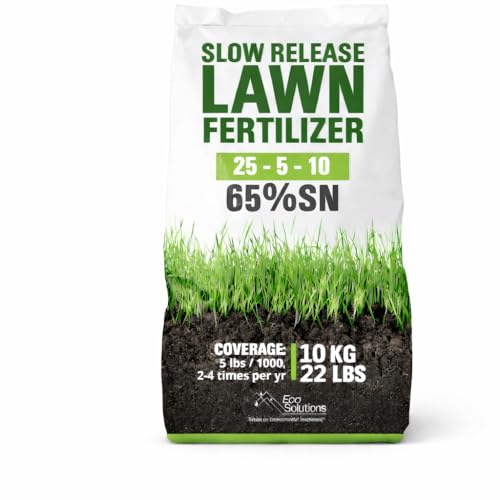
The only pick here sized and blended for a whole lawn, at 22 lb with a 25-5-10 ratio.
Best for: turf owners feeding a whole yard in one pass Skip it if: you only grow in pots and raised beds
This is the outlier in the group, and that's exactly why it earns second place. At 22 lb it carries roughly 22 times the weight of the Osmocote container, and its 25-5-10 blend puts nitrogen well ahead of the other two numbers. Grass wants nitrogen. Tomatoes and roses generally don't want it in that proportion.
Eco Solutions claims 65% granular nitrogen and feeding for up to 110 days, which is the second-longest window in this roundup. The listing describes a blend of both slow and quick-release nitrogen, so you get an early green-up followed by a sustained feed. The brand also states it's safe for kids and pets when used as directed, and positions it for residential yards through to sports fields.
Model SRGF. Beyond the size and weight, the listing publishes little: no dimensions, no coverage area in square feet, no colour. For a 10kg bag, knowing the square footage would matter more than for anything else here.
It's the most expensive pick in this set, and it's the slowest seller of the five. If your entire garden is containers, this is 22 lb of the wrong product.
Pros:
- Largest package here by a wide margin, 22 lb
- Second-longest feed claim, up to 110 days
- Nitrogen-forward 25-5-10 suits turf
- Stated safe for kids and pets as directed
- Combines quick and slow-release nitrogen
Cons:
- The most expensive pick in this group
- No published coverage area for a bulk bag
- Wrong nutrient balance for vegetables and flowers
- Slowest seller of the five here
3. Scotts Evergreen, Flowering Tree & Shrub Continuous Release Plant Food — Best upgrade
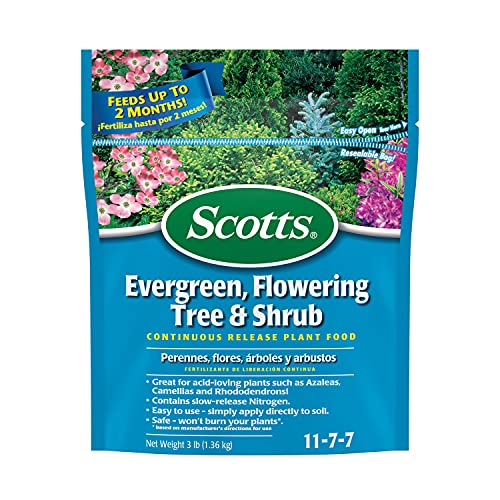
Named for acid-loving shrubs specifically, which no other pick in this set targets.
Best for: hydrangeas, dogwoods and other acid-loving shrubs Skip it if: you want a single feed for vegetables and turf too
Specialisation is the whole argument here. Scotts lists this for evergreens, dogwoods, hydrangeas, magnolias and other acid-loving trees and shrubs. Every other pick in this group is a general-purpose feed, so if your problem is a hydrangea that sulks or a row of arborvitae that won't fill in, this is the one written for the job.
At 3 lb it sits in the middle of the pack on quantity, three times the Osmocote container and a fraction of the Eco Solutions bag. Dimensions are 9.5 x 3 x 5.5 in, model 200910. It's the second-cheapest pick here, which is unusual for a targeted formula.
Scotts claims feeding for up to 2 months, application straight to the soil with no mixing, and no plant burn when used as directed. That 2-month figure is where the case weakens. It's the shortest window among the three long-standing brand formulas here, so you're looking at repeat applications across a season rather than one and done.
The other cost of specialisation is reach. Buy this and you still need something else for the vegetable bed and the lawn.
Pros:
- Only pick targeting acid-loving trees and shrubs
- Second-cheapest of the five
- 3 lb sits between container size and bulk bag
- Published dimensions of 9.5 x 3 x 5.5 in
- Applies directly to soil, no mixing
Cons:
- Up to 2 months is the shortest feed of the branded picks
- Too narrow to be your only fertilizer
- No published NPK ratio on the listing
- No stated coverage in square feet
4. GARDENWISE 10-10-10 Plant Fertilizer Slow Release — Most versatile
A balanced 10-10-10 aimed at every bed you own, with quick-release nitrogen layered underneath.

Best for: mixed beds where one balanced feed has to do everything Skip it if: you want the longest gap between applications
The published NPK is the reason to consider this one. A 10-10-10 split gives equal weight to nitrogen, phosphorus and potassium, which is why the listing runs through vegetables, tomatoes, arborvitae, shrubs, roses, flowers, fruit and fig trees. One container, one application rate, no thinking about whether a formula suits the plant in front of you.
GARDENWISE describes a dual approach: quick-release nitrogen for an immediate boost, with slow-release feeding for up to 8 weeks behind it. The granules are described as fine, which helps them spread evenly and work into soil rather than sitting on the surface. Package is 1 quart at 2.01 lb, model 10 10 10 Fertilizer.
It's also the pick buyers choose most often in this group, edging out even Osmocote on how quickly it moves. That says something about how many gardeners want a single balanced bag.
Two problems. The 8-week claim is among the shortest here, so you're feeding roughly every two months through the season. And it's priced in the upper part of this set despite carrying just 2.01 lb, which makes it a lot of money per pound compared with the 22 lb bag.
Pros:
- Balanced 10-10-10 published on the listing
- Suits vegetables, roses, shrubs and fruit trees alike
- Quick-release nitrogen plus slow-release feeding
- Fine granules spread evenly
- The pick buyers here choose most often
Cons:
- Up to 8 weeks is one of the shortest windows in the set
- Premium price position for only 2.01 lb
- No published dimensions or coverage area
- Balanced blend is a compromise for pure turf
5. RAINFLOW 11.28 OZ Slow Release Fertilizer — Best budget pick
The cheapest way into coated granules, at 11.28 oz with a strong 17-17-17 ratio.

Best for: a small patio garden and a first bag to try Skip it if: you need published weight and coverage figures before you buy
This is the cheapest of the five, and at 11.28 oz it's also the smallest. For a balcony with six pots, or for testing whether granular feeding suits how you garden, that combination makes sense. You're not committing to 22 lb of anything.
The published ratio is 17-17-17, the highest concentration of the two balanced blends here. RAINFLOW says the slow-release technology delivers nutrients for up to 60 days and describes the product as organic plant food suitable for vegetables, flowers and shrubs. The granules are green, model LZH-Fertilizer, and the listing calls them easy to spread and mix into soil.
Where it falls short is documentation. The listing publishes no weight, no dimensions and no coverage area, so you're working out application rates from the 11.28 oz on the label and nothing else. It also carries the shortest feeding claim in this roundup at 60 days, which means around three applications where Osmocote asks for one.
It's the second-slowest seller here too. Fine as a trial, thin as a season plan.
Pros:
- Cheapest of the five picks
- Highest published concentration at 17-17-17
- Described as organic and all-purpose
- Small 11.28 oz size suits a patio garden
- Granules spread or mix into soil easily
Cons:
- Shortest feeding claim of the group, up to 60 days
- No published weight, dimensions or coverage
- Smallest quantity here by a clear margin
- Second-slowest seller among these five
How much ground does each bag actually cover?
This is the gap in almost every listing for the best electric slow release fertilizer, and it's worth being blunt about it. Only Osmocote publishes a coverage figure: up to 37 sq. ft. from 1 lb. The other four give you a weight or a volume and stop.
That leaves you doing arithmetic with the numbers you do have:
- Osmocote: 1 lb, up to 37 sq. ft. stated
- Scotts: 3 lb, no coverage stated
- GARDENWISE: 1 quart at 2.01 lb, no coverage stated
- Eco Solutions: 22 lb, no coverage stated
- RAINFLOW: 11.28 oz, no weight or coverage stated
Two practical rules follow. First, application rates differ hugely between a container feed and a lawn feed, so you can't take the 37 sq. ft. figure from one and apply it to another. Second, buy for the plants you're feeding rather than the raw weight. A 22 lb turf bag spread over flower pots is waste, and a 1 lb container is a rounding error on a front yard.
If a listing gives no coverage, check the label instructions before you open it and measure the bed. Guessing high is how granular feed burns roots.
When a different pick wins
The ranking holds for most gardens, but three specific conditions flip it.
If you have real lawn, Eco Solutions wins outright. Not because it's better made, but because 22 lb of 25-5-10 is the only thing here built for turf. The cutoff is roughly this: if your grass area is bigger than the beds, buy the bag.
If your problem plants are acid-lovers, take Scotts. A hydrangea, a dogwood or a magnolia responds to a formula written for it. You'll accept up to 2 months per application instead of 6, and you'll need a second product for vegetables. That's a fair trade for the plants that were actually bothering you.
If you want one bag for everything, take GARDENWISE. A published 10-10-10 covers tomatoes, roses, shrubs and fig trees without you thinking about it. The price is more frequent feeding, roughly every 8 weeks.
If you've never used granules and aren't sure you'll stick with them, start with RAINFLOW. The cheapest pick, the smallest quantity, the lowest commitment.
The verdict
Osmocote Smart Release Plant Food Plus is the default recommendation for the best electric slow release fertilizer, and the reason is a single number. Up to 6 months from one application is more than double what any other pick here claims, and it's backed by a coated-prill design rather than a plain blended granule. It's also the only listing in the group that tells you how far the container goes, at up to 37 sq. ft. per 1 lb. Eleven nutrients and a no-burn pledge round out the case.
Two conditions flip that. If you're feeding a lawn rather than pots, Eco Solutions Slow Release Lawn Fertilizer 25-5-10 is the correct buy on both count and chemistry: 22 lb of nitrogen-forward blend, with a stated 110-day window that's genuinely close to Osmocote's. And if your priority is a shrub border of hydrangeas or dogwoods, Scotts targets acid-loving plantings by name, which nothing else here does.
The runner-up's real advantage over Osmocote is straightforward. Scale. Osmocote at 1 lb solves a container problem beautifully and a lawn problem not at all.
FAQ
Is the best electric slow release fertilizer worth paying more for?
Worth paying more for? Only when the extra buys a longer feeding window. Osmocote sits roughly mid-range in this set and claims up to 6 months, while the most expensive pick here claims up to 110 days. Price and duration don't track each other reliably in this category, so compare the stated feed length against the price position before you decide.
Does electric mean anything on a slow release fertilizer listing?
Electric means nothing on a granular fertilizer listing. None of these five products has a motor, cord or battery, and none mentions electricity in its specifications. The word usually reflects confusion with a powered spreader, which throws the granules and is bought separately, or with resin-coated granules like Osmocote's. Shop these on coating and feed duration instead.
Can I use the same fertilizer on my lawn and my vegetable beds?
Using the same fertilizer on both works only with a balanced blend. GARDENWISE at 10-10-10 and RAINFLOW at 17-17-17 give equal weight to all three nutrients, so they suit mixed plantings. Eco Solutions at 25-5-10 pushes nitrogen hard for grass and would be the wrong balance for tomatoes or flowering shrubs.
Osmocote or GARDENWISE: which should I buy for containers?
Osmocote or GARDENWISE for containers comes down to how often you want to feed. Osmocote claims up to 6 months and publishes coverage of 37 sq. ft. per 1 lb, so one application handles a season. GARDENWISE claims up to 8 weeks but publishes a balanced 10-10-10 and adds quick-release nitrogen for a faster visible response.
What is the biggest mistake buyers make with slow release fertilizer?
The biggest mistake is over-applying because nothing seems to be happening. Coated granules release gradually by design, so a week of no change is normal. Adding a second dose on top risks burning roots. Follow the label rate, note the stated window, whether that's 60 days or 6 months, and wait it out.
Start by measuring your beds and your lawn separately, then buy for the larger of the two. For most gardeners that means a 1 lb container of Osmocote sitting on the potting shelf, feeding pots and raised beds through a full season on one application. The reason it stays the default isn't the nutrient count or the branding. It's that a fertilizer you only have to remember once is a fertilizer you'll actually apply correctly. Short windows create missed applications, and missed applications are what stall plants mid-season.